- De-Pinkwashing Israel, By Toshio Meronek, Truthout | News Analysis | Winter 2013

- Queers Resisting Zionism: On Authority and Accountability Beyond Homonationalism, Oct 10 2012, by Heike Schotten, Birthright Unplugged's Director of Communications and Haneen Maikey, Director of Al Qaws
-
An Open Letter to LGBTIQ Communities and Allies on the Israeli Occupation of Palestine & Petition, by Birthright Unplugged Delegation Winter 2012
-
Birthright Unplugged's Communiqué
Winter 2010
- “Taglit-Birthright and Birthright Unplugged to Merge,” spoof by Young Jewish and Proud, November 8, 2010
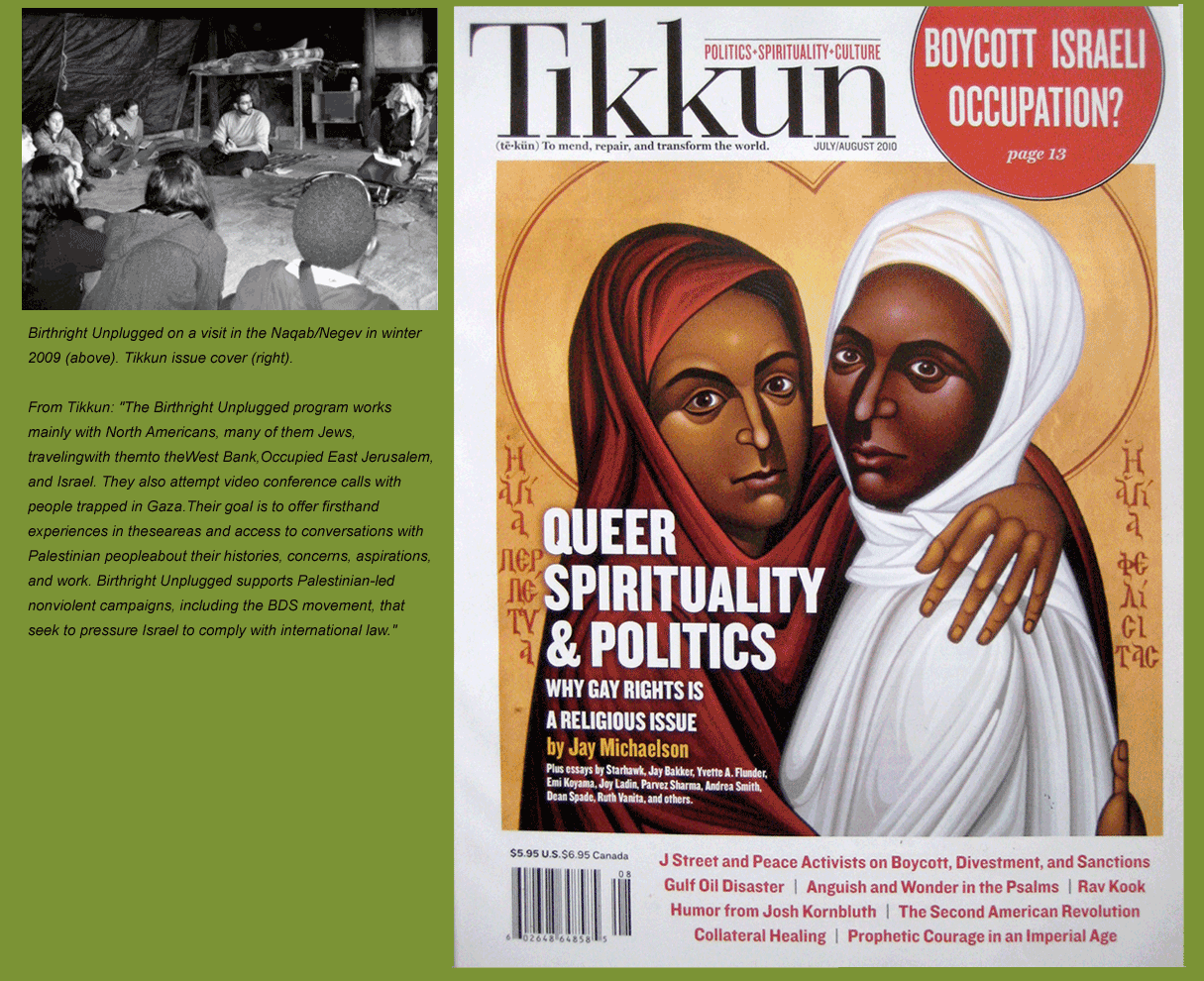
- Boycott Israeli Occuption?: Is BDS the Way to End the Occupation?, Tikkun Mag
 azine July/August, 2010
- To Know is Not Enough: How Hampshire Became the First to Divest. by Will Delphia. This short documentary features interviews with over a dozen student activists from Hampshire College's 'Students for Justice in Palestine. Two of Birthright Unplugged’s 2008 alums worked on this historic divestment effort.
August 2010
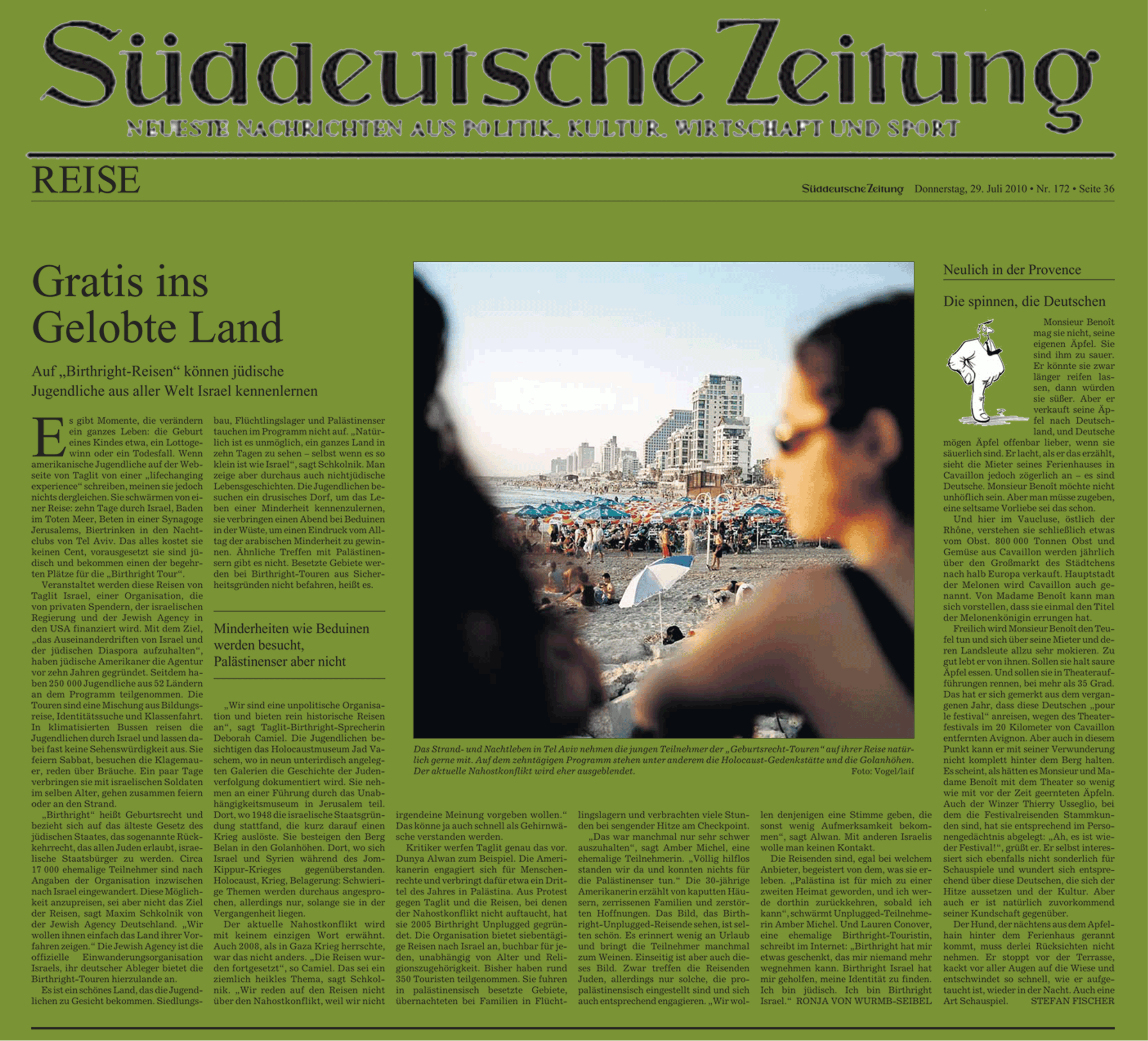
- All Expenses Paid Trip to the Promised Land | By Ronja Von Wurmb-Seibel | Suddeutsche Zeitung (German Daily Newspaper). Below in German and English.

July 9, 2010
-
Birthright Unplugged's Communiqué
Winter 2009 - Spring 2010
-
 Should Israel Birthright Include Implication For Occupied Territories?
Lourdes Garcia-Navarro, National Public Radio
January 10, 2010
- Many Questions, No Easy Answers. Sociology class West Bank t
 rip underscores debate on Israel, Palestinian Conflict
Melissa Beecher, The Boston College Chronical
January 2010
-
 West Bank youth see Israel with "Birthright" tour anyway?
Erika Solomon, Reuters. Published internationally. Below in English and Arabic.
August 21, 2009










-
 Refugees’ photographs stolen from Allston library | by Tony Lee, Metro Boston
April 26, 2007
-
Birthright Unplugged Press Release
Palestinian Refugee Children's Art Stolen From Boston Public Library: Organizers Suspect Political Motives
April 25, 2007
-
Birthright Unplugged's Communiqué
Spring 2007
- Entry Denied: Palestinian-Americans Among Thousands Blocked by Israel
from Occupied Territories | Amy Goodman

Suzy Salamy, Palestinian-American
filmmaker hired for a documentary in part on the work of Birthright
Unplugged is interviewed about her denied entry by Israeli authorities.
broadcast Thursday, January 18th, 2007
-
 Creating Cultures of Solidarity: American Jews Redefine Birthright
An Interview with Dunya Alwan and Hannah Mermelstein from Birthright Unplugged and Birthright Re-Plugged
by Jodi Melamed, December 2006
-
Birthright Unplugged's Communiqué
September 2006
-
Sierra's Statement | Birthright Israel intended trip participant pulled because
she planned to travel with Birthright Unplugged
June 5, 2006
- Birthright Unplugged Press Release & Call To Action | Birthright Israel removes participant because she also planned go to the West Bank with Birthright Unplugged.
June 1, 2006
-
Birthright Israel: Joining West Bank trip
is grounds for expulsion
by Daphna Berman
June 6, 2006
-
 Crossing the Green Line: Birthright nixes woman with West Bank plans |
by Chanan Tigay
Crossing the Green Line: Birthright nixes woman with West Bank plans |
by Chanan Tigay
June 6, 2005
-
 Come, See Palestine! Upstart tours of Palestine are challenging
fully paid "See Israel" holidays in a battle for the hearts and minds of young
American Jews | by Rachel Shabi
Come, See Palestine! Upstart tours of Palestine are challenging
fully paid "See Israel" holidays in a battle for the hearts and minds of young
American Jews | by Rachel Shabi
June 5, 2006
-
An Expedition into the Occupied Palestinian Territories | By Thorsten Schmitz | Suddeutsche Zeitung (German Daily Newspaper)
April
24, 2006
-
 Flap over young Jews' visits to Holy Land
After free trips to Israel, some activists stay on in the Middle East - to work
for the Palestinian cause.
by Matt Bradley | March
9, 2006
-
Birthright Unplugged's Communiqué
March 2006
-
 Nora Barrows-Friedman
broadcast February 1, 2006
-
 CKUT Interview
broadcast November 18, 2005
-
 Group showing Jews Arab West Bank
Anthony Tricot | Yediot Ahronot in English
August 28, 2005
-
 An Interview with Birthright Unplugged Founders Hannah and Dunya Posted by Joseph
July 12, 2005
-
 Taglit Birthright versus 'Birthright Unplugged'
by Sheera Claire Frenkel | July 12, 2005

Participants in a gay pride parade wave rainbow colored streamers as they dance in Independence Park
in Jerusalem. (Photo: Ruth Fremson / The New York Times)
Palestinian, US and Israeli LGBT groups are mobilizing against Israeli "pinkwashing."
In 2009, a well-funded non-profit with the mission of enhancing Israel's public image in the world set its sights on gays and their allies. That year, the ten-year-old group StandWithUs launched its lesbian, gay, bisexual and transgender-focused iPride campaign. Israel's newspaper of record, Haaretz, ran a positive article on the campaign:
"Tel Aviv's burgeoning gay scene may be the single most effective Israel-advocacy instrument in the Zionist toolbox, according to participants of a new program that uses Israel's vibrant gay culture to improve the country's image abroad."
iPride organizer Yoav Sivan explained to the newspaper that, "Israel advocacy needs to come from the gay community and it needs to come from the most liberal, leftist parts of society ... It receives much more credibility that way."
A few months later, StandWithUs planned one of its first gay-oriented offensives in the US when it registered to conduct a workshop at the US Social Forum, a leftist political conference that draws as many as 20,000 attendees. StandWithUs Program Director Brett Cohen was to lead a lesson entitled "LGBTQI (lesbian, gay, bisexual, transgender, queer, questioning, and intersex) Liberation in the Middle East."
Queer Arab groups sounded the alarm. In an open letter to US Social Forum organizers, they claimed:
"StandWithUs is cynically manipulating the struggle of queer people in the Middle East through its workshop.... StandWithUs has no connection with the LGBT movement in the Middle East apart from ties to Zionist Israeli LGBT organizations, yet it claims to speak for and about our movements. It has no credibility in our region, and as organizations working in and from the Middle East, we condemn its attempt to use us, our struggles, our lives and our experiences as a platform for pro-Israeli propaganda...."
As the progressive Jewish blog Mondoweiss reported, the result of the outcry was that the US Social Forum organizers cancelled the workshop, giving as their reason that StandWithUs had misrepresented itself.
In response to the cancellation, StandWithUs issued a press release that was picked up by big gay media outlets like The Advocate magazine. "'US Social Forum' Bans Advocate for Middle East Gay Community," the news release read. "They have shown that they are so focused on hating Israel that they cannot focus on standing up for the people at risk like those in the LGBTQI community who suffer under the oppressive regimes."
Israel touts certain policies that its supporters say make it gay-friendlier when compared to other Middle Eastern regimes (legally, gay people can serve openly in Israel's conscripted military, for example), but advocates for Palestinians emphasize that that doesn't excuse government-initiated violence against Palestinians.
Actions like StandWithUs's have originated a new word: pinkwashing - now a commonly used term in activist circles involved in the fight for Palestinian liberation. Such activists believe that Israel's government is using its so-called support for one traditionally oppressed group (LGBTQs) to erase the oppression of another (Palestinians). Recognizing that Israel is the single largest recipient of US military aid - an amount that has increased to more than $3 billion per year under President Obama - these organizers are pushing back against the practice in cities around the country, while facing some push-back of their own.
Exposing a Public Relations Campaign
In June 2012 at the world's largest LGBT film festival Frameline in San Francisco, an anti-Israeli occupation group interrupted one of the special Saturday night movie screenings. As Festival exec K.C. Price stood to introduce the director of an Israeli consulate-backed film in front of an audience of a couple of hundred people, an assemblage of 20 protestors from QUIT (Queers Undermining Israeli Terrorism) took over the front of the theater.
An activist with QUIT handed Price its first "Pink Sponge Award" in the form of, yes, a pink sponge - a reference to pinkwashing. Another, reading from a scroll, listed the group's reasons for giving the award, including "leadership in silencing queers who want their film festival to stand up for the human rights of Palestinians" and the festival's apparent "steadfast defiance of the demand by Palestinian queers to stop partnering with the Israeli Consulate."
Audience members were handed moist towelettes bearing similar messaging. A cacophony of boos and applause trailed the protestors as they left the theater.
QUIT co-founder Kate Raphael coordinated the protest. Growing up in a staunchly Zionist, yet otherwise progressive family, "It was many years of questioning everything I believed in before I really became involved in the Palestine movement," she says. The 1982 Israeli invasion of Lebanon, which the United Nations condemned as an act of genocide, was a turning point. "Most Jews of my generation ... that was the moment when we felt, 'Now's the time I really have to do something.'"
Since then, Raphael has attended several trips to the West Bank, where she was arrested and deported for filming clashes between the Israeli military and activists. With QUIT, she's promoted boycott campaigns against companies such as the carbonated beverage machine-maker Soda Stream, which received tax incentives to move some of its manufacturing to a factory in the contested West Bank as part of the Israeli government's re-settlement campaign.
QUIT's public activities have garnered them a following - of both supporters and enemies. Zionists affiliated with StandWithUs regularly show up to QUIT-planned events to hold counter-protests. "The reason StandWithUs is so fixated on hating QUIT," Raphael says, "is they want to be able to use all the space that there is for queer issues to say, 'Look how great Israel is, they're so pro-gay.'" Plus, "a number of prominent people in that 'ultra-Zionist thug' community are unfortunately queer."
The "A"-Gays on Team Israel
The presentation of QUIT's Pink Sponge Award came a few months after the organization leaked a series of Frameline emails that have since been passed around thousands of times online. In the emails, Frameline Executive Director K.C. Price is clear about his support for the Israeli Consulate. But he's not the only visible gay person rooting for Israel's government.
In March 2011, bowing to pressure from a large donor (porn entrepreneur Michael Lucas), New York City's LGBT Center cancelled a planned "Party to End Israeli Apartheid" by a pro-Palestinian group. Lucas is also a columnist for Out magazine, the country's highest-circulation monthly magazine geared toward gays. In August, the publication accepted money from the Israeli government to cover the Tel Aviv gay scene, while generally skirting the Palestine issue.
In Philadelphia, organizers for the Equality Forum's annual LGBT rights summit chose Israel as their "Featured Nation" for 2012, bringing DJs and drag queens from Israel's gay hub, Tel Aviv, to perform at the conference. The event's keynote speaker? Israel's ambassador to the US, Michael Oren - a selection that the group Pinkwatching Israel calls "akin to the Equality Forum inviting a white South African ambassador as a keynote speaker during the apartheid era." (Two months later, Oren would speak at the conservative Christians United for Israel conference alongside prominent homophobe and CUFI founder John Hagee, also known as the guy who called Hurricane Katrina God's response to a planned New Orleans gay pride parade.)
Other LGBTQ organizations say they want to remain "apolitical" on the issue. (For several years, Frameline had expressed as much.) But Raphael believes that standing aside isn't possible. On one hand, "We do understand that it's a big risk for any organization that depends on funding to come out and side with BDS," referring to the Boycott,
Divestment and Sanction approach employed with success by activists during South African apartheid, and now in this fight. She points to the Zionist community-initiated firing of the director of the San Diego Women's Film Festival in 2007, after the director boycotted the showing of Israeli films as a show of Palestinian support. On the other hand, ignoring the issue is tantamount to supporting Israel's actions, she says.
The South Africa Model: Boycott, Divestment, Sanctions
In spite of the potential backlash, a number of queer and transgender people are speaking out in support of Palestinians and calling for boycott, divestment and sanctions. In June, bisexual author Alice Walker wrote a pointed refusal to an Israeli book publisher requesting to reprint her bestseller The Color Purple:
It isn't possible for me to permit this at this time for the following reason: As you may know, last fall in South Africa the Russell Tribunal on Palestine met and determined that Israel is guilty of apartheid and persecution of the Palestinian people, both inside Israel and also in the Occupied Territories. The testimony we heard, both from Israelis and Palestinians (I was a jurist) was devastating.... Indeed, many South Africans who attended, including Desmond Tutu, felt the Israeli version of these crimes is worse even than what they suffered under the white supremacist regimes that dominated South Africa for so long....
Dean Spade, a Seattle-based law professor and the founder of the country's first transgender legal aid organization, the Sylvia Rivera Law Project, mirrors the sentiment. Spade visited Palestine's West Bank on a trip with other LGBT observers last January. "What I saw helped me understand why Palestinians have called for a boycott of Israel, utilizing the strategy taken up against apartheid South Africa," he says.
In March, Spade initiated the cancellation of a Seattle LGBT Commission-sponsored public event featuring several Israeli LGBT speakers. In his letter to the Commission, Spade wrote that aspects of his trip to Israel were "utterly devastating. I visited a Palestinian village where the Israeli military uses tear gas and skunk water to harass families engaged in peaceful protest against the theft of their land and water every week and met a family whose son had been killed in December from a tear gas canister fired at his head. I sat in their living room and watched video footage of Israeli soldiers waking their children from bed at gunpoint in the middle of the night, arresting children and shooting gas canisters into their homes."
Sa'ed Atshan helped with ground support for the first-of-its-kind LGBT mission that Spade was a part of. A gay Palestinian now attending grad school in Boston, he says that the most common presumption that people in the United States have about gay Palestinians is, "Life must be hard, and we hear that you guys want to escape to Israel for your freedom." It's a peculiar assumption, however. "You can't tell Palestinians, 'We want to have interventions into Palestinian society to quote-unquote rescue gay people,' but at the same time ignore the fact that someone's home is about to be demolished, or about to be shot on the way to school or work, or going to be denied health care," says Atshan. "You have to understand what are, in a sense, priorities."
As a member of the LGBTQ Palestinian organization alQaws, Atshan believes gays aren't the only ones being targeted by groups like StandWithUs, or the Zionist public relations firm BlueStar. Israel also touts its supposed environmentalism ("greenwashing") and technological innovation to keep peoples' minds off the Palestine problem. In these cases, "It's not necessarily targeting a queer audience, but it's targeting liberal, Western, intellectual, progressive people, and it's trying to detract attention away from the gross violations of human rights."
Organizations like alQaws, formed by Haneen Maikey in 2007, have helped to bring political pluralism into Palestinian society, Atshan says. They've shown other Palestinians that "Queer Palestinians are activists; they're politically conscious, and they're part of the Palestinian nation." Meanwhile, the Zionist campaign promotes the idea that queer Palestinians "have given up on Palestinian freedom and are concerned only in some notion of sexual liberation."
Dunya Alwan co-led the observers' mission that Atshan and Spade were on. Raised in the US in a multicultural household, she has both Jewish and Muslim family members. Her Iraqi-American family had many Palestinian friends. "I grew up thinking 'Iraqi' was synonymous with 'exile', and 'Palestinian' was synonymous with 'refugee,'" she says. Today, she regularly leads tours called Birthright Unplugged - a play on Birthright, the Israeli organization that offers free ten-day trips to Israel for young, mostly American, Jews, sponsored in part by the government.
Describing the goal of Birthright Unplugged, Alwan believes that, "It's important that foreigners who support human rights and liberation do that in conversation with the people who are most directly affected." After the trip, tour members return to the US, "having formed relationships with a range of people in Palestine, who the foreigners will then be accountable to."
Alwan is quick to point out that Israel is not exactly a gay haven, either. In the country, known in Arabic as "the '48" (so named because that's the year Palestine came to be called Israel in much of the world), violence against sexual minorities persists in spite of a few relatively progressive laws including the allowance of gay civil unions. Several high-ranking public office-holders are openly homophobic in their words and political platforms, and in 2009, a gunman entered an LGBT community center in Israel's "gay capitol," Tel Aviv, and opened fire, killing two.
"We're not saying that there aren't problems for queer people in Palestine," emphasizes Raphael. "There are, just as there are for queer people in many countries, including [the US and Israel]." But, as Alwan says, "Zionism created a state so that whether you're LGBTQ or not and you're Palestinian, you're a second-class citizen, and at risk of a great deal of violence and harm."
For Palestinians, there's still "a sense that the mainstream American press is so biased toward the Israeli government, that people feel in many ways that Palestinian suffering continues with impunity for Israel, and that in the world, especially in the United States, the world is blind to that suffering," Atshan says. "When Palestinians are asked, 'What can we do for you, how can we help you?' Usually people don't say, 'Provide me with aid or with clothes, or send us medicine.' They say, 'Please, when you go back, share our stories with the world.'"
Adds Alwan: "The US is propping up an apartheid state and without that bolstering, it couldn't function at all the way that it does." International support is key, especially from the US. Both sides are depending on it.
In the US, the concept of pinkwashing is starting to click. The first academic conference exclusively regarding pinkwashing is set for next April at the City University of New York. The New York Times published an op-ed critique of the practice late last year.
And the queer Palestinian movement in the '48 continues to grow. Groups like alQaws, ASWAT (a collective of Palestinian lesbians), and Queers for Boycott, Divestment and Sanctions, are working with Israeli LGBTQ groups like Black Laundry, which has organized actions similar to QUIT's within Israel. "The Zionist propaganda hijacked the voices of gay Palestinians, and exploited them to further their own political projects. In time, we realized that we have to create an organized response," says Atshan. "We have to reclaim our voices."
return to top
Queers Resisting Zionism: On Authority and Accountability Beyond Homonationalism
Oct 10 2012, by Heike Schotten, Birthright Unplugged's Director of Communications and Haneen Maikey, Director of Al Qaws
[This article was written as a response to a recently published article by Maya Mikdashi and Jasbir Puar on the intersections and impasses between US centered pinkwashing and pinkwatching activism. Click here to read Mikdashi and Puar's rejoinder to this response. Clear here to read the original article by Mikdashi and Puar]
Jasbir Puar and Maya Mikdashi’s recent “Pinkwatching And Pinkwashing: Interpenetration and its Discontents” challenges those of us who work for Palestinian liberation to re-think our practices of solidarity and queer resistance. The authors suggest that pinkwatching, as a form of political activism, fails to be sufficiently radical. That is, pinkwatching fails to get at the roots of pinkwashing, which lie in settler colonialism, Islamophobia, and homonationalism. Pinkwatching therefore reproduces the discourses and dynamics that enable pinkwashing, thereby perpetuating it.
We fully appreciate the importance of self-critique, especially for activist movements. However, we think Puar and Mikdashi lean rather too heavily on the conceptual framework of homonationalism in their analysis of pinkwatching, making it do more work than it can bear. This overreliance on homonationalism obscures specific, politically relevant features of pinkwatching activism that are particular to Palestine and Palestine solidarity work. Moreover, we believe the authors’ self-exemptions from activist struggle pushes their criticisms dangerously close to a rehearsal of academic critique at the expense of contributing to movement building. Finally, the lack of a single example of the kind of work they critique renders their argument impossible to actually assess, leaving us grasping at straws – and, as we shall argue, straw caricatures of ourselves and our movement.
We write this response as activists, writers, and thinkers who are committed to justice for Palestinians. Haneen is a queer Palestinian activist living in Jerusalem, while Heike is an American queer academic and activist located in Boston. Both of us participate in and organize anti-pinkwashing activism. Haneen’s work in this area is much more extensive (as co-founder of alQaws and Palestinian Queers for Boycott, Divestment, and Sanctions [PQBDS], as well as a member of Pinkwatching Israel's coordinating team). Heike has focused more generally on various BDS campaigns, but she has also incorporated Palestine and pinkwatching activism into her academic life as both teacher and researcher. Together, we have carefully considered Puar and Mikdashi’s claims. We have also engaged friends and comrades (activists and academics alike) in discussions about this piece. Our response, then, reflects our views as well as the views of activists and academics from our respective communities. We offer this piece, in part, as a response to Puar and Mikdashi. We hope, too, that it will serve as an invitation to further engagement, collaboration, and collective struggle for the liberation of Palestine.
Homonationalism and Pinkwashing: On Palestine and Solidarity
Puar and Mikdashi’s virtually exclusive reliance on homonationalism to evaluate pinkwatching leads to a number of difficulties. First, this framework obscures the specific manifestations of pinkwashing in the Palestinian context, rendering Palestine somehow beside the point. Second, the focus on homonationalism allows for easy—but misplaced—critiques of Palestinian “authenticity” and pinkwatcher solidarity. Finally, the authors’ failure to cite a single example of the pinkwatching activism they critique further compounds the problems engendered by the narrow confines of this theoretical framework. The lack of concrete evidence raises not simply logical questions for their argument, but ethical and political questions as well.
Pinkwashing is more than a branding campaign that queer Americans can congratulate themselves for opposing. The conventional depiction of pinkwashing as an attempt to divert attention away from the occupation is simplistic and one-dimensional. In Palestine, pinkwashing is part of the ongoing Nakba. Both Zionism and pinkwashing depend on a notion of the prior destruction and continued negation of Palestine and Palestinian belonging. This is the case whether one interprets Zionism as homophobic, gay-friendly, or—in its popular narrative form—as having followed a historical trajectory from an originary homophobia toward ever-increasing tolerance. Zionism must be understood as a historically specific, racialized process through which different discourses of sexuality emerge that bolster, rather than undermine, Zionist ideology.
In this context, pinkwashing is a tactic of Zionism and an influential discourse of sexuality that has emerged within it. As PQBDS/alQaws consistently point out, the disavowal and erasure of (queer) Palestinian bodies and subjectivities constitute pinkwashing. This invisibility of Palestinian bodies and images is matched only by a hypervisibility when they do appear. Palestinians are seen only as “backward” or “threatening,” while queer Palestinians only become legible as either “gay” or “victims of culture.” Invisibility and hypervisibility are results of the ongoing erasure of Palestinian belonging.
Pinkwatching, then, is neither a narrow rejoinder to pinkwashing nor a promotion of global queer solidarity. Pinkwatching reframes queerness as a politics by revealing the sexual politics inherent to contemporary Zionist ideology. Pinkwatching’s attention to the biopolitics of Zionism disrupts the latter’s regime of surveillance. Pink-watchers return the gaze; they disrupt the hierarchical positioning of subject and object. Initially, pinkwatching activism was based on the dismantling of Palestinian erasure, the reclamation of international queer spaces, and the promotion of new queer Palestinian bodies, images and voices. Today, pinkwatching continues to uncover and make visible the racial, ethnic, and sexual violence that informs Zionist ideology.
For these reasons, the authors’ focus on “authenticity” (sorry–at least one of us does not know how to articulate a non-authentic queer Palestinian voice) is limited by a critique of homonationalism that ignores the specificities of Palestine. This oversight may be read as slightly patronizing, suggesting that Palestinian queers are either too naïve or lacking in enough critical insight to discern between activist commitments that are appropriate and those that tokenize them. More problematic still are the ways in which an emphasis on authenticity ultimately overlooks queer Palestinians’ strategic uses of recognition and visibility. Beyond simply “making our voices heard” or claiming "authenticity,” these tactics are intended as a direct and immediate challenge to the presumptions of pinkwashing’s Zionist logic. Finally, such claims overlook the fact that Palestinian queers daily work against, and re-define, fixed notions of queerness as well as narratives of the closet, coming out, and rights typically associated with a politics of visibility and recognition. For example, in the face of repeated questioning by members of the first LGBTQ delegation to Palestine (in January 2012), local activists continually challenged the delegation by refusing to engage in discussion about “the situation of LGBTs in the West Bank.” Instead, the work was repeatedly framed as solidarity with Palestine (the outcome of this work is evident in point two of the delegation’s solidarity statement). Similarly, in New York, SiegeBusters asked PQBDS to take part in their action protesting the LGBT Center’s ban of their event during Israeli Apartheid Week. PQBDS felt this was a clear example where such work is not the role or the responsibility of queer Palestinians. Participating in such actions, we felt, might have resulted in tokenizing us, despite the organizers' good intentions.
The authors’ homonationalist emphasis also misconstrues pinkwatching activist work. The authors contend that pinkwatching activists myopically focus on Israel and neglect the larger, enabling frames of imperialism, racism, and Islamophobia. But why does activist focus on Israeli pinkwashing entail a neglect of US pinkwashing, Islamophobia, neoliberalism, or the difficulties of rights discourse? This is faulty logic. It is simply untrue that focusing on one struggle precludes concern for, or work towards, other struggles, much less does it entail a limited analysis of local or global politics. Rhetorically, such an assertion is reminiscent of the oft-repeated Zionist objection “Why Israel?” or “Why don’t you protest X country’s human rights violations?” It is almost as if the authors view pinkwatching work as problematically “singling out” Israel. Empirically, however, this claim is simply untrue. Just as BDS activists resist the wars in Iraq and Afghanistan, protest the United States’ hidden wars in Pakistan, Bahrain, Yemen, and Somalia (among others), and actively resist the impending US-Israeli war on Iran, so too are pinkwatchers vigilant regarding the United States and Europe’s deployment of their own Islamophobic versions of pinkwashing to justify war, imperialism, and discriminatory immigration policies. Indeed, the only example of supposedly neglected pinkwatching activism the authors cite in their article concerns a float in the 2011 San Francisco Pride Parade. Sponsored by Zionist front-group Iran180, the display featured a blow-up doll of Ahmadinejad being beaten and sodomized with a missile by a white dungeon master, ostensibly in protest of Iranian oppression of LGBT people and to manufacture American LGBT support for war on Iran. This grotesque – and strangely homophobic – instance of pinkwashing was, however, systematically de-bunked by BDS and pinkwatching activists. In other words, the single piece of evidence cited in Puar and Mikdashi’s article only confirms the opposite of what their argument contends.
Finally, the authors claim that pinkwatchers compromise on divisive questions “in the name of political expediency and coalition building.” Again, the authors offer no examples of such compromise. By rebuking imaginary activists for failing to broach subjects like the legitimacy of violent resistance, such criticisms simply appear untethered to the difficult and complex processes that face any developing movement, this one in particular. Two years ago, we collectively began to raise awareness about Palestine, colonialism, and Israeli apartheid through the example of pinkwashing and the politics of sexuality. To the audiences we addressed, Palestine was the divisive question. It continues to be the most challenging aspect of this movement. In other words, divisive issues are far from avoided in pinkwatching work. The divisive issue is Palestine. Indeed, as Haneen argued in the “Queer Palestinians Talk Politics” speaking tour, LGBTQ communities should be divided over Palestine. Her claim entreated audiences to link organizing on justice in Palestine with the organizing of people of color, anti-war activists, HIV activists, and more. In pinkwatching work, we bring Palestine and the relentless attempts to erase it to the foreground. It is the very naming of this erasure, the calling out of Zionism, that “divides” people. Certainly, violent resistance, refugees, and “final status” issues are also divisive, but they are parasitic on the primary issue of Zionism itself, which pinkwatching, by its very character, is committed to uncovering. To pinkwatch is precisely to talk about Palestine, and to force the divisive issue of Zionism into the conversation.
A very concrete example of such inter-movement negotiation of Zionism is the writing of the LGBTQ Palestine delegation’s solidarity statement (with which Puar was involved). For Palestinian participants, a lot of compromising happened in this process, one of which was the group’s repeated assertions (throughout the text) that they support Israeli progressive activists. We understand activists’ fear of being labeled "anti-Semitic.” But for Palestinians, these comments put Israel and Israelis on an equal footing with Palestinians. They expressed a “coalition” interest that distorted the meaning of solidarity with the Palestinian liberation struggle. Nevertheless, the announcement of “acknowledging and resisting US complicity and settler colonialism” was actually one of the crucial parts of the statement that was included and, moreover, added a new layer to the growing debate. It is worth noting that here, the “divisive issue” of Zionism was implicitly on the table, and what is evident in the statement is both an egalitarianizing of Israelis and Palestinians and a simultaneous critical acknowledgment of (US) settler colonialism. Such compromise and negotiation is part and parcel of this work. Such interactions allow us to develop a sharper discourse, expose its limitations, and construct a future vision together that is compatible with long-term movement building.
We are well aware of the problematic hegemony of particular gay Western notions and strategies. It is true that a significant challenge of pinkwatching activism has been to draw a line between queer involvement in the struggle for Palestinian liberation and the tendency to make pinkwatching about queers and sexuality in Palestine/Israel. But we find this to be a problem much more in Israel than in the US or Europe. There are still many gay Israeli activists who insist that “Israel does have gay rights, and we as gay activists worked hard to make it happen,” doing what we call “pinkwashing in reverse” (see, for example, this interview with Hagai El-Ad and the writings of Aeyal Gross). But careful examination of most of the pinkwatching materials, statements, and actions produced in the last three years reveals a movement committed to channeling all of our capacity and vision to expose Israel’s colonial project, occupation, and apartheid.
Pinkwatching is not about gay rights; it is not about gay Israelis (progressive or not); it is not about the status of homosexuals in Palestine; it is not about self-congratulatory gay Americans or Europeans. Indeed, Queer BDS and Pinkwatching are part of a Palestinian-led campaign. Pinkwatching originated by promoting the Palestinian liberation struggle as relevant to worldwide queer movements by highlighting our responsibility to engage in and fight other struggles. From the beginning, BDS was a key practice that shaped pinkwatching activism. Rather than viewing pinkwatching as homonationalist, then, we understand it as an act of solidarity, akin to the BDS work of people of conscience all over the world. Pinkwatching activists defer to the leadership of (queer) Palestinians in their work not as an exercise in homonationalism, but rather from a commitment to working in solidarity with those most affected by violence and domination, a central principle of anti-oppression organizing. This work is undertaken not “in the name of” Palestine, a Palestinian nation, or an exceptional Palestinian sexual subject (much less from a superficial celebration of identity politics). It does not commit one to any particular state or state formation whatsoever (just as BDS work does not commit one to a one state solution). It is instead a form of holding ourselves accountable to the needs and requests of those most affected by violence and oppression. We see such acts of solidarity as, if anything, a deflection of US homonationalist practices.
Positionality and (Self-)Critique
The authors’ acknowledgements of their positionality was perhaps the most disappointing aspect of this article. Despite the fact that both authors are themselves part of pinkwatching efforts (through writing and by participating in the first queer delegation to Palestine), they nevertheless offer their article as a series of “observations.” Such a choice locates the authors outside the movement, a convenient position that relieves them of complicity or responsibility for the problems they point to, while explicitly dissociating themselves from the questions and complexities of activist struggle. This disassociation is confirmed by their reference to “divergences between academic and activist concerns and strategies.” What precisely are these divergences? As “observers” of pinkwatching, are the authors claiming a (solely?) academic perspective? Is academia (or are academics) outside of or beyond activism? Do the authors (or academics more generally) have an analytical framework that activists lack? We are concerned that the authors are implicitly presenting activist work as less thoughtful or intellectually sophisticated than academic work, and thus needing to “learn from” the lessons being taught in this piece.
The intended audience of this article is also unclear, as pinkwatchers have waged similar critiques. Haneen has written publicly about these issues. The compiled statements, writings, and activism of PQBDS and pinkwatchingisrael.com (including the latter’s new Pinkwashing Kit) offer vast resources for thinking through issues of pinkwashing and pinkwatching in ways that clearly resist homonationalism. Both the recent LGBTQ and the Indigenous and Women of Color Feminists delegations to Palestine have offered anti-homonationalist opposition to pinkwashing. Globally, queer Palestinian groups succeeded in re-locating the International Lesbian, Gay, Bisexual, Transgender and Queer Youth and Student Organization's (IGLYO) General Assembly that was planned to take place in Tel Aviv outside of Israel. US-based queer theorist Judith Butler refused to accept the Civil Courage Award from Berlin’s Pride Committee in 2010 because of complicity with racist and homonationalist formations. Various Arab and Muslim queer organizations from around the world resisted and effectively shut down a panel on LGBTQI Liberation in the Middle East by Zionist front-group Stand With Us at the 2010 US Social Forum. Meanwhile, within the United States, smaller pinkwatching actions have questioned homonationalist assumptions and fought pinkwashing in an anti-colonialist frame, whether through clever guerrilla art in the Bay Area or the ongoing efforts of Boston activists to get Israeli films out of the city’s LGBT Film Festival.
This proliferation of existing critical theory and activism raises the bar for arguments like Puar and Mikdashi’s, challenging all of us not simply to re-hash familiar critical terrain, but to begin to speak the language of complicity, contradiction, and, crucially, strategy. In other words, what now? Indeed, the article left us wondering, “how can this criticism help to advance our work?” Part of the reason we believe we can find no answer to this question is because the critique of “they” and “them” unfolds in a moralizing manner that would otherwise have been impossible if the authors had included themselves within the movement. Our fellow activists felt blamed, humiliated, or singled out by this piece. Some were unsure if they were the target of critique, given that the authors did not cite any examples. The authors may have been legitimately cautious about naming specific people or organizations in an already small movement. However, the lack of concrete evidence for their claims leaves us wondering just where the finger is pointing. And it is clear that finger-pointing is going on. Although the authors are careful to specify that their argument about the homonationalist structure of pinkwatching is not a normative one, by the end of the article, pinkwatchers’ alleged complicity with homonationalism emerges as an egregious intellectual, political, and strategic error. This error needs to be called out, but apparently lacks any solution or productive mode of address (or at least none the authors care to offer). Such finger-pointing is, we believe, very different from invitation or constructive critique.
Unfortunately, this dynamic is nothing new in solidarity work. Many of us may recall working under the powerful shadow of Joseph Massad’s work on the Gay International. For many, Massad’s work effectively produced a straw image of the “Gay Arab” who is, by definition, complicit with cultural imperialism and an agent of international gay organizations. Massad's discourse reinforced an academic/activist hierarchy that obscures the ways in which academics' privileged position can force activists to spend their time measuring and assessing themselves according to the academic’s discursive rubric, putting themselves on trial before one another and the academy. However, Massad’s critique did not by any means promote a new discourse, more aware communities or better queer activism in Arab societies. This came from within activist fields of experience, through activists’ efforts to analyze their own needs and explore their internal and external working dynamics.
We want to suggest that the “homonationalism” and “normalization of settler colonialism” of Puar and Mikdashi’s article have the potential to operate in much the same way. To praise the piece for its properly critical perspective (i.e., for its willingness to provoke disagreement and divisiveness) is a familiar academic positioning that we ought to be cautious about reproducing. As well, the claim that homonationalism is not only a contemporary critical model but, moreover, the state of things today might be understood as a form of bolstering one’s own academic brand. Puar and Mikdashi’s vague generalizations, academic authority, and general lack of evidence have the potential to produce a new set of straw caricatures—not the Gay Imperialist and Gay Arab this time, but the Homonationalist Pinkwatcher and Token Palestinian Queer. Moreover, these new characters seem to be offered not in the spirit of furthering a movement, but rather from a position of academic observation, analysis, and judgment. It is almost as if the task has become to differentiate the “proper” pinkwatcher from the “improper,” homonationalist pinkwatcher (much less the “proper” Palestinian queer from the patsy for homonationalist gay American activists).
We appreciate Puar and Mikdashi’s vigilance in holding us accountable to our principles in our activist work. However, we are troubled by the ways in which they fold pinkwatching into a homonationalist framework. While they offer a worthy critique of pinkwatching activism, because of the implicit valorization of academic theorizing and analysis and the gaping lack of specific examples of homonationalist pinkwatching, we end up wondering not only to whom, but about whom, this article was written. We worry that a set of straw caricatures is being erected, and entreat the authors to specify in greater detail to what (or whom) they are referring. Such vague, critical musings seem less productive to us than an engaged critique that implicates its authors even as it prods a movement to look more closely at its own workings and motivations. The relationship between academia and activism is potentially a positive and interactive one, wherein both sides can inspire and sustain one another organically, with the ultimate goal of pushing our movement(s) forward together. We hope that this exchange can initiate precisely such a constructive and self-reflective process regarding pinkwashing, pinkwatching, and homonationalism within our movement.
return to top
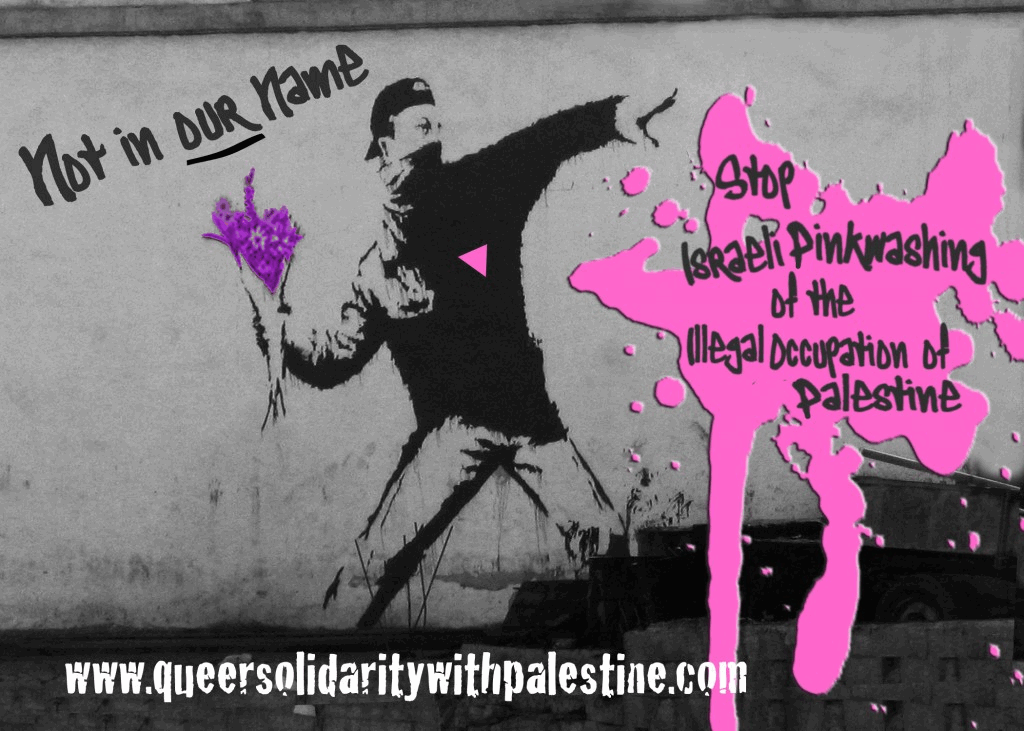
We are a diverse group of lesbian, gay, bisexual, queer and trans activists, academics, artists, and cultural workers from the United States who participated in a solidarity tour in the West Bank of Palestine and Israel from January 7-13, 2012.
What we witnessed was devastating and created a sense of urgency around doing our part to end this occupation and share our experience across a broad cross-section of the LGBTIQ community. We saw with our own eyes the walls—literally and metaphorically—separating villages, families and land. From this, we gained a profound appreciation for how deeply embedded and far reaching this occupation is through every aspect of Palestinian daily life.
So too, we gained new insights into how Israeli civil society is profoundly affected by the dehumanizing effects of Israeli state policy toward Palestinians in Israel and in the West Bank. We were moved by the immense struggle being waged by some Israelis in resistance to state policies that dehumanize and deny the human rights of Palestinians.
We ended our trip in solidarity with Palestinian and Israeli people struggling to end the occupation of Palestine, and working for Palestinian independence and self-sovereignty.
Among the things we saw were:
- the 760 km (470 mi) separation wall (jidar) partitioning and imprisoning the Palestinian people;
- how the wall’s placement works to confiscate large swaths of Palestinian land, splits villages and families in two, impedes Palestinians from working their agricultural land, and in many cases does not advance the ostensible security interests of Israel;
- a segregated road system (one set of roads for cars with Israeli plates, and another much inferior one for cars with Palestinian plates) throughout the West Bank, constructed by the Israeli state and enforced by the Israeli army; these roads ease Israeli travel to and from illegal settlements in the West Bank and severely impede Palestinian travel between villages, to agricultural land, and throughout a territory which is and has been their homeland;
- a system of permits (identification cards) that limits the travel of Palestinian people and functionally imprisons them, separating them from family, health care, jobs and other necessities;
- militarized checkpoints with barbed wire and soldiers armed with automatic rifles and the humiliation and harassment the Palestinian people experience daily in order to travel from one place to another;
- the reconfiguration of maps to render invisible Palestinian villages/homelands;
- harmful living conditions created and enforced by Israeli law and policy such as limited access to water and electricity in many Palestinian homes;
- violence perpetrated by Israeli settlers against Palestinians, and the ongoing growth of illegal settlements facilitated by the Israeli military;
- homelessness as a result of the razing of Palestinian homes by the Israeli state;
- home invasions, tear gas attacks, “skunk water” attacks, and the arrest of Palestinian children by the Israeli military as part of ongoing harassment designed to force Palestinian villagers to give up their land;
While travel restrictions prevented us from directly witnessing the state of things in the Gaza Strip, we believe the blockade of the Gaza Strip has produced a humanitarian crisis of monumental proportion.
Our time together in Palestine has led us to understand that we have a responsibility to share with our US based LGBTIQ communities what we saw and heard so that we can do more together to end this occupation. In that spirit, we offer the following summary points in solidarity with the Palestinian people:
- The liberation of the Palestinian people from the project of Israeli occupation is the foremost goal of the Palestinian people and we fully support this aim. We also understand that liberation from this form of colonization and apartheid goes hand in hand with the liberation of queer Palestinians from the project of global heterosexism.
- We call out and reject the state of Israel’s practice of pinkwashing, that is, a well-funded, cynical publicity campaign marketing a purportedly gay-friendly Israel to an international audience so as to distract attention from the devastating human rights abuses it commits on a daily basis against the Palestinian people. Key to Israel’s pinkwashing campaign is the manipulative and false labeling of Israeli culture as gay-friendly and Palestinian culture as homophobic. It is our view that comparisons of this sort are both inaccurate – homophobia and transphobia are to be found throughout Palestinian and Israeli society – and that this is beside the point: Israel’s illegal occupation of Palestine cannot be somehow justified or excused by its purportedly tolerant treatment of some sectors of its own population. We stand in solidarity with Palestinian queer organizations like Al Qaws and Palestinian Queers for Boycott, Divestment, and Sanctions (PQBDS) whose work continues to impact queer Palestinians and all Palestinians. (http://www.alqaws.org, http://www.pqbds.com/)
- We urge LGBTIQ individuals and communities to resist replicating the practice of pinkwashing that insists on elevating the sexual freedom of Palestinian people over their economic, environmental, social, and psychological freedom. Like the Palestinian activists we met, we view heterosexism and sexism as colonial projects and, therefore, see both as interrelated and interconnected regimes that must end.
- We stand in solidarity with queer Palestinian activists who are working to end the occupation, and also with Israeli activists, both queer and others, who are resisting the occupation that is being maintained and extended in their name.
- We name the complicity of the United States in this human rights catastrophe and call on our government to end its participation in an unjust regime that places it and us on the wrong side of peace and justice.
- We support efforts on the part of Palestinians to achieve full self-determination, such as building an international Boycott, Divestment, and Sanctions (BDS) movement which calls for the fulfillment of three fundamental demands: (http://www.bdsmovement.net/call)
- The end of the Occupation and the dismantling of the Wall (jidar).
- The right of return for displaced Palestinians.
- The recognition and restoration of the equal rights of citizenship for Israeli citizens of Palestinian descent.
- We call upon all of our academic and activist colleagues in the US and elsewhere to join us by supporting all Palestinian efforts that center these three demands and by working to end US financial support, at $8.2 million daily, for the Israeli state and its occupation.
Signed, January 25, 2012:
Katherine Franke |
Professor of Law and Director, Center for Gender & Sexuality Law, Columbia University; Board Member Center for Constitutional Rights |
Barbara Hammer |
Filmmaker, Faculty at European Graduate School |
Tom Léger |
Editor, PrettyQueer.com |
Darnell L. Moore |
writer and activist |
Vani Natarajan |
Humanities and Area Studies Librarian, Barnard College |
Pauline Park |
Chair, New York Association for Gender Rights Advocacy (NYAGRA) |
Jasbir K. Puar |
Rutgers University, Board Member Audre Lorde Project, author of Terrorist Assemblages: Homonationalism in Queer Times |
Roya Rastegar |
Independent artist and scholar |
Dean Spade |
Assistant Professor, Seattle University School of Law and Collective Member, Sylvia Rivera Law Project |
Kendall Thomas |
Nash Professor of Law, Columbia University |
Lisa Weiner-Mahfuz |
intersections/intersecciones consulting |
Juliet Widoff, MD |
Callen-Lorde Community Health Center |
All organizational affiliations are listed for identification purposes only and in no way indicate a position taken by such organizations on the issues raised in this statement.
Sign the petition: http://www.queersolidaritywithpalestine.com
return to top
Birthright Unplugged's Communiqué
Winter 2010
Dear All,
We are writing to update you on Birthright Unplugged’s most recent work, some of our alums’ work, and also to let you know what’s on the horizon.
Our recent work
This summer, Birthright Unplugged organized several workshops and presentations and participated in numerous meetings and conferences. We were a presence at the 2010 Allied Media Conference, the 2010 U.S. Assembly of Jews Confronting Israeli Apartheid and Racism, and this year’s U.S. Social Forum, all of which took place in Detroit. We really prioritized this work this year, since so many hundreds of activists came together at these meetings from across North America in order to develop national networks and initiatives related to justice for Palestine. We led and participated in workshops, meetings, and panels on “pinkwashing” (Israel’s use and promotion of gay and lesbian civil rights to obfuscate its racist practices), consumer and cultural boycott practices (with a focus on creative methods and the use of media), and increasing national networking for BDS and international solidarity in the Palestinian context. We are proud to say that numerous Birthright Unplugged alums were also organized, presented at, and/or participated in many of the offerings related to Palestine justice work at these meetings and are also hard at work in their own communities as well.
In addition, Birthright Unplugged produced, with the input of many movement workers, an exhaustive Boycott Divestment & Sanctions FAQ. Thousands of copies of this FAQ, in the form of posters and small postcards, were distributed at each of the above conferences. The FAQ was also issued as a poster at the Social Forum and is downloadable from our website at here.
Birthright Unplugged in the Media
Documentary
Hampshire College’s successful 2009 divestment campaign has been chronicled in a short, 30 minute film by Will Delphia entitled To Know is Not Enough: How Hampshire Became the First to Divest. According to the website, “Hampshire is often credited with being the first US college to divest from the occupation, and this video attempts to understand the group and the campaign that made it happen. The video is constructed from interviews with over a dozen student activists from Hampshire College's Students for Justice in Palestine.” Two of Birthright Unplugged’s 2008 alums worked on this historic divestment effort. The documentary can be seen here (we welcome you to use and distribute it).
Tikkun
In Tikkun’s July/August 2010 issue there is an article entitled "Boycott Israeli Occuption?: Is BDS the Way to End the Occupation?"
This section includes a short write-up on our Unplugged program and some photographs from one of our recent trips. Note: A caption states that we “travel primarily with Jews,” which is not accurate.
German News Media
The is the second time Süddeutsche Zeitung, a widely distributed German daily, has covered Birthright Unplugged. We are pleased by the continued international exposure that this piece represents and also wish to note that it is limited in its scope and in some ways reinforces the “two-sides” narrative, which Birthright Unplugged rejects.
“The Promised Land for free,” Süddeutsche Zeitung, 29 July 2010, by Ronja von Wurmb-Seibel
Culture Jamming/Spoof Article
The following news headline, of November 8, 2010 —“Taglit-Birthright and Birthright Unplugged to Merge”—came as a complete surprise to us here at Birthright Unplugged!
That’s because it is not exactly true. This article is part of a clever culture jamming effort by Young Jewish and Proud, a new group that espouses “a vision of collective identity, purpose and values written by and for young Jews committed to justice in Israel and Palestine.” You may know members of this group already from their recent disruption of Benjamin Netanyahu’s keynote address at the 2010 Jewish Federation General Assembly in New Orleans (you can watch a video of this disruption at their website). In their faux article “referring” to our work, Young Jewish and Proud writes:
“Taglit-Birthright program has decided to merge with Birthright Unplugged and welcome Jewish and Palestinian youth together to return to their ethnic roots in the Holy Land. The group, to be renamed Birthright for All (Taglit Le’Kulanu), will adopt the slogan: Israelis And Palestinians. Two People, One Future.”
While we at Birthright Unplugged are in no way in partnership with Taglit-Birthright Israel, we have been consulting with several Palestinian, Arab, and Muslim groups about helping them access travel to Jerusalem and beyond on an Unplugged-type program. Details coming soon!
Some Alumni Work and Reflections
Three of our 2010 alums – Ashley McAdam, Becky Barbrow, and Stuart (William) Pike – are behind Christmas Break in Palestine, a new documentary exploring “the many social and political costs of the Israeli occupation in the Palestinian territories.” The alums made the film in January 2010 on a university-sponsored trip to Israel and the West Bank (running time: 24 min).
Many of our alums are also actively involved in ongoing movement and campaign work and many credit their travel with Birthright Unplugged as a turning point in their lives and work for justice. Here are just a few of many examples, in their own words:
• Lindsey, Birzeit University Right To Education Campaign, an effort to defend Palestinians’ right to education.
“I first came to Palestine during the winter of 2009, just a few days into the war on Gaza. An undergraduate International Studies major focusing on human rights and conflict resolution, what I knew and expected of Israel/Palestine, and of my Birthright Unplugged trip, was injustice. I had read about the settlements, the repression, the restriction of movement, the crippling of economies, the Wall; I had immersed myself in the history of expulsion, the long line of disappointments that has been each successive round of peace talks, each of which, in its own way, failing to get the heart of the matter; and I had prepared myself for all these things, knowing that no self-respecting activist, as I hoped to be, could ignore the occupation and apartheid of Palestine, nor all the atrocities that have come therewith.
“In those ten days I spent in Palestine with Birthright Unplugged, I learned more than any scholarly article or textbook could or had told me. Hearing the stories of survival and resistance firsthand solidified my commitment to Palestine activism, my passion for a cause I've come to realize receives barely any of the attention and indignation from the international community it so deserves….
“I write today from the office of the Right to Education Campaign at Birzeit University, where I have worked for several months as an intern helping the organization in its mission to document and advocate against the violations of the basic human right of accessing education which Palestinians endure under Israeli occupation….It was on my Birthright Unplugged trip, standing on the very land for which generations of Palestinians have fought and continue to fight, that I realized it would not be the last time I would do so. I left Palestine determined to return, and did so with the vision to further my role in the movement. I owe so much to Birthright Unplugged for this contribution it has made to my life, and wish all the best to any of you who will participate in the future.”
• Sriram, The Minnesota Break the Bonds Campaign, A campaign to divest Minnesota state investments from war profiteers, MNBBC.
“I went a Birthright Unplugged-led trip in August 2005 as someone already in solidarity with the Palestinian cause. Coming from India, a country with its own colonial past and rich history of struggle, as well as my own personal roots in leftist politics, it was easy to ideologically identify with the Palestinian struggle. But political solidarity does not always beget a commitment to hard-nosed organizing, and it was the Birthright Unplugged trip that proved to be the catalyst for me. It was, to put it mildly, a crucial cornerstone in my life. I saw the resilience, frustration, courage, heterogeneity, anger, love, intelligence, pain, and salubrity of the Palestinian liberation struggle, where survival alone is resistance to oppression. Today, I spend most of my waking hours organizing in the BDS movement in North America, and conducting research on the same. If you are committed to fighting oppression, organizing for a just peace, and standing on the right side of history, take this trip and pay your respects to the Palestinian struggle.”
On the Horizon
We are currently planning an Unplugged trip this winter for a group primarily composed of students and professors. In addition, we hope to offer a Re-Plugged trip for Palestinian children in a West Bank refugee camp in the district of Al Khalil/South Hebron. The camp’s original residents fled from 18 villages in the Gaza, Hebron, and Bir Saba/Beersheeva areas. This will be our first time traveling with children who are originally from these areas. While we still cannot access Gaza, we hope to travel with the children to the Bir Saba/Beersheeva and Al Khalil/South Hebron Districts to visit the destroyed villages where their families used to reside.
It’s that time of year…
Finally, we want to thank you for your continuous and generous support. As you know, we rely mostly on individual donations to do our work. We hope you will consider making a donation, no matter how small (and, of course, no matter how large!). Finally, many thanks to those of you who have made your annual contributions – we are extremely grateful for these contributions, which are sustaining and allow us to keep the focus of our work on justice rather than fundraising. To donate to Birthright Unplugged, please visit us here.
With all our best,
Dunya & Heike
return to top
“Taglit-Birthright and Birthright Unplugged to Merge”, spoof by Young Jewish and Proud, November 8, 2010
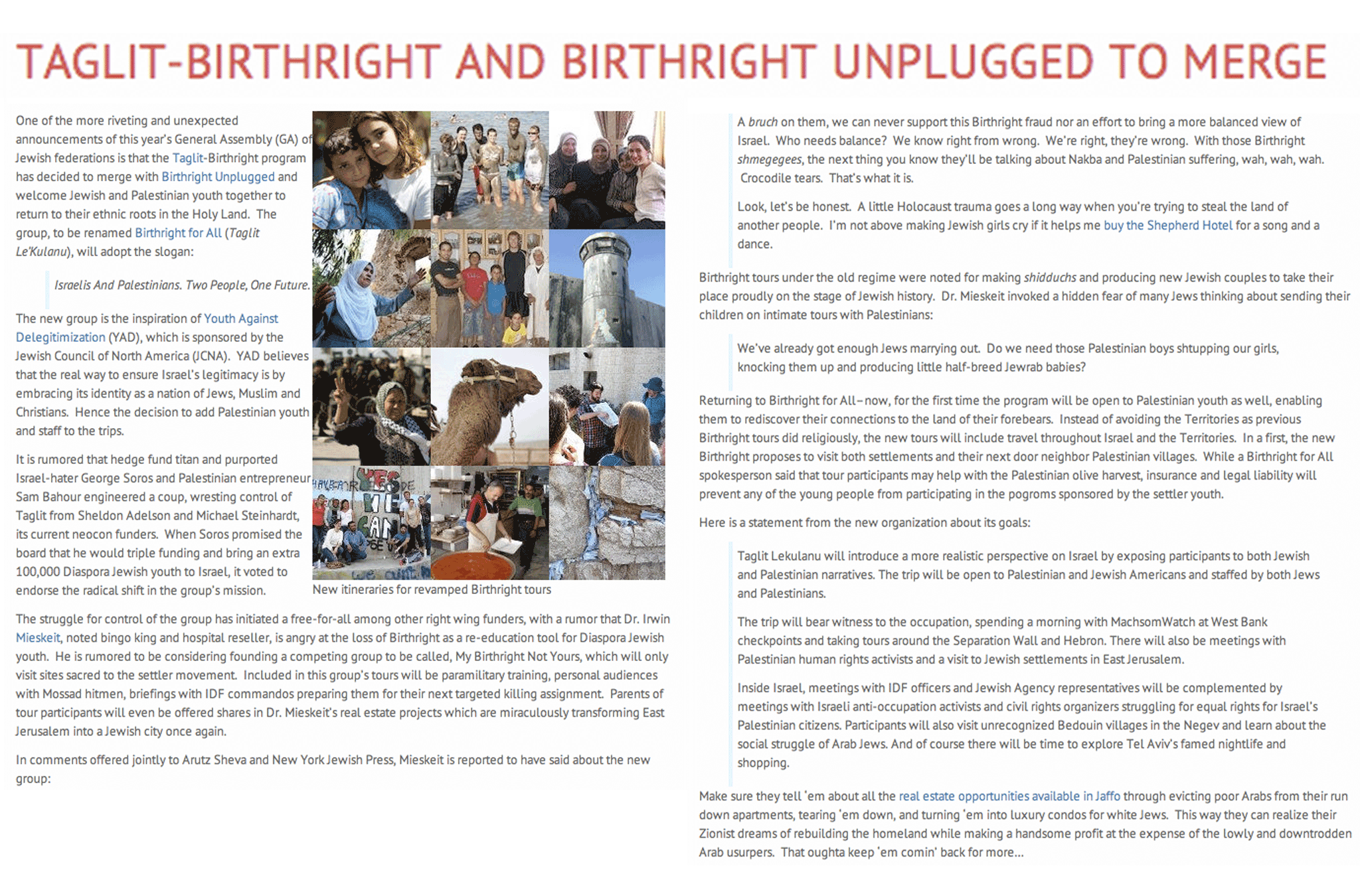
To link to this spoof/article click on this link. To read more about Young Jewish and Proud, click on this link
return to top
Boycott Israeli Occuption?: Is BDS the Way to End the Occupation? Tikkun Magazine, July/August 2010. Click here to download the entire article: Tikkun PDF
return to top
To Know is Not Enough: How Hampshire Became the First to Divest
Independent documentary, Will Delphia, August, 2010
Hampshire College’s successful 2009 divestment campaign has been chronicled in this short, 30 minute film. The documentary features interviews with over a dozen student activists from Hampshire College's 'Students for Justice in Palestine. Two of Birthright Unplugged’s 2008 alums worked on this historic divestment effort. August 2010.
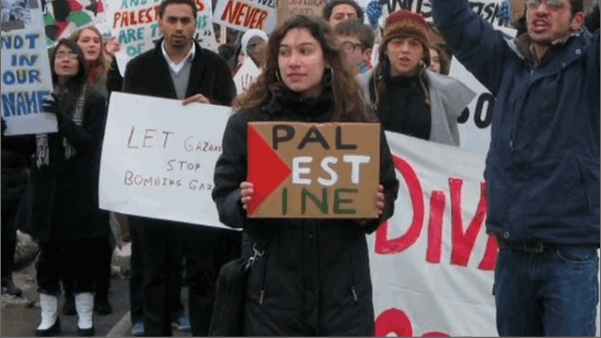
Still from To Know Is Not Enough: How Hampshire Became the First to Divest, video, 2010
return to top
return to top
All Expenses Paid Trip to the Promised Land
Ronja Von Wurmb-Seibel, Süddeutsche Zeitung, July 9, 2010
Some moments are life-changing—the birth of a child, winning the lottery, the death of a loved one. The young Americans who describe their experiences on Taglit Israel’s website, however, have something else entirely in mind. Raving about their ten-day journey through Israel, they write about swimming in the Dead Sea, worshipping in a synagogue in Jerusalem, and grabbing a beer in one of Tel Aviv’s nightclubs. It is an all expenses paid trip, provided that they are Jewish and can manage to land one of the coveted spots on the Birthright Tour.
The trips are organized by Taglit Israel, an organization financed by private donors, the Israeli government, and the U.S.-based Jewish Agency for Israel. Since its founding a decade ago by Jewish Americans with the goal to “diminish the growing division between Israel and Jewish communities around the world,” 250,000 young adults from 52 countries have participated in the program. The tours are a mixture of educational class trip and an individual search for identity. Participants travel through Israel in air-conditioned buses, leaving hardly a sight unseen. They observe the Sabbath, visit the Wailing Wall, and discuss local traditions and customs. Several days are also spent in the company of similarly-aged Israeli soldiers and together they go out for a night on the town or a day at the beach.
“Birthright” refers to the oldest law of the Jewish state, the so-called Law of Return, which affords all people of Jewish descent Israeli citizenship. According to Taglit’s own reports, approximately 17,000 former participants have since emigrated to Israel. It is not the goal of the program to promote the possibility of citizenship, however, says Maxim Schkolnik of the Jewish Agency for Israel in Germany. “We simply want to show them the land of their ancestors.” The Agency as a whole is the official immigration representative for Israel and its German branch administers the Birthright tours within Germany.
The glimpse of the country participants receive is a picturesque one. Israeli settlements, refugee camps, and Palestinians are not parts of the tour. “It’s naturally impossible to see an entire country in ten days, even one as small as Israel,” says Schkolnik. That said, he adds that participants definitely also get a view of non-Jewish life. Travelers visit a Drusian village and spend a night in the desert with Bedouins, both encounters intended to help participants become acquainted with and gain an impression of the everyday lives of Arab minorities. Because of security concerns, which prevent Birthright tours from extending into occupied territories, there are no such encounters with Palestinians.
“We are not a political organization and only offer purely historical tours,” says Taglit Birthright spokesperson Deborah Camiel. Participants visit the Yad Vashem Holocaust Museum, a complex which documents the persecution of Jews in nine connected underground galleries. They are given a guided tour through Independence Hall, where the State of Israel was established in 1948, sparking the 1948 Arab-Israeli War soon thereafter. They also climb Belan Mountain in the Golan Heights, a significant point of battle between Israel and Syria during the Yom Kippur War. It is clear that difficult topics—the Holocaust and war in Israel—are addressed during the tour, but only as long as such topics lie in the past.
As was the case even in 2008, as Gaza was engulfed in war, the current Middle East conflict is a point of discussion that is never mentioned on the tour. “[Despite the conflicts in 2008] the tours continued,” says Camiel. Schkolnik considers it a delicate topic. “We don’t talk about the Middle East conflict during the trip, because we don’t want to purport to have any particular opinion on the issue.” To do so, according to Schklonik, could easily be considered brainwashing.
Critics accuse Taglit of doing precisely that. Dunya Alwan, an American who spends four months out of the year in Palestine, focuses her efforts on human rights. Out of protest against Taglit and its tours, during which the topic of the Middle East conflict is never broached, she founded Birthright Unplugged in 2005. The organization offers seven-day tours of Israel available to anyone, regardless of age or religious affiliation. Since its founding, roughly 350 tourists have traveled through Palestinian-occupied territories, stayed with families in refugee camps, and spent hours in the unbearable heat at checkpoints.
“Sometimes it was incredibly difficult to bear,” reflects Amber Michel, a past participant. “We stood there completely helpless and unable to do anything to help the Palestinians.” The thirty-year-old American recalls broken-down houses, families ripped apart, and destroyed hopes. What Birthright Unplugged participants see is rarely pleasant. With little resemblance to a vacation, the tours sometimes bring individuals to tears. This view is also one-sided, however.
Although travelers encounter Jews, they are pro-Palestinian and likewise involved in pro-Palestinian efforts. “We want to give those a voice who otherwise receive little attention,” says Alwan. She said that Birthright Unplugged did not arrange contact with other Israelis.
Regardless of the tour they choose, participants are enthusiastic and inspired by what they experience. “Palestine has become a second home for me and I will come back as soon as I can,” raves Unplugged participant Amber Michel. Former Birthright traveler Lauren Conover writes similarly on Taglit’s website, “Birthright has given me something no one can ever take away. Birthright has helped me find my identity. I am Jewish. I am Birthright Israel.”
return to top
Birthright Unplugged Communiqué – Winter/Spring 2009-2010
Dear All,
We are writing to update you about our most recent Birthright Unplugged trip, fill you in on some of the our alums’ work, and let you know what’s on the horizon.
Our January Unplugged trip
We recently returned to Palestine with a group of mostly college students in the wake of the one-year anniversary of Israel’s war on Gaza. The living conditions in Gaza remain devastating for all who are living there, including a largely contaminated drinking water supply and Israel’s continued siege that closes Gaza to trade and travel. The siege has prevented Gazans from importing building materials, making it impossible to rebuild the 3500 homes that were destroyed and the 56,000 homes damaged during Operation Cast Lead. Gazans have resourcefully turned to building houses out of mud in yet another demonstration of their unwillingness to be defeated.
In January, 1,400 protesters from all over the world arrived in Cairo to participate in the Gaza Freedom March, an attempt to break the siege and stand in solidarity with the people of Gaza. Hundreds also traveled from the West Bank and ‘48/Israel to the Erez Crossing to participate as well. One of the results of this organizing effort was the Cairo Declaration, a statement produced by marchers in conversation with Palestinians in the West Bank and Gaza, which condemns Israel’s illegal actions against Palestinians and affirms its commitment to the right of return for Palestinian refugees. The Cairo Declaration is also a call to the international community to focus our work on BDS.
To learn more about the water crisis in Gaza and to pitch in:
http://www.mecaforpeace.org/project/maia-project
To learn more about the housing crisis in Gaza:
http://www.irinnews.org/Report.aspx?ReportId=88032
http://electronicintifada.net/v2/article10974.shtml
To learn more about the Cairo Declaration:
http://electronicintifada.net/v2/article10988.shtml
Our trip was filled with poignant and educative experiences. As is typical for us by now, during the trip we spent time in Occupied East Jerusalem, the West Bank (in Palestinian cities, villages, and refugee camps), and inside Israel/’48 in historically Palestinian cities, Tel Aviv, villages destroyed in 1948, and the Naqab (or Negev).
Some especially stirring conversations on the trip were when we were in touch with Gaza during two video conference calls. The first of these was with Berlanty Azzam of Bethlehem University. Berlanty is a student from Gaza who was in her final semester of university when she was arrested by the Israeli Army and deported to Gaza. We spoke with Berlanty around Christmas time. Her mother had been granted a permit by Israel to go to Bethlehem for the holiday and was using the trip in order to collect Berlanty’s belongings from her room. We asked the university to facilitate the video conference call so that we could speak with Berlanty from the campus where she had studied. Our conference call to Gaza was the first live conversation with Gazans held from the University, and it drew many faculty members who wanted to see Berlanty, talk with her, and send her good wishes. Our conversation was emotional—filled with information, laughter, and tears—and a reminder of the possibility of building relationships despite the profound barriers Israel imposes.
Our second conversation with Gazans was a video meeting with Dr. Haider Eid, a Palestinian professor living in Gaza, and a group of Gazan students from the Palestinian Students for the Cultural and Academic Boycott of Israel (PSCABI). Some of the students were from the Islamic University, which was bombed by Israel in January. Their message was loud and clear: they spoke of the horrors of the 2009-2010 attacks, their inability to build and live normal lives, and their feelings of isolation, referring to all the people of Gaza as “orphans.” Their demands are also crystalline: they reiterated that non-violent, punitive measures like BDS should be maintained until Israel meets its obligation to recognize the Palestinian people's inalienable right to self-determination and fully complies with the precepts of international law. They reminded our group of the demands of the 2005 BDS call, which have been many times re-printed in our humble Communiqué. These demands are that Israel must comply with international law by:
Ending its occupation and colonization of all Arab lands and dismantling the Wall;
Recognizing the fundamental rights of the Arab-Palestinian citizens of Israel to full equality; and
Respecting, protecting, and promoting the rights of Palestinian refugees to return to their homes and properties as stipulated in UN resolution 194.
Several of our recent alums have also had their reflections on the trip and the situation in Palestine/Israel published and we encourage you to check out their words.
Lauren Costello has published work in community and college campus newspapers:
http://www.wickedlocal.com/west-roxbury/news/lifestyle/columnists/x2077695697/Breaking-the-silence-The-Israeli-and-Palestine-conflict
http://bcgavel.com/2010/02/27/column-immersion-trip-calls-bc-students-to-action/
David Willner communicated his experiences in Palestine/Israel in another campus paper:
http://www.bcheights.com/2.5479/a-student-perspective-on-an-international-crisis-1.1174560
And Mark Tilsen received coverage in Indian Country Today with the headline, “Oglala Lakota traveler sees ‘deep parallels’ in Palestine”:
http://www.indiancountrytoday.com/home/content/83032447.html
January 2010 was also the 10th anniversary of Birthright Israel and NPR felt their story would not be complete without some voices from Birthright Unplugged. NPR interviewed Dunya, one of the travelers on the trip, and Noam, our one and only Israeli alumnus from the Carter Peace Prize-funded Brandeis trip in January 2008, who happened to have joined us on the trip that day. Noam’s unequivocal verbiage helps to closes NPR’s piece. The piece aired on Sunday’s Morning Edition: http://www.npr.org/templates/story/story.php?storyId=122416343
On the horizon
Stay tuned for details of our Unplugged trip. We will again travel extensively and learn from a wide swath of Palestinians and also share in several strategy, tactics, and organizing workshops to facilitate participants’ work in justice movements and Boycott, Divestment, and Sanctions (BDS) campaigns in their home communities. Our upcoming dates will be released in about a week!
Important Campaign Developments
BDS is catching on like wildfire, both around this country and around the world. The number of cities building BDS movements is growing tremendously, just as the campuses observing Israeli Apartheid Week continues to increase. There are campus divestment campaigns, state government divestment initiatives, and consumer boycotts happening in multiple places across the globe.
Proof that BDS is working has been made abundantly evident by the Israeli Reut Institute’s criticism of what they called the “Delegitimation Network”—an “unholy alliance” with the Palestinian “Resistance Network”—which consists of the broad, decentralized, informal movement of peace and justice, human rights, and BDS activists all over the world. Citing protests against Israeli officials visiting universities, Israeli Apartheid Week, faith-based and trade union-based activism, and “lawfare”—the use of universal jurisdiction to hold Israeli war criminals accountable for their actions—the Institute made clear that the effects of BDS are palpable and a credible threat to Israel’s legitimacy: http://electronicintifada.net/v2/article11080.shtml
Across the country, our alums are involved in this campaign work, from the Minnesota Break the Bonds campaign to Hampshire College’s historic divestment from Israel that has provided inspiration and insight for the Michigan and Berkeley initiatives currently in the works, to the Israeli Apartheid Week programming in several cities, and more. This is a very exciting time in Palestine/Israel justice work and there are initiatives springing up everywhere. The momentum is really building. If you are not already involved, we encourage you to find ways to get on the train!
Opportunities to Learn and Work With Activists and Organizers from Across the U.S.
There are three gatherings/conferences being held back to back in Detroit this June that we encourage you to participate in and spread the word about. Each will draw activists from across the country and have supporting campaign work for justice in Palestine/Israel. We encourage you to check them out and if you attend, watch for Birthright Unplugged as we’ll have offerings at all three.
Allied Media Conference, June 18-20
http://www.alliedmediaconference.org/node/4284
Jews Confront Apartheid, June 19-June 22
http://jewsconfrontapartheid.org
United States Social Forum, June 22-June 26
http://www.ussf2010.org
Ways to stay in touch and support Birthright Unplugged’s work
Thanks, as always, for keeping up with our work! We hope you will consider joining our Facebook group. We post campaign updates and calls there and we welcome you to do the same. Check us out there too!
Also, Birthright Unplugged is looking for a volunteer or two to help us with the website. We are looking for a commitment of a only couple of hours per month. If this person is you (or you know someone who could do it), please get in touch with us: info@birthrightunplugged.org
Finally, we want to thank you for your continuous and generous support. Thanks also to those who have pledged their annual contributions – we are extremely grateful for these contributions, which allow us to keep the focus of our work on justice rather than fundraising. To donate to Birthright Unplugged, please visit us at: http://www.birthrightunplugged.org/donate
With all our best,
Dunya & Heike
return to top
Should Israel Birthright Include Implication For Occupied Territories?
Lourdes Garcia-Navarro, National Public Radio
January 10, 2010
There was a massive celebration this week for the 10-year anniversary of Birthright Israel. The nonprofit program, which pays for young Jews to come to Israel to connect with their Jewish roots, is a runaway success. But not everyone thinks that's a good thing. Birthright Unplugged is a program that takes Jewish-American university students to the occupied territories to show them what they say is the reality Birthright Israel ignores in its quest to bring Jews from around the world to Israel. NPR's Lourdes Garcia-Navarro reports.
TRANSCRIPT
LIANE HANSEN, host:
In Israel this past week, the non-profit program Birthright Israel marked its 10th anniversary. The program pays for young Jews to go to Israel to explore their roots. More than 250,000 Jews from all over the world have been on Birthright tours. A new study shows that alumni of the program are much more likely to feel a continuing connection to the Jewish state. But the program has its critics.
NPR's Lourdes Garcia-Navarro reports.
LOURDES GARCIA-NAVARRO: The auditorium is packed with young men and women chanting - Israel, Israel, in front of a massive stage. The MC leaps around exhorting the crowd to cheer louder.
(Soundbite of cheering)
GARCIA-NAVARRO: The participants are from countries that span the globe: Brazil, Russia and the United Kingdom. But by far, the largest group are the Americans where 75 percent of young Jews outside of Israel live.
(Soundbite of cheering and music)
GARCIA-NAVARRO: Bruce Springsteen's "Born in the USA" blasts out over the speakers, thousands of young people leap to their feet.
The past 10 years, Birthright has offered free 10-day trips here for Jews between the ages of 18 and 26. The goal is to have them reconnect with their Jewish identity, and a new study from Brandeis University shows that it has the desired effect. Participants are 57 percent more likely to marry a Jew and 23 percent more likely to feel a strong connection to Israel.
Speaking at the celebration, Israel's president Shimon Peres lauded the program.
President SHIMON PERES (Israel): All of you are participating in one of the most brilliant (unintelligible) and the most successful experience in the history of the Jewish people.
(Soundbite of cheering)
GARCIA-NAVARRO: Gidi Mark is the CEO of Birthright Israel, called Taglit in Hebrew.
Mr. GIDI MARK (CEO, Birthright Israel): It all started by out of the concern that more and more young Jews decided to marry non-Jews. And, as you know, unfortunately we are as many as the Chinese. We want to keep our family strong and thats what we are doing.
GARCIA-NAVARRO: As they tour sites like Masada, the Holocaust Memorial - Yad Vashem, the Western Wall and the Golan Heights, participants are accompanied by young Israeli soldiers.
Unidentified Man: It's like normal to go to the army and they have friends in the army. And they have friends in Gaza Strip that may get killed every day. And they have friends that diedinbus bombs and...
GARCIA-NAVARRO: At the end of the trip, the soldiers and the visitors say good-bye with testimonials from each side.
Nineteen-year-old Ellen Faulchy(ph) is from Northern Virginia.
Ms. ELLEN FAULCHY: Any time I watch the news now it's not going to be just another four people killed in a suicide attack. Like, you guys are here. Like you're doing the unbelievable to protect all of us. And I think I can say for all of us, thank you so much.
(Soundbite of applause)
GARCIA-NAVARRO: The Israeli who led the tour, Ronan Malek(ph), ends the session with this message to the group.
Mr. RONAN MALEK (Tour Guide, Birthright Israel): Who are the soldiers of Israel? These are the soldiers. You think that those soldiers can kill somebody innocent?
GARCIA-NAVARRO: Birthright Israel says it is a non-political organization, but critics say it espouses a particular point of view. To give the Palestinian side of the Mideast narrative,one group has started an alternative tour. It's called Birthright Unplugged.
Ms. DUNYA ALWAN (Director, Birthright Unplugged): Today is a really good day to see how settlements are functioning.
GARCIA-NAVARRO: Dunya Alwan is an American of Jewish and Iraqi heritage. Today, she's shepherding a group of students from Boston College to the City of Hebron andelsewhere in the occupied West Bank.
Ms. ALWAN: The idea is to give them a breath of understanding of Palestinian voices through all of that travel. We speak with people from all sectors: government, social, social service. they have family home stays in a Palestinian refugee camp. Thats what theyve done last night.
GARCIA-NAVARRO: Nicole Fisher(ph) is a Jewish student who decided to come on this tour rather than the one offered by Birthright Israel.
Ms. NICOLE FISHER (Boston College): Being able to see what goes on in these camps and being able to talk to people firsthand, you learn so much more. You know whats going on, as opposed to just seeing the Israeli side of it. It's good. It's good balance.
(Soundbite of traffic)
GARCIA-NAVARRO: In Hebron, the group walks through the center of the Old City. Twenty-two-year-old Maram Shuster(ph) is an Israeli who studies in the U.S. and is an alumni of Birthright Unplugged. She says Birthright Israel does more harm than good.
Ms. MARAM : These people made the trip all the way here. They're not being informed with any kind of truth, any kind of criticism about this country. And they're going to go back and be ambassadors and fall in love with a land that they know what about? They no nothing. So, for me, I have no other word than propaganda.
GARCIA-NAVARRO: Birthright Unplugged is tiny in comparison to its rival organization. Only hundreds of young people have participated in this program, compared to the tens of thousands who go on Birthright Israel trips every year.
Lourdes Garcia-Navarro, NPR News, Jerusalem.
To listen: http://www.npr.org/templates/story/story.php?storyId=122416343
return to top
Many Questions, No Easy Answers. Sociology class West Bank trip underscores debate on Israel, Palestinian conflict
Melissa Beecher, The Boston College Chronical
January 2010
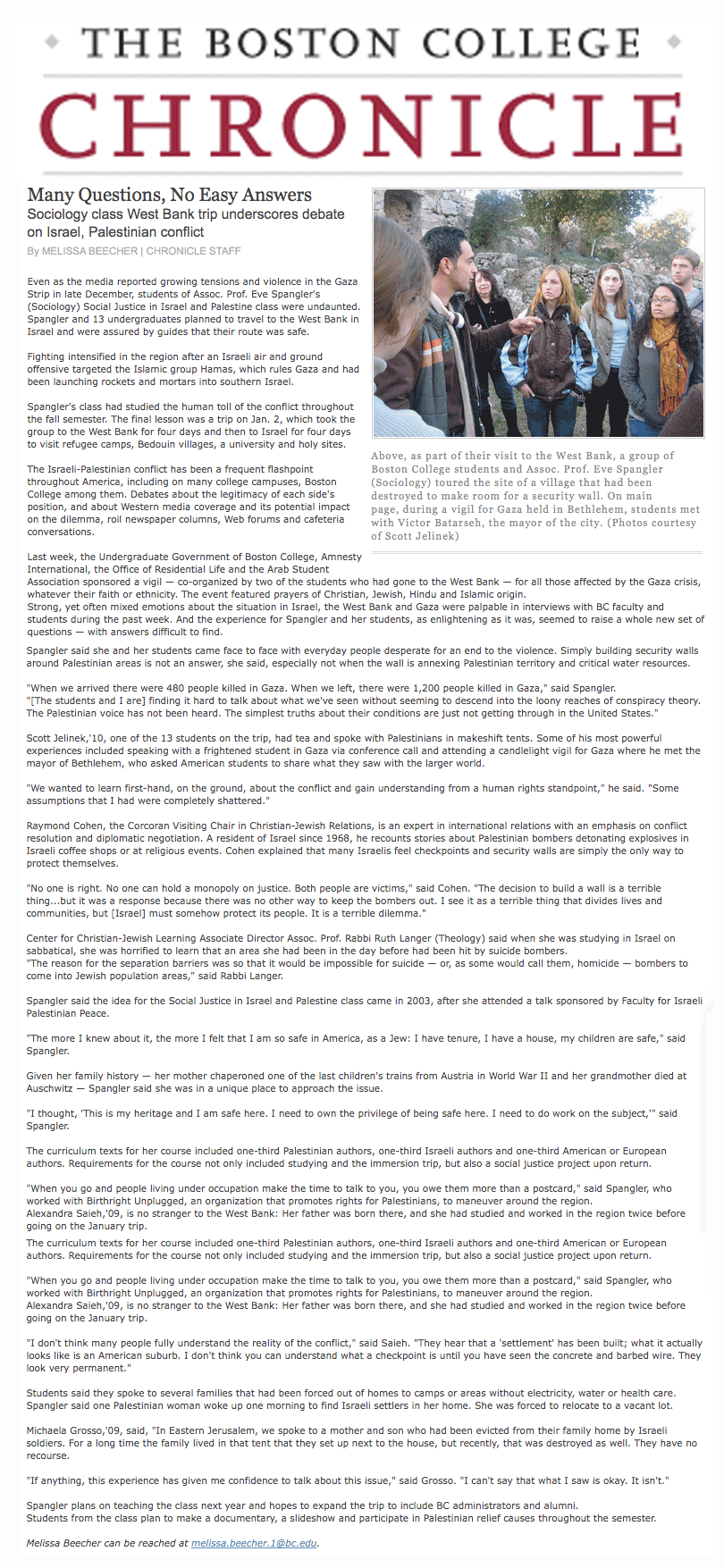
return to top
West Bank youth see Israel with "Birthright Unplugged"
Erika Solomon
August 21, 2009
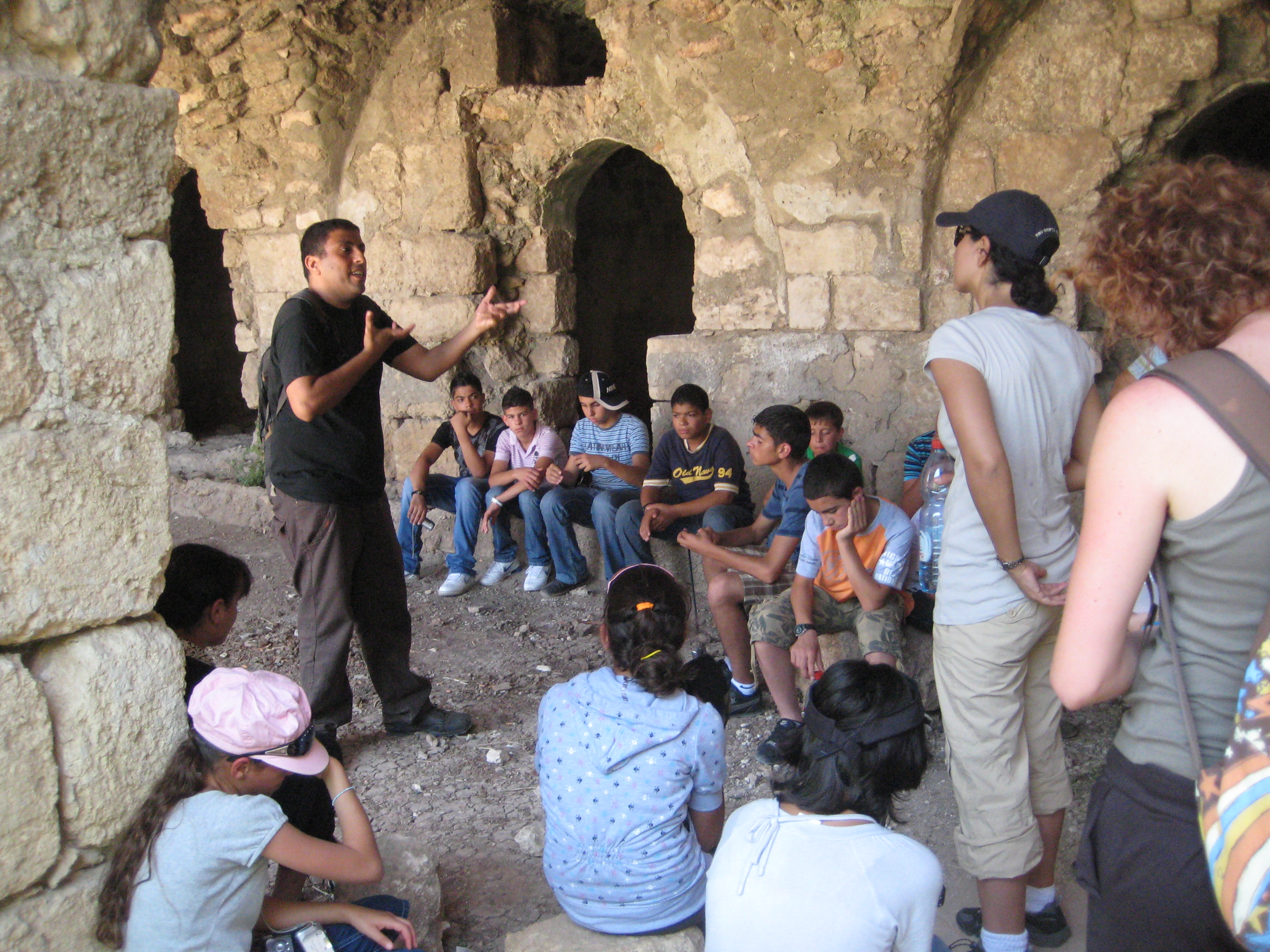
A Birthright RePlugged guide (L) speaks to Palestinian youths from the West Bank during their visit to the ruins of the old Arab market near the Israeli city of Lod near Tel Aviv August 4, 2009 in this picture released by Birthright RePlugged on August 20, 2009. ''Birthright RePlugged,'' partially funded by the Carter Center's Peace Program, takes Palestinian refugee children to Israel twice yearly to visit the villages of their ancestors.
Fourteen-year-old Jum'a Ismail lives 50 km (30 miles) from the Mediterranean but had never seen the sea. The Palestinian youth had never set eyes on an Israeli civilian or an airport. Juma'a's horizons expanded this summer, when he left Jalazoun refugee camp in the occupied West Bank with "Birthright Replugged" on a trip taking Palestinian refugee children to Israel to visit the villages of their ancestors. "It's an attempt to get out, while they still can," said the program's creator, Dunya Alwan. Once Palestinian children turn 15, they must carry Israeli-issued West Bank identity cards and are no longer able to travel through Israeli checkpoints without special permits. "Birthright Replugged" is partially funded by the Carter Center's Peace Program, founded by the former U.S. president Jimmy Carter. It takes groups of 20 Palestinian children into Israel twice yearly. Alwan, an Iraqi-American from a Jewish-Muslim family, calls her work a counterweight to "Birthright," the program offering Jewish youth from around the world an all-expenses-paid, two-week trip to Israel to foster ties to the Jewish state.
EYE-OPENER
Movement from the West Bank to Israel was easier before the second Palestinian uprising that began in 2000. Suicide bombings on Israeli buses and cafes triggered a security clampdown that is only now loosening, under international pressure. Palestinians must still carry ID cards to move around the West Bank. Getting into Arab East Jerusalem, also captured by Israeli forces in the 1967 war, or into Israel itself, is nearly impossible for most. That puts the Mediterranean coast and Israel's international Ben-Gurion airport, out of range. Alwan says her little trips may be the first and last opportunity for the youngsters. On their return to the West Bank, they cannot stop talking about the sea, the airport, how Israeli Jews and Arabs coexist, and how they have no roadblocks to worry about. "They don't ever seem to think about if there is going to be a checkpoint ahead or not," says 14-year-old Haneen al-Nakhla. "We're always worrying and calculating those kinds of things." They are puzzled to see Israelis who are neither soldiers carrying weapons, or settlers, who also tend to be armed.
REALITIES
Some 2.5 million Palestinians live in the West Bank. Israel is home to 7 million, of whom 20 percent are Arab Israelis. "We had no idea how many Jewish people there would be. There are more than Arabs," said Haneen. "The Arabs and Jews talk to each other, like it's normal. I thought it was really strange. We don't ever talk to Jewish people at home." Alwan's tour does not alter sentiments; the students all support a Palestinian "right of return" to homes and land lost in the 1948 war over Israel's creation -- a demand Israel says would destroy the Jewish character of the state. For Alwan, simply showing the teenagers the former homeland turns an idealized dream into realities they can discuss. Lydda, or Lod in Hebrew, was where their grandparents once lived. It's now part of the sprawling airport outside Tel Aviv. "These kids see the challenges and complexities. They see that what they have rights to now has an airport on it," Alwan said. Sobering it may be, but the airport is a big hit. Most of the teenagers have never flown or even been close to a plane, and they take countless photographs. "I had to take pictures to show my family. They've never seen an airliner either," said Jum'a, who at home hardly notices the watchtowers, razor-wire fences and high concrete walls of the barrier Israel has erected in the West Bank. The normality of Israel's heartland shocked them. "I really felt how much I live under occupation," says Haneen. She has decided she "would really like to become an airline stewardess," and Jum'a says: "I definitely want to be a pilot." Back home, the Jalazoun kids seem conflicted. They start a sentence arguing for peace and freedom for Palestinians and Israelis, then end up saying there's no hope of it. But a talk with participants of past trips, who are a bit older now, suggests that ideals of coexistence tend to develop. Ahmawd Ghazawy, 19, from Jenin refugee camp, was on the first Birthright Replugged trip in 2007. "Before 1948 there were Jews and Arabs and they lived in peace," he says. "It could happen again."
return to top
West Bank youth see Israel with "Birthright Unplugged"
Erika Solomon
August 21, 2009
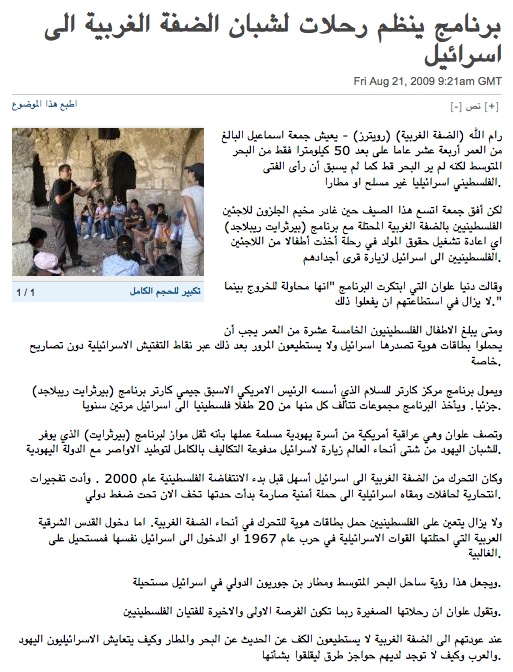
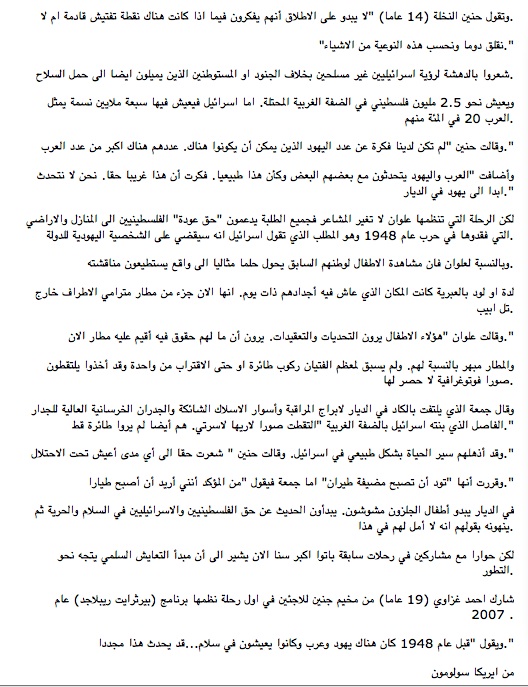
return to top
Birthright Unplugged Communiqué – Summer/Fall 2009
Dear All,
We are writing to fill you in on Birthright Unplugged’s recent summer season, to let you know what’s on the horizon for us in the upcoming year, and to put in a plug to make us part of your end of the year donations.
This spring, we expanded our Re-Plugged program significantly. Based on our past work and in conversation with our partners, we developed a curriculum for a pilot project of Birthright Re-Plugged called “Rehearsing Return.” This summer, we launched the new program with 20 children from Jalazone Camp, just north of Ramallah. As usual, we started our journey by traveling to Jerusalem and then headed for the sea. Most of the children had never visited any of the places we traveled to and were thrilled to do so and, as we have come to expect, braved jellyfish in order to spend the maximum time possible in the surf.
Prior to our departure, the children had researched the villages and towns their families fled in 1948 by interviewing their families and searching the archives of palestineremembered.com. Upon their return from the Re-Plugged trip, the children then made a study of the past and present uses of these lands in order to prepare themselves to imagine the future of these lands. The children’s families are originally from four villages with different histories of expulsion and land confiscation. They found that between 1948 and 1952, three of these Palestinian villages – ‘Abbasiyya, ‘Innaba and Bayt Nabala - were depopulated and destroyed, and in their place Israel had built seven exclusively Jewish towns, among them Kefar Truman, named after U.S. president Truman. The fourth village, Al Lydd, is where the Jewish Armycommitted its biggest massacre in Palestine, in which 426 men, women, and children were murdered. Soon after the massacre, most of the residents of al-Lydd fled, although some were able to return. Of the 19,000 people who used to call al-Lydd home, however, only 1,052 were allowed to stay. Al Lydd’s name was subsequently Hebrewized and is now a city called Lod with a predominantly Jewish population. The village’s lands have been parceled out to the Jewish-only towns of Zeitan, Yagel Ahi'Eser, and Ginnaton (and the Ben Gurion International Airport).
When we returned to the camp, the children reviewed their photos and reflected on what they had seen. They began a process of developing ideas, drawings, and proposals for their imaginings and hopes for the future based on these historical developments,given what they had seen of the land’s post-1948 development and who is now living there. While we plan to continue to work with Palestinian young people and facilitate their travel to Jerusalem, the sea, and their ancestral villages, we hope to develop this component of the program, which supports them to explore and express their aspirations to end their refugee status in accordance with international law.
We are pleased to report that this year, for the first time, all of our Re-Plugged staff, chaperones, guides, drivers, hosts, and trainers were Arab and predominantly Palestinian. We worked with people from ’48/Israel, Jerusalem, and the West Bank. Given increasing Israeli travel restrictions on people of Palestinian descent, constraints that divide Palestinians from one another, we were especially proud to have been able to thwart Israeli segregation efforts in this way.
As we often do, we put out calls to the media in an effort to have these children’s stories be told widely. Despite past efforts to garner media attention, Re-Plugged has not attracted interest from English-language media, which have only sought to cover our Unplugged program. Re-Plugged has previously been covered by Arabic media, and this summer for the first time two English-language outlets expressed interest in Re-Plugged. There were many challenges presented by this interest and ultimately, in order to prepare the children for conversations with journalists, we held some media trainings for the children. We worked with a former grade school teacher and staff journalist at the Palestinian Broadcast Service to develop and conduct a training session with the kids, in order to help them consider the kinds of messages they might like to share with the media. Following the training, the children were so excited about working with press that when the journalist asked for two or three children to be chosen to speak with her, so many raised their hands that the interview became a collective conversation. The piece that resulted was based largely on the children’s conversation with the journalist and was circulated widely around the world.
In English, the piece appeared in news outlets in Singapore, India, Switzerland, Lebanon (The Daily Star) and the U.S. (ABC News, MSNBC, and the New York Times). The piece was also translated into Portuguese, Indonesian, Arabic, and Spanish, and was featured by Reuters Arabia. Link to the story in English and in Arabic:
http://www.haaretz.com/hasen/spages/1108955.html
http://ara.reuters.com/article/entertainmentNews/idARACAE57K0BU20090821?sp=true
As far as we know, “Rehearsing Return” is the first program of its kind to be conducted with residents of a Palestinian refugee camp and we look forward to its next phases.
+++++++++++++++++++++++++++++++++++++++++++++++++++++++++++++++++++++++
This summer’s Unplugged program also went well.
We traveled with our largest group ever and yet still maintained a scale and atmosphere that encouraged conversation amongst ourselves and with our hosts. Our group included students, an organizer, a college professor, a judge, and a lawyer with an illustrious resumé that included defending the rights of indigenous North Americans against the U.S. federal government in the Wounded Knee case. We also traveled with many members of a family comprised of both Native North American and Jewish people. All of our participants were committed to working on social justice issues.
As usual, our trip focused on Palestinian lives and first person accounts from a wide swath of Palestinian communities and perspectives. We spent time in occupied East Jerusalem, the West Bank, and increased time in ’48/Israel. Gaza was represented by Huwaida Arraf, a Palestinian human rights lawyer, activist, and organizer with the Free Gaza Movement. The Free Gaza Movement is one of several efforts to break the siege on Gaza. Specifically, they have attempted to sail from Cyprus to the Gaza Strip in order to deliver food, water, and medicine, traversing international waters essentially closed by Israel. Since August 2008, there have been several successful voyages, and they have also brought international witnesses with them to see firsthand the devastating effects of Israeli violence against the Palestinian people. In 2008, their ship The Dignity was brutally rammed by the Israeli navy, inflicting considerable damage to the vessel and later causing it to sink. In 2009, another ship of theirs, The Spirit of Humanity, was confiscated by the Israeli navy, and efforts are currently being made to recover it.
We started our trip in East Jerusalem. Our last several groups have seen firsthand the aggressive evictions of Palestinians in East Jerusalem. This summer the Sheikh Jarrah neighborhood continued to be besieged by settlers and bulldozers. These activities elicited international condemnation, including by US Secretary of State Hilary Clinton, who called them "provocative," strong words from an administration that has otherwise set a low bar for Israel. On our last several trips our groups have met with Um Kamel, a refugee from ’48 resettled by the United Nations in the 50’s to Sheikh Jarrah. Her home was bulldozed, and we have met with her in recent years in the tent she lives in with her family near the rubble of her home. This summer, however, when our group met with her, her tent had been bulldozed, and the area where it once stood was fenced off. In other words, Um Kamel and her family were again made refugees, and the Israeli settlers next door had picked through the furniture of the displaced to use in their burgeoning neighborhood.
Our travelers also learned about Israel’s tightening travel restrictions insofar as they themselves were confronted with the government’s latest experiment: “West Bank Only” visas. Issued this summer, these visas - given at the border crossing from Jordan to the West Bank, a passage controlled by Israel - restrict the travel of foreign nationals to only the West Bank. While this measure seems have been temporary, it has been threatened for years, and one can only suspect that it was an experiment in curtailed movement that, unless the trajectory shifts, will resurface in one manifestation or another. This new development signals the greater reach of Israeli segregation efforts to divide people based on their identities. This has been the case for Gazan, West Bank, Jerusalemite Palestinians, Palestinians with Israeli citizenship, and Palestinians in diaspora. This latest initiative, to limit the movement of foreign nationals, will further divide people from one another and puts both Birthright Unplugged and Re-plugged in jeopardy.
In addition to spending time in occupied East Jerusalem, we also spent time in communities in the occupied West Bank affected by the Wall, and rural and urban areas. We also spent time inside ’48, meeting with Palestinian citizens of Israel, Bedouins in the Naqab/Negev, people in unrecognized villages, and internally displaced people, learning about the lack of rights they have relative to Jewish citizens of Israel. Finally, we stayed in a refugee camp and learned about the critical importance of respecting and promoting the rights of all refugees, including Palestinian refugees.
In contrast with Re-Plugged, our Unplugged program has a history of press interest by Western outlets, and this summer was no exception. Most prominently, our work was featured in an article in Ha'aretz English, an Israeli daily paper: http://www.haaretz.com/hasen/spages/1110632.html.
In addition, the Palestinian Broadcast Corporation did an interview focusing on the Unplugged trip and BDS, broadcast in Arabic.
Our Unplugged trip continues to include information necessary to understand and support the Palestinian Call for Boycott, Divestment, and Sanctions (BDS) against Israel. This summer, we held our second three-day BDS institute, which was comprised of workshops designed to develop resources and strategies to support the international BDS Campaign. Our participants were from relatively diverse communities; all came prepared to develop skills to apply to campaign work and all left poised to work on BDS in their own communities.
Right now, we are preparing for our winter Unplugged trip, when we will be working with Boston College once again on a travel program connected with a course this Fall entitled Social Justice in Israel/Palestine.
+++++++++++++++++++++++++++++++++++++++++++++++++++++++++++++++++++++++++
In 2009, AIPAC Executive Director Howard Kohr addressed a capacity crowd and spoke about the BDS movement. He said, “This is more than the simple spewing of hatred. This is a conscious campaign to shift policy, to transform the way Israel is treated by its friends to a state that deserves not our support, but our contempt; not our protection, but pressure to change its essential nature.”
Staff members of Birthright Unplugged have just returned from the recent Student Divestment/BDS Conference organized by the Students for Justice in Palestine at Hampshire College (Amherst, MA, Nov. 20-22, 2009). In February 2009, Hampshire became the first college or university in the U.S. to divest from companies on the grounds of their involvement in the Israeli occupation of Palestine, and we are extremely proud to report that two of our alumni were part of that groundbreaking work. Not only this, but seven of our alumni were involved in the conference itself, as organizers, attendees, organization representatives, and workshop leaders. Forty colleges and universities from across the U.S. and Canada were represented at the conference and many more have expressed interest in this work. We believe that 2010 will be an important year for BDS work and hope all of you will consider finding ways you can participate in your own, local campaigns. For example, there are many Israeli products on all kinds of grocery shelves throughout our communities. One easy thing you can do is to carry coupons that say “DON’T BUY INTO APARTHEID.” When you check out, simply hand the coupon to the cashier with your money or credit card. You can also request that the store not stock Israeli products. Coupons for downloading and printing can be found here: http://www.quitpalestine.org/dbia/coupon%20side%201.pdf
While the international BDS campaign has already had a number of early triumphs, there are also casualties. In particular, we want to draw your attention to the case of Mohammed Othman. Mohammed has worked for ten years in the non-violent struggle against the Apartheid Wall, is a staff member at Stop the Wall working on BDS, and has met with a number of our Birthright Unplugged delegations and groups. On September 22, 2009, Mohammed was on his way back from a trip to Norway where he was doing BDS work when he was detained by the Israeli military. Norway had recently announced that it was pulling all of its investments from Elbit Systems, an Israeli defense company that manufactures the monitoring system installed on rural sections of the West Bank Wall. The Norwegian Finance Minister Kristin Halvorsen was quoted as saying, "We do not wish to fund companies that so directly contribute to violations of international humanitarian law" (Associated Press, September 3, 2009). After 61 days of detention for the purpose of interrogation by Israeli Security Agency officers, Mohammad was placed in administrative detention for a three-month period, during which time he is being held without charge or trial. To support Mohammad and follow his case, you can join the Facebook page: Free Mohammad Othman2
++++++++++++++++++++++++++++++++++++++++++++++++++++++++++++++++++
We will continue to do the work for which you have come to appreciate us. And, as always, we need and cherish your support. A number of you have pledged annual contributions, for which we are extremely grateful. These grants sustain us, and allow us to be able to focus our work on Palestinian liberation, rather than on fundraising. We hope you will continue to give. To donate to Birthright Unplugged, visit us at: www.birthrightunplugged.org/donate.
Please also spread the word about our work. The more people involved in the struggle for justice, the better.
With all our best,
Dunya Alwan & Heike Schotten
return to top
Whose birthright is it anyway?
By Raphael Ahren | Haaretz | September 3, 2009
http://www.haaretz.com/hasen/spages/1110632.html
It's a hot summer morning, somewhere in the Holy Land. Rivka, Lea, Aron, Dan and other American visitors are sitting on a bus. They are participating in a seven-day trip; the guide, holding a map, explains the scenery, pointing out certain communities and discussing the Israeli-Palestinian conflict.
What may sound like a run-of-the-mill Birthright Israel trip is anything but. This particular group is not on its way from the Western Wall to Independence Hall in Tel Aviv, and Hebrew is not permitted. The 16 participants are riding in two vans with Palestinian license plates, traveling from the Dheisheh refugee camp near Bethlehem to Hebron - or "Khalil," as the organizers say it, using the town's Arabic name. And instead of aiming to strengthen young Diaspora Jews' connection with Israel - the goal of the free 10-day Birthright Israel trip - Birthright Unplugged offers North Americans a pro-Palestinian narrative of the Arab-Israeli conflict, to "help participants develop an understanding of daily life under occupation," as the brochure explains. "We encourage participants to be deeply reflective, and after the program we support their involvement in human rights and justice-oriented efforts."
Founded in 2005, Birthright Unplugged hosts twice-yearly trips of about 20 people each. Most participants are Jewish. They visit the West Bank and East Jerusalem, see the separation fence and some checkpoints and meet with Palestinian officials and families who discuss the difficulties they have with the Israeli authorities. This particular trip's participants range in age from 17 to 83, but they hold similar views on the Middle East conflict. Everyone appears to agree that Israel oppresses the Palestinians for no apparent reason, and that terror attacks intended to kill Israelis are "understandable" and even "definitely justifiable" sometimes.
Abdulhadi Hantash, an "expert on land and settlement" for the Land Defense General Committee-Palestine, is one of those who addressed the group. Standing near an Israeli roadblock in Hebron, he explained that settlers hope to connect the settlements of Kiryat Arba and Givat Harsina, and are trying to uproot the Palestinians who live between them.
"The Palestinians have a choice: Either stay home and live like in a prison, because the settlers put up fences everywhere, or leave. The settlers here are very bad, they are more aggressive than elsewhere. They're all bad - but here they're even worse." The participants nodded silently.
"Whoever believes the Israeli government wants peace is foolish and doesn't know anything about politics," Hantash continued zestfully, adding, "We still extend our hand in peace."
After Hantash was done with his presentation, Mark Tilsen, of South Dakota, raised his hand. "Does the Israeli army supply the settlers with weapons?"
"Yes, I saw it with my own eyes," Hantash answered. "About six months ago, I saw soldiers taking settlers in their trucks to a Palestinian neighborhood and telling them to attack the residents there."
'A different light'
Supported by donations from private individuals and small organizations, Birthright Unplugged was conceived by two Jewish Americans as a reaction to the success of the original Birthright trip, which once tried to force Unplugged to change its name.
"A few years ago, my aunt was in Israel on a free trip for Jewish educators," said Unplugged co-founder and director Dunya Alwan, who was born to an Iraqi-Muslim father and an Ashkenazi Jewish American mother. "I told her she's lucky that her niece has done human rights work in the West Bank, and that I would like to help her see the area in a different light."
But her aunt was not ready to spend even 30 minutes looking at the separation fence or a checkpoint, said Alwan, 46. Disappointed, she told her friend Hannah Mermelstein, who later became her co-founder, about the incident.
"Hannah said: Dunya, there are so many trips for educators and young people that show a very particular narrative - it's part of state-building."
Due to her age, Alwan never had the chance to participate in the original Birthright. "I didn't know how travel was used to support a Zionist narrative," she said. "It was so painful for me to hear about the existence and the purpose of Birthright Israel - to bring people here and to patriate a land and to give full citizenship rights to people who are Jewish when the vast majority of Palestinians are either in diaspora or refugees. I very much wanted a Jewish presence to refute that idea."
Alwan and Mermelstein decided to provide an alternative to the vastly successful Birthright project, which has brought 240,000 Jewish young people from the Diaspora to visit Israel since it was founded in 2000.
"We're Jewish and we have worked in the West Bank and know it well," Alwan said. "Whenever we talk to [Palestinians] and ask them what we can do to support them they always say, tell our story. I am not comfortable telling other people's stories, but I am comfortable with supporting the telling of others' stories."
On this particular morning, Alwan took her group to the rooftop of a Palestinian family's house, showing them some buildings recently built by Jewish settlers, describing how the army protects them and obstructs the path to a local Muslim cemetery and how local Palestinian merchants were forced to leave their market. The family said that the night before, 11 settlers from an adjacent building threw a Molotov cocktail into their house, causing a fire that destroyed many of their possessions. They pointed to a room with blackened walls and debris.
Tilsen observed that there was no burnt smell in the room. There could have been a fire there a few days ago, but not last night, he remarked. He also commented that would have been nearly impossible for settlers to have thrown a bottle through the windows, since they were small and protected with bars. Settlers could not have thrown something into the room from outside the premises, he concluded.
Kathy Cohen, 24, later said damage from the alleged Molotov cocktail damage in the room was the most shocking thing she had witnessed. "It was just completely charred and black," said the Philadelphia teacher. "The possessions were completely destroyed on the floor, what little possessions they had. The mother looked like she was about [to break out] in tears. The boy told us that his brother was hurt and was in the hospital because of it."
"The settlers didn't even care if somebody was in there who could be hurt," Cohen continued. "They have so little respect for human life."
She added that someone had told her he saw Israeli soldiers shoot a teacher in front of his students "for no apparent reason."
Why would soldiers do that?
Cohen: "I don't know. I feel occupation corrupts people."
Like the original Birthright, Unplugged has an agenda. "We're not trying to be objective at all," Alwan acknowledges. "This is the premise: There are narratives that have been suppressed, politically, journalistically, socially ... The people who travel with us can easily get a [book about Israel] and have access to a pretty broad [range] of Israeli narratives of all kinds. It's intentionally much more difficult for that to be the case in terms of Palestinian narratives. And that's a gap that we're trying to fill."
Some participants are in the Middle East for the first time, and while they might have been critical of Israel before the trip, their experiences appear to intensify and cement that view.
Jim Bour, 57, of Wisconsin, spent some time with an Israeli-Arab coexistence group before joining Unplugged, in what he described as an effort to understand both sides. After three days of Unplugged's "straight and not one-sided" programming, he concluded that "the bad guys are in the army outfits ... I don't see the Palestinian army and the Arab gun-toting teenagers and the Arab checkpoints - I see Israeli [forces] controlling people's lives to a point that makes [Palestinians] redundant and miserable."
When asked whether Israel alone carries the blame for the current state of affairs, Judy Tilsen, a 57-year-old judge from St. Paul, Minnesota, said Israel is actually not the only oppressor in the region. Once it was Jordan and before that there was someone else. "But now, during the last 60 years, Israel has taken the role of the oppressor," she said.
Other participants expressed feelings of guilt. Amber Michel, 29, said she witnessed many of her fellow travelers "crying from the first day we met - crying in the bus, at dinner, at people's homes." Strolling along the Hebron souk, where she bought a carrot juice and six keffiyehs, she explained: "It's painful to be here and to be so obviously American. It's uncomfortable because I feel responsible. We pay. My American money goes to Israel."
Israel is guilty, the U.S. is guilty - what about terror attacks by Palestinians? Does Unplugged ever address blown-up buses with dead civilians?
Michel: "In a word, no. But we've only been together as a group for three days. And we have four more days. So we have time to talk about it. But I think those of us who come to this trip already from an activist perspective feel that those acts are [committed] in desperation and frustration."
While they are not necessarily justifiable, they are certainly understandable, she says.
"It's hard because I'm a privileged American, so sometimes I don't really feel like I have a moral right to say one way or another. I don't have to live like this, I don't know what it's like. Honestly, I can't imagine what I would do if my house were broken into and somebody took my father and mother to jail. Maybe I don't have a moral stance on this. I don't want any loss of innocent life. At the same time, I don't know what I would do if I were in the same position they're in. I don't know how you live that way."
Alwan says a discussion of violent resistance has been "an element in the itinerary a couple of times," but adds that because "the Western world tends to overrepresent the occurrence of Palestinian violent resistance relative to other Palestinian expressions of resistance, we are hesitant to contribute [to] this misrepresentation."
Some Unplugged participants seemed keen to avoid discussions of Palestinian terrorism. Not so Aron Rosenberg, a 19-year-old student from Vancouver, who says he used to be pro-Israel, but switched sides when he started college and realized that virtually all activists support the Palestinian cause. One person's terrorist is another one's freedom fighter, he says, adding keenly that in light of the occupation, "quote-unquote terrorist attacks" against Israel were "definitely justifiable."
So in the name of resistance it is legitimate to kill innocents?
Rosenberg: "Who is saying they're innocent?"
He then mentions Gilad Shalit - the soldier "who was kidnapped, or arrested, however you want to put it." Shalit's fate, Rosenberg says, is no worse than that of hundreds of imprisoned Palestinians - "artist, intellectuals, people who maybe have no involvement in the conflict other than being Palestinian." Israel cannot be a democracy and a Jewish state at the same time, he concludes.
Indeed, several Unplugged participants said they initially supported a two-state solution, but after seeing what they saw and speaking to Palestinians, they changed their minds.
"Just one state [in which] everyone is an equal citizen - I think it's the best idea," Michel says. "Our [Palestinian] guide last night said he doesn't want a two-state solution - because if I accept that I will be recognizing a purely Jewish state and I don't want to set a precedent for that for all over the world. Then someone wants to have a purely Christian state and I don't want that."
Asked whether she doesn't have the same problem with the Islamic Republic of Iran, Michel doesn't answer. Instead, she quotes the guide again: accepting a Jewish state would set a precedent of exclusivity. "I see the consequences of that kind of exclusivity here: poverty and oppression and death, and I don't want to support that."
return to top
March 2009
Birthright Unplugged Communiqué – Winter 2009
Birthright Unplugged’s winter season was dominated by Israel’s war on Gaza.
Israel’s attacks started on a Saturday. The following Monday morning, Dunya called Sumer in Beit Lahia, a village in the north of Gaza. Sumer has been a regular presence on our trips, doing her best to “host” us in Gaza through the phone lines. Because Israel has denied entry to visitors to Gaza for many years, Birthright Unplugged has arranged conference calls between Unplugged participants and residents of Gaza in an effort to include Gazans on our trips. While Sumer lives in Gaza, like most Gazans the rest of the members of her family are refugees. In 1948, Sumer’s family fled al-Masmiyya al-Kabira, a village about twenty miles north of Gaza. The village she now lives in is adjacent to the pre-’48 Palestinian city Isdud (now the Israeli city of Ashdod). When Dunya spoke to Sumer, her voice was shaking and she found it difficult to speak. She tried to be reassuring but she was clearly frightened. Later that day, Hannah phoned Sumer only to learn that her family had sought refuge with other extended family members because their home had been shelled by the Israeli army and destroyed. The United Nations estimates that some 50,800 Gazans were made homeless as a result of Israel’s attacks on Gaza. Sumer’s family is still homeless, and, like most of the tens of thousands like her, it is not the first time this has occurred at the hands of the Israeli state.
Despite the war, our Unplugged program was undeterred , and our trip this winter was comprised of students from Boston College. The group spent their fall semester on campus studying Palestine and Israel and then joined Birthright Unplugged for a trip during their January break. They are now back on campus developing social justice projects related to their experiences. The group arrived one week into the war on Gaza, a situation that understandably generated some trepidation on the part of the students about their trip. They soon understood, however, that - as with all of our Unplugged trips - the danger our groups face is from Israeli settlers and soldiers, and that our Palestinian hosts will do everything in their power to protect us as friends and guests.
Although the first portion of our trip took place in occupied East Jerusalem and the West Bank, we spent the rest of our nine day trip in Israel (or “’48” as it is called in Arabic). This is a change for us, since in years past we have spent only a single day of our Unplugged trips outside of the West Bank and East Jerusalem. We made this shift in order to better highlight the racist structures, policies, and attitudes to which Palestinian citizens of Israel are subject, constraints that are often neither understood nor acknowledged in the West. However, we will continue to ensure that the oppression and disenfranchisements faced by Palestinians living under occupation in the West Bank and as mere residents of East Jerusalem are made clear on the trip.
Our day in the Naqab (or Negev) was particularly striking. We spent an afternoon sitting in a tent with an elder of the Bedouin community of Wadi el-Na'am, approximately thirty miles east of Gaza. This village, the largest unrecognized Bedouin village in Israel, is sandwiched between Israel’s main hazardous waste disposal facility, numerous chemical factories, and a power plant. As we listened to the stories these Palestinian Bedouin Israeli citizens face, we could hear Israeli fighter jets flying overhead. These were the planes that were firing missiles and chemical weapons on Gaza, the same planes that also dropped messages entreating residents to flee ongoing attacks. These messages came as ghoulish advisories to an incarcerated population who could hardly escape the massive, simultaneous Israeli assault from the land, sea and air. As we listened to the jets we also learned from our hosts about how their once nomadic community of Bedouin shepherds have been corralled into a limited area flanked by evaporation pools that pollute the air and leach cancer-causing chemicals into the soil and water. Our hosts explained that cancer and miscarriage rates are high in these communities due to the toxins in the environment. While there were no bombs falling on this particular airspace and no advisories falling from the skies, it was clear that here, again, the attacks on Palestinian people are multidirectional and, in this case, waged against the very cells and wombs of the people of this community.
The students in the group had varying and wide-ranging experiences on the trip, but it is worth noting that early on the group began discussing the possibility of a partnership between Boston College and Bethlehem University, both of which are Catholic universities. We are pleased with these students’ efforts in this regard, for as segregation is increasingly imposed by Israel on Jewish and Palestinian residents throughout ’48 and Palestine, it is important to counteract this trend and forge relationships with Palestinian people and academic and cultural institutions. In addition, in light of the Palestinian Campaign for the Academic and Cultural Boycott of Israel (PACBI) http://www.pacbi.org/, it is as important to build relationships with Palestinian institutions as it is to break ties with Israeli academic and cultural institutions until they are in compliance with international law.
+++++++++++++++++++++++++++++++++++++++++++
In the past weeks, there has been an international groundswell for Boycott, Divestment, and Sanctions (BDS)against Israel. A historic stand has been taken in South Africa, where dockworkers have refused to offload Israeli ships, and British and U.S. college campuses are being occupied and by students demanding full disclosure of university investments. These students are calling for divestment from corporations that benefit from occupation, and demanding that their schools develop relationships with Palestinian academic institutions and send humanitarian aid to Gazans. In Massachusetts, Hampshire College became the first U.S. institution of higher education to officially divest from companies that do business with Israel. This development is significant both for the precedent it sets and also because Hampshire was also the first college in the United States to divest from South Africa. We are proud to say that two alums of Birthright Unplugged’s first BDS Institute worked on this effort for the past year. This is an important moment and we urge you to focus your work in this area. For more information about BDS or to join the Global Day of Action for BDS in Solidarity with the Palestinian people, check out http://www.bdsmovement.net/ or contact the Palestinian Boycott, Divestment and Sanctions National Committee (BNC) at info@bdsmovement.net.
+++++++++++++++++++++++++++++++++++++++++++
On the horizon: both our Unplugged & Re-Plugged programs are taking shape and we have much in store for this summer.
We are planning a new version of our Re-Plugged program this summer in which we partner with the BADIL Resource Center for Palestinian Residency & Refugee Rights. Badil takes a “rights-based approach to the Palestinian refugee issue through research, advocacy, and support of community participation in the search for durable solutions” and also does educational and empowerment programming with hundreds of children in Palestinian refugee camps. Birthright Re-Plugged has developed a pilot program to complement Badil’s youth work. We will, as usual, facilitate the travel of Palestinian children living in refugee camps to Jerusalem, the sea, and their original villages, as well as spend time with Palestinian citizens of Israel. However, in addition we will also be working with the children to research and photograph their villages past and present. We aim to develop a process by which the children will then produce proposals that explore and imagine the practical possibilities for the implementation of their rights. These proposals will form the basis for a new exhibition that explores the cherished, legal, and feasible right of return.
We are also pleased to report that since the last time we wrote, the Re-Plugged exhibits have been hung in Sweden and across the United States, from Massachusetts to Wisconsin to California. They are still available – if you are interested in hosting one please check them out on the web: http://www.birthrightunplugged.org/replugged/exhibits/
This summer, Unplugged will continue to travel with mostly North American activists in an effort to galvanize their justice movement work. We will expand our BDS Institute, this time opening a significant portion of the programming to the general public. The travel portion of the trip will be August 1, 2009 – Aug 7, 2009, and the institute will be August 8, 2009 – August 11, 2009. Please help us spread the word about this institute to individuals and lists you think may be interested: http://www.birthrightunplugged.org/unplugged/dates
+++++++++++++++++++++++++++++++++++++++++++
There are also a few staffing changes at Birthright Unplugged.
This winter we bid farewell to our co-founder and co-director Hannah Mermelstein. We are tremendously grateful to Hannah for her tireless work on Birthright Unplugged and on behalf Palestinian rights. Hannah built Birthright Unplugged with great care and attention to detail and her contributions are inseparable from the organization itself. We wish Hannah all the best in all her work to come!
Dunya Alwan will remain as a Director. Heike Schotten will become our Communications and Outreach Coordinator. Heike is a 2006 Birthright Unplugged alum. She has consistently volunteered with BRUP since traveling with us, and we are thrilled that she will now be taking on a more consistent role.
The rest of our staff will work with us on a project-by-project basis. They include Hazem, from Badil who will serve as an Unplugged trip leader and Re-Plugged advisor, and Ryvka returns as our BDS Institute coordinator and trainer.
We will continue to do the work for which you have come to appreciate us. And, as always, we need and cherish your support. Please spread the word about our work. To donate to Birthright Unplugged, visit us at: www.birthrightunplugged.org/donate
return to top
September 2008
Dear friends,
As many of you know, this year marks the 60th anniversary of the Nakba, the 1948 expulsion of the Palestinian people during the creation of the State of Israel. Birthright Unplugged has just finished a season of programming that reflects this anniversary, in conjunction with the growing Boycott/Divestment/Sanctions (BDS) movement to address the ongoing Nakba that Palestinian people experience to this day.
In June, we undertook our largest and most ambitious Re-Plugged project yet: To commemorate the 60 years since the Nakba, we worked with 60 youth from three refugee camp communities and 36 different original villages on a three-day camp inside 1948 Palestine (present-day Israel). People from Dheisheh, Balata, and Jenin camps are rarely able to meet each other, so the experience was meaningful both because it brought together these separated communities and because it provided a program that will be impossible for the youth to participate in once they turn 16 and are issued ID cards that the Israeli army uses to control their movement.
This summer, we faced more difficulties than ever before transporting the children through checkpoints that surround their communities. The northern bus, carrying children from Jenin and Balata camps, spent upwards of two hours stopped at two different checkpoints as an Israeli American friend and Re-Plugged volunteer used her linguistic and cultural knowledge to negotiate on their behalf. As this bus finally passed through the last checkpoint, soldiers warned our colleague, in Hebrew, that they had made a special exception and that this would not be the protocol in the future. The children from Dheisheh waited anxiously in their centers until getting the word that the northern bus had successfully passed and the southern bus could begin its considerably shorter journey to Beit Jamal, the monastery that hosted our program.
Beit Jamal is located in the middle of dozens of destroyed and depopulated Palestinian villages, home to most of the inhabitants of Dheisheh and other southern West Bank refugee camps. The view from the monastery of ancient olive groves and open land allowed the children to imagine what their families' communities used to look like and what they might again look like when the right of return is implemented. The view of the nearby Israeli city of Bet Shemesh reminded them that this return will not be easy.
In addition to visits to the sea and to the original villages of some of the youth, which we include in every Re-Plugged trip, we also facilitated numerous small and large group activities throughout our days together. The most moving for many was a series of activities designed to support the children to think both abstractly and concretely about what return will mean. Picture small groups of boys and girls across a fertile landscape of destroyed villages, seeking shade under trees and ruins, being led in guided meditations, writing and drawing exercises, and conversations about how their lives would change should residents of their camp communities be repatriated to their ancestral lands. We listened to their proposals for the application of the right of return and their musings on the potential loss of their present camp neighborhoods and the prospect of Jewish Israeli neighbors. It was both promising and complex.
A dedicated volunteer staff worked with us to make every moment possible, and included Palestinian friends and colleagues from the refugee camp centers and elsewhere, Palestinian and Arab friends with foreign passports, Unplugged alumni from past trips, and others. With their help, we were able to lead small group workshops, as well as prepare with the youth for a public performance the final evening. Palestinians, Israelis, and internationals joined us for the event, including a group from the nearby joint Jewish and Palestinian community of Neve Shalom / Wahat as Salaam. The youth, split up by center, put on a program of poetry, dancing, acting, circus, and more, using cultural activism to affirm their rights.
During the performance, and throughout the days leading up to it, all three Re-Plugged exhibits were displayed, showing the photography and writing of nearly 100 Palestinian youth living in refugee camps in the West Bank, Jordan, Lebanon, and Syria. Glaringly missing was any representation from Gaza, as we have not yet been able to work there due to Israeli travel restrictions. The Israeli closure of Gaza is ever strengthening, and people continue to suffer from lack of food, fuel, and medicine. In July we had hoped to visit Gaza and meet with the people we know only through conference calls with Unplugged and e-mail correspondence about Re-Plugged. We had gathered computers and medical supplies to donate, and applied to Israeli authorities two months before we were scheduled to enter. Our applications, which we were told to submit one week before going, were still "in process" by the time we left Palestine. We plan to apply again this winter and will continue to do so until we are permitted to enter and conduct a Re-Plugged workshop there.
As we think about the future of Re-Plugged, we are inspired by the work of the Palestinian organization Badil and the Israeli organization Zochrot, who are thinking and speaking not only about the right of return for Palestinian refugees, but about the implementation of this right. How can we establish a true culture of return among our youth, Badil is asking. What will our communities look like when the refugees return, asked Zochrot at their June conference, and how can we ensure that the implementation is just?
One of our Unplugged groups was able to attend a session of this Zochrot conference as we began our first Unplugged trip ever to promote a particular type of follow-up work and activism. The regular six-day travel portion of Unplugged led into a four-day institute on Boycott, Divestment and Sanctions (BDS) against Israel, and investment in Palestine. At this institute, activists from across the US and Canada came together to hear from Palestinians involved in the BDS movement, to discuss their own ongoing campaigns in North America, and to imagine new campaigns on local, state, and national levels; in schools, universities, community groups, and more.
The institute was designed to respond to the 2005 Palestinian civil society call for BDS, which itself was modeled on the anti-apartheid struggle of South Africa. By creating an institute in which North American activists collaborate with each other and with Palestinian BDS leaders, we hope to encourage a sense of accountability and direction for a growing and promising movement. The institute was a huge success, and participants left with concrete tools and skills, including one year strategic plans for campaigns in their particular communities.
We will continue to be in touch with our Unplugged alumni as always, both from the institute and from our other trips, and will support their activism throughout the year. Coming off of a full and meaningful summer, we are taking a break from our traditional Unplugged trips for the winter, as we work with other delegations and continue to try to get into Gaza for a Re-Plugged workshop. We will still write to you about our work and our plans, and encourage you to become involved in local campaigns in your communities. We also encourage you to bring one of our Re-Plugged exhibits, created by Palestinian children in Palestine, Jordan, Lebanon and Syria, to your community. E-mail birthrightunplugged@gmail.com if interested. You can see the exhibits at www.birthrightunplugged.org/replugged/exhibits
.
As always, thank you for reading and for your ongoing support. The Birthright Unplugged network of friends, supporters, and volunteers is always growing, and we could not do our work without you.
Best wishes,
Dunya and Hannah
Palestinian civil society call for boycott (these are the final paragraphs; for the full text and more BDS resources, see www.bdsmovement.net).
"...We, representatives of Palestinian civil society, call upon international civil society organizations and people of conscience all over the world to impose broad boycotts and implement divestment initiatives against Israel similar to those applied to South Africa in the apartheid era. We appeal to you to pressure your respective states to impose embargoes and sanctions against Israel. We also invite conscientious Israelis to support this Call, for the sake of justice and genuine peace.
These non-violent punitive measures should be maintained until Israel meets its obligation to recognize the Palestinian people's inalienable right to self-determination and fully complies with the precepts of international law by:
- Ending its occupation and colonization of all Arab lands and dismantling the Wall;
- Recognizing the fundamental rights of the Arab-Palestinian citizens of Israel to full equality; and
- Respecting, protecting and promoting the rights of Palestinian refugees to return to their homes and properties as stipulated in UN resolution 194."
return to top
Does Birthright deliver?
By Alison Avigayil Ramer | Haaretz.com | May 28, 2008
www.haaretz.com/hasen/spages/987977.html

A MASA mega-event attended by Prime Minister Ehud Olmert in May 2008 (Dan Keinan)
Millions of dollars, thousands of participants... but it's not clear that programs like Taglit-Birthright and MASA make the impact the founders intended.
If you're Jewish, North American and in your 20s then you're in demand. The chances are, you've probably either participated in an Israel program organized by one Zionist organization or another - or at the very least, you've been approached to take part.
Taglit-Birthright Israel is the original, the most dominant and the best-funded of the numerous organizations set up since 2000 that offer young Jews the opportunity to go on short and long-term trips to Israel.
Birthright by itself has brought over 160,000 young Jews to Israel on free 10-day trips and this summer the organization plans to bring 60,000 more. The organization focuses on bringing young Jews to Israel for the first time, many of whom may only have a loose affiliation with Judaism, with the aiming of bolstering their religious and cultural identity.
According to Birthright, the organization's goal is to "diminish the divide between Israel and the Jewish communities around the world; to strengthen the sense of solidarity among world Jewry; and to strengthen participants' personal Jewish identity and connection to the Jewish people."
Rachel Daniel, a previous Birthright participant, recalls the positive impact it had on her. "My Birthright trip really gave me the opportunity to deepen my Jewish identity and establish a relationship with Israel. After 10 days I really felt that Israel was my home and that as a Jew I had a place here."
Other participants argue that the organization pushes their political and religious views on the participants too much, with the result that it is hard to feel well informed. "Everyone who comes on Birthright knows that they have an agenda - marry Jewish, make aliyah, make Jewish babies. They pay for the trip, so they can tell us whatever they want about Israel, but it would be nice to learn different viewpoints."
A complete contrasting experience is offered by a subversively similar-sounding group, Birthright Unplugged. Founded as a reaction to and corrective for, the mainstream Zionist narrative of birthright trips, the organization offers six-day tours of the West Bank. Their trips challenge the idea that Jewish people have a birthright to the lands beyond the 1967 borders, expose young Jews to the Palestinian experience since 1948 and give them first-hand experience in Palestinian cities, villages, and refugee camps. The organization also tries to bring Palestinian voices to the international community, particularly to Jews from the United States.
The program openly cultivates activist initiatives on behalf of Palestinians by its alumni, including pro-sanctions and pro-boycott work. As The Birthright Unplugged website explains,
"After the program we support our participants' involvement in human rights based and justice oriented efforts, including contributing to the Boycott/Divestment/Sanctions movement against Israel until it complies with international law. This initiative is a direct response to the call from Palestinian civil society and is designed in the footsteps of the ultimately successful movement against South African apartheid."
According to Hannah Mermelstein, one of the co-founders of Birthright Unplugged, "Sharing Palestinian voices in the West is a way to critique Zionism, which in large part attempts to silence Palestinian voices."
Mermelstein co-founded Birthright Unplugged together with Dunya Alwan, an Iraqi-American of both Muslim and Jewish descent, after years of doing human rights work in the West Bank. Palestinian people kept telling her that they wanted their stories to be heard in the United States and shared with people outside of Palestine, so she and her co-founder created the organization to provide tourists with safe access to the West Bank.
The majority of the group's participants are Jewish, roughly a third of them have participated in Birthright trips and over half have previously come to Israel on Zionist youth trips.
Apart from Taglit-Birthright and Birthright Unplugged, there are also many options for young Jews who want to stay in Israel for longer-term trips.
MASA, a project that was founded by the Jewish Agency and Prime Minister Ariel Sharon's office in 2004, provides young Jews between 18 and 30 with the opportunity to spend a semester or a year in Israel.
Since 2004, MASA has brought over 27,000 young Jews to work, study, volunteer and intern in Israel. This year it has brought over 8,000 participants between 18 and 30, from over 50 countries to Israel. The organization aspires to involve over 20,000 participants a year.
All participants enroll in independently-run programs that are approved by MASA. According to the organization, "Participation in their long term programs is the most effective way to shape the next generation of Jewish leadership in Jewish communities, and young Jews' sense of shared destiny with the State of Israel."
Last week, to celebrate the end of a year of programming, more than 5,000 participants from different MASA-approved programs attended the MASA mega event. The event was complete with high-profile politicians, including Prime Minister Olmert and Jewish Agency Chairman Ze'ev Bielski, live music, a laser light show and fireworks.
"At an event like this, I really feel that I am a part of a larger movement. When I go back to the United States and am in the minority I can remember the thousands of people here and know that I'm not alone," said Noah Speldman, a MASA and Birthright participant.
Funders of these programs may note with some anxiety the reactions of other participants to programs specifically designed to shore up identification with Israel and Israelis, and to develop a mainstream pro-Israel outlook.
For instance, MASA participants who did not attend the mega event argue that they don't feel a deeper attachment to Israel because of MASA and that, ironically, participating in their programs isolates them from Israeli society.
"Even though I am taking courses at an Israeli university, I rarely come into contact with Israeli students and almost all of my friends here are foreigners," said Joshua Goodman, a Masters Student at Tel Aviv University and MASA participant. "If I weren't in my program, I think that I would be less isolated from Israeli society and would be more connected to Israelis."
Other participants find the mainstream Zionist orientation of the program's politics - their founding purpose - to be a deterrent.
An alumna of numerous MASA programs argues that she "found the whole organization to be a little too Zionist for me. MASA doesn't really give you a complete view of Israeli society and certainly does not expose you to any of the post-Zionist perspectives. Unfortunately, I think that this kind of Zionist project can actually make you feel more disconnected from people in Israel."
Young North American Jews are seemingly making use of these programs to deepen their understanding of Jewish life and the Middle East, but very much on their own terms. They express an unorthodox diversity of opinion about Israel that major Jewish organizations that established these programs may not quite have expected.
return to top
Birthright Unplugged's Communiqué
Spring 2008
Dear Birthright Unplugged friends,
We have just finished another Birthright Unplugged season and are writing to fill you in on our work and something of the current situation in Palestine.
This winter we ran one classic Unplugged trip, three Re-Plugged workshops, and one trip for a group of Brandeis University students funded by Jimmy Carter's peace prize monies. We worked not only in Palestine, but with Re-Plugged in Jordan, Lebanon, and Syria. We made this choice because there are Palestinian refugee camps in these countries and we feel it is important to represent the diaspora and communities in exile in our work, especially this year - the 60th anniversary of the Nakba.
Our Unplugged group was, as usual, mostly Jewish and North American; the Brandeis/Carter Center group consisted of campus leaders from at least four different countries and a variety of disciplines, and included two Israeli citizens: one Palestinian and one Jewish.
Both our Unplugged and Brandeis/Carter Center trips were built around travel, meetings and homestays. In addition to conversations with grassroots organizers and families, we tried to schedule meetings with those in governance, including Fatah, independent political parties, and Hamas. We were successful with all but one: we could not meet with any political leaders from Hamas because most are in Israeli prisons at this writing.
While the issue of political prisoners always finds its way into informal conversations with families, organizations, and taxi drivers, this winter it was even more prevalent in our programming. We visited the first legal clinic in a Palestinian law school, at Al Quds University in Abu Dis, and the newly opened prisoners' museum at that university, which contains an archive of prisoners' writings, artifacts and art by prisoners, facts and figures about interrogation facilities and techniques, and memorials for prisoners who have been killed during torture or died from lack of medical care in prison.
Prisoner issues are not relegated to museums, and are not things of the past. As we arrived to meet an American-born Israeli human rights lawyer and her husband, a former prisoner whom she met while working on his torture case, our taxi drivers jumped out of the car and embraced the man. After the hugging and kissing finished we asked how they knew each other. It turns out they had all been imprisoned together and had not seen each other in years. When we expressed to our host, the man's wife, what a small world, she said, no, on the contrary, it happens all the time, and explained that this is due to the prevalence of Palestinian incarceration.
One could rightly say that the largest prison in Palestine is the Gaza Strip. The only geographical location within Palestine that been unable to take our Unplugged groups or run Re-Plugged from has been Gaza. Israel continues to close Gaza's borders to both Palestinians and foreigners, and as we write is in the midst of massive attacks that have killed more than 100 people in the past week alone. The Israeli closure and invasions have gotten increasingly intense, and in the past few months the world has watched severe food shortages, ambulances running out of fuel, and hospitals having to choose which patients to save because they don't have enough electricity to run generators for all of them. In a situation in which the United Nations and aid organizations have been scrambling and failing to meet the basic needs of Gazans, the Knesset (Israeli parliament) has ruled that the humanitarian crisis is not serious enough to warrant a reversal of Israel's electricity cuts and blockages of aid trucks.
While our groups were unable to go to Gaza, we have included Gazans in our program through articles and video conferences. One video conference this season was snowed out, but students in Gaza City and the Brandeis/Carter Center students in Ramallah gathered around cell phones to talk and to listen. The call went on for over an hour as the phone in Gaza was passed to student after student. The Gazan students spoke about their desire for peace and security, shared pleas for solidarity, an end to the collective punishment they are subjected to, and to live lives we take for granted with the ability to go to university, attend exchange programs, and simply be safe.
About 80% of Gaza residents are refugees from 1948. This year marks the 60th anniversary of the Nakba (catastrophe), during which most Palestinian people were forced from their land and villages and are still living as refugees to this day. Our Re-Plugged programs work with the third and fourth generation of refugees living in camps, usually in the West Bank. While we are unable to go to Gaza, this winter we were able to work with children in camps in Jordan, Lebanon, and Syria. We could not bring them to their villages the way we do with children from West Bank camps, but we conducted workshops with them during which they used photography and writing to record their families' histories and their own thoughts to share with their communities and with people abroad. We worked with partner organizations in each camp, including the Jordanian Women's Union (Jordan), the Palestinian Women's Humanitarian Organization (Lebanon), and Aidoun (Syria).
We traveled first to Jordan, where we worked in Wehdat camp with girls from villages in the Yaffa and Ramla areas. The camp feels like an extension of Amman, with more than 50,000 registered and many thousands of unregistered refugees. While most Palestinian refugees in Jordan have Jordanian citizenship, the sense of Palestinian identity is strong. As separated as Palestinian people are from each other, assertions of unity are ever present, and we witnessed a march of thousands demonstrating in solidarity with the people of Gaza.
From Amman we flew to Beirut, where we worked in Burj al Barajneh camp with girls and boys from four different villages in the Akka and Safad areas of northern Palestine. The children shared with us the stories of their grandparents' flight in 1948, and shared even more passionately their own stories of their lives in the camp. They spoke about the historic lack of services provided by the Lebanese government and by the United Nations Relief and Works Agency (UNRWA), instituted to take responsibility for their welfare. They showed us the tangled mess of electric wires and water hoses that hang from every house and over every street and regularly electrocute camp residents. We saw the camp flood during a rainstorm and children roll their pants up to their knees and leap doorway to doorway to get to and from school. Our apartment, on the edge of the camp overlooking re-construction of one of the bridges that Israel bombed in 2006, had no heat, electricity for just a few hours during the entire week we were there, and the water from the tap was semi-filtered sea water still tasting of salt. The center's electricity would come and go, and inevitably in the late afternoon we would find ourselves meeting with the children by candlelight, trying to upload their photographs onto the computer before the battery ran out.
Despite obstacles and constant reminders of the persistently temporary status of Palestinian refugees, the children created beautiful and poignant work that they displayed for their community at the end of our program. Siblings, parents, and even some grandparents came to celebrate with the children. One grandmother, whose grandson photographed her making soup that "warmed our stomachs," pointed proudly at her grandson's work as she read about her village in the children's words. Our partner organization is already planning other venues for the children's work.
Our last stop was Syria, the birthplace of the alphabet and of ice cream. We worked about fifteen miles south of Damascus in Khan Eshieh camp, with girls and boys from six different villages in the Tiberias and Nazareth regions of the Galilee. We could see the Golan Heights from the camp, with the lights of an Israeli post beaming from the top of the nearby mountain as a constant reminder of the continued occupation of both Palestinian and Syrian land.
We met with the children in a house just outside the camp. On the first day of our program, we could hear the children's joyful screams as they came riding down the road and piled out of the back of a pickup truck and into the house. We talked with them a bit, heard their families' stories, explained the program, gave out cameras, and asked if there were any questions. One girl raised her hand. "I have a question," she said. "Why does your government give so much money and support to Israel when they've taken our land?" This set the tone for several days of questions, comments, poetry, and letters directed towards George Bush, Condoleezza Rice, Tony Blair, and others.
The children's expressiveness, we were told, is nurtured by the quality of their UNRWA schools, in sharp contrast to the neglect we have seen in the camp schools in Palestine and Lebanon. Palestinian people in Syria have all the rights of Syrians except the right to vote and run in elections, as they are not citizens. Palestinians get equal opportunities for university scholarships and employment, unlike in Lebanon where they are explicitly excluded from more than 70 professions and countless other opportunities. Many camp residents have moved to the outskirts of the camp, like the family who hosted our meetings across the street in a lovely house with carefully tended gardens. Still, on the door of this house was a sticker that said in Arabic and English, "The right to return home is inalienable." While Syria has provided Palestinian people with refuge, dignity and good future prospects, we are reminded that the state of being a refugee is a limbo that can be addressed in only one way: the implementation of a basic human right - the right to return.
We are particularly proud that in Syria, the workshop model was so successful that in addition to the show touring, our partner organization is planning regular activities in Khan Eshieh Camp for young teenagers and will hold similar oral history, photography and writing workshops this summer for children from refugee camps across Syria.
Birthright Unplugged now has three exhibits which are beginning to tour. Our latest show, "Palestine Through Our Eyes: 60 Years Since The Nakba" is being booked in the US and internationally. It will hang in all 16 Syrian camps, a cafe in Lebanon, a film festival in Sweden, numerous universities, and the American Friends Service Committee in Chicago. The shows will be used as tools for education and to raise funds for children's programming in the refugee camps where we have worked, and are a beautiful document and testament of children's photography and storytelling from refugee camps in Palestine and in the diaspora.
While our work has focused on the rights and losses of Palestinian people, the impact of wars and occupation on Iraqis was palpable, particularly in Jordan and Syria. Since 2003 these border countries have been dealing with the largest growing refugee crisis in the world. The United Nations estimates that nearly 2.2 million Iraqis have fled the country in the past 5 years, with nearly 100,000 fleeing to Syria and Jordan each month. These refugees have been subject to the policies, capacities, and whims of these border countries, leaving the US and its partners in crime largely off the hook for this latest made-in-the-USA humanitarian crisis. We heard stories of desperate searches for medical care too often denied, relatives divided from and often lost to each other, and people in persistent states of flux and danger, and we saw the huge UNHCR tents in Syria that we know process only the smallest numbers of those in need. These people deserve safety, refuge and dignity - all basic human rights. As we watch governmental and United Nations efforts failing the vast majority of Iraqi people we see grassroots support as essential and humbly suggest it in the forms of work, student, and refugee visa sponsorship, as well as material support.
. . .
We spent our last week in Palestine preparing for our spring and summer programs. Toward this end, we took a research trip. We had the exceptional use of a rental car for one day and wanted to make the most of it. A friend and colleague of ours, a leader in a cultural center in a West Bank refugee camp, was recently issued a temporary permit allowing her to travel inside Israel. This young woman, who has traveled to seven countries in the past year, had never been to her original village about 20 miles from the camp where she lives. We had the privilege to accompany her to her village where still stand vast green open lands with fields and mountains and now, more newly, a Bedouin community, a kibbutz, and the large colony of Beit Shemesh. We spent just a few precious hours with her as she walked amongst the destroyed houses of her village planting flowers and cactus, and experienced her first and possibly only visit to the place her ancestors lived for centuries. We then returned her to the refugee camp.
. . .
As usual, Birthright Unplugged has a lot on the horizon. We are developing a Boycott/Divestment/Sanctions (against Israel) + Investment (in Palestine) institute for organizers and activists that will work in concert with one of our summer Unplugged trips. Speaking of investment, one piece of good news: Dr. Bronner's soaps, an American Company, has announced that it will use fair trade and organic sources for all major ingredients, and recently became the biggest buyer of Palestinian olive oil through the Palestine Fair Trade Association in Jenin.
We are also planning Re-Plugged programming focused on educating about and commemorating the 60th Nakba anniversary. As a teaser, this summer's Re-Plugged program will involve many of our West Bank Re-Plugged alums, Nakba survivors, and Palestinian luminaries, will be built around implementing refugee rights, media, education, and will involve plenty of good food and fun.
We also want to thank you, our readers, for your support. Many of you work with us, donate to us, translate with us, house and feed us, scheme with us and more. We cannot do what we do without a large extended community and we are sincerely grateful to so many of you for being such a significant part of this work. Alf shuker / a thousand thanks!
Sincerely,
Dunya and Hannah
return to top
Birthright Unplugged's Communiqué
Fall 2007
Dear Birthright Unplugged friends,
In the past month we have shared with you some of our media successes of
the summer, and we are writing now to tell you about our work on the ground
in Palestine this busy season.
The summer began for us in Jenin refugee camp. Our pre-trip visits made
it clear that this would be one of our most daunting Re-Plugged trips.
The entire Jenin district is under a virtual lockdown by the Israeli military,
with between 5-8 checkpoints between the refugee camp and Jerusalem. Often
as we traveled we encountered soldiers with machine guns drawn and trained
on the grid-lock of cars that are corralled throughout the day.
This summer, we worked with 20 girls and boys from the Freedom Theatre
and took them to Jerusalem, the sea, and the villages their grandparents
were expelled from in 1948. We usually work with children from 2 or 3
different villages; this time they were from 11 villages. While this
was logistically
ambitious for us, we chose to work this way because the children were
part of a creative community and wanted to work together after the trip
on a
number of projects related to it. With help from many volunteers, including
Palestinians from ’48 (Israel), Sweden, and the United States,
we split into groups and managed to take each child to her/his own village.
There continue to be Israeli-imposed barriers to Palestinians with Israeli
citizenship connecting with Palestinians with West Bank IDs, as Israel
forbids its citizens from entering the most populated areas where Palestinians
live under occupation. In an effort to connect Palestinians across these
divides, we work with a cooperating Palestinian organization. This time,
Baladna of Haifa hosted us in their homes and youth center and joined us
for the village visits. We were fortunate to have with us Palestinian guides
spanning three generations and all with a wealth of knowledge about the
places we visited.
For all of the children this was a unique journey and filled with meaningful
experiences, some of which they describe in the exhibition we prepared
with them after the trip. Here are a few stories that stand out for us:
-
As we left Haifa in 3 buses for the villages, Bilal, whose grandparents
are from Zir’in, got on the bus headed to Um Il Fahm instead. When
we asked him why he switched groups he refused to tell us, and we assumed
it was for social reasons. When the group arrived in Um Il Fahm, a thriving
Palestinian city, his reason became clear. A woman ran toward the bus crying
and holding children by the hand. It was his sister, whom he hadn’t
seen in 5 years because she is married and living in Um Il Fahm. Bilal’s
sister is also subject to Israeli travel restrictions which make it illegal
for her travel between the city where she lives and Jenin refugee camp,
a short distance away, where her family lives.
-
Naqa’s family is from Ayn Hawd, a village that was occupied in 1948
but not destroyed. The expelled villagers fled to neighboring countries,
to Jenin, and to a forested hilltop just a couple kilometers away. Naqa’s’ distant
relatives camped on the hilltop and for decades have struggled to establish
a new village, also called Ayn Hawd, To this day, the new Ayn Hawd is only
partially recognized by the Israeli government. The original village is
now inhabited by Israeli artists and called a Hebraized version of Ayn
Hawd. Naqa’ had directions from her grandparents about how to find
their house. As she approached the mosque, now a restaurant/bar, she took
an abrupt turn that led her down a narrow passageway through overgrown
fruit trees. Our group followed until we arrived in what is now the back
yard. We were heard by the Dutch man and Israeli woman now living inside
and when they learned why we had come, they invited the group in. Naqa’ stood
aside and began to cry, her hands full of pomegranates, pine cones and
rocks she’d found on the property. The Dutch man, in an attempt to
soothe her, said, “It’s okay, you can come back another time,
it’s no problem.” A boy from the group replied, “Actually,
it is a problem. When she turns 16 next year, the Israeli army will not
let her come.
-
Ahmed and Mohammed are brothers from what was in 1948 the small village
of Burayka. After the 336 residents were expelled by Zionist militias,
their 63 homes were destroyed by Israeli orders and the village was turned
into an Israeli military base. Later, the base was closed and the former
village became a trash dump. Our guide led us near the area where the houses
had been and the boys called their grandfather in Jenin refugee camp. Ahmed,
holding the phone to his ear, looked out at the hills that surround the
destroyed village and described what he saw. Their grandfather, who was
about their age when he and his family fled, guided the boys through barbed
wire, brambles and trash to a series of mounds adjacent to a tree. The
mounds, piles of stones covered in rusting blowing garbage, is where their
grandfathers house once stood. In 1948, as the boys’ grandfather
fled with his family, he carved his name in the tree by his house. Almost
60 years later, this tree bearing his name is the only evidence of their
presence on the land.
The children involved in this year’s Re-Plugged trip worked on
an exhibit which was on view in the camp and is now hanging at the Arab
American
University in Jenin, and an additional copy is available for exhibition
outside of Palestine.
As the 60th anniversary of the 1948 Nakba approaches - May 15, 2008 - we
are thinking about the most effective ways to include the widest variety
of refugee experiences in our Re-Plugged work. On the horizon may be some
work with children in Gaza, Jordan, Syria, and Lebanon, and we hope that
our trips and exhibits get more exposure throughout the US in 2008.
Re-Plugged continues to be deeply moving for the children and their communities,
and we are honored to facilitate it. We are also supporting others to do
similar work. In the summer of 2006, we wrote a manual about how to lead
trips like Re-Plugged, and have been sharing it. We recently read a report
that Tel Rumeida, a neighborhood in Khalil (Hebron) that we worked from
last year, took over 100 Palestinian children to Jerusalem and the sea
this summer.
After Re-Plugged ended, we began to prepare for Unplugged, which brought
two groups of mostly Jewish North American people on 6 day trips to Palestinian
cities, villages, refugee camps, and destroyed/occupied villages. Although
we have done this trip ten times now, we continue to learn each time, as
the discourse changes slightly with each trip. This summer in particular
we noticed that more of our Palestinian friends and colleagues, and our
Israeli friends and colleagues living in the West Bank, said that they
feel that the prospects for a viable two state solution may be over and
that one state with equal rights for all may be the only solution to advocate
for. Though we heard overwhelming apprehension about the near future, and
despite a trajectory that has seen very few positive changes on the ground
in their communities for decades, all these people continue to work nonviolently
for justice.
We also add new elements into our Unplugged itinerary each time. This
summer we were able to arrange video conferences with staff from the
Gaza Community
Mental Health Programme (GCMHP). Both the circumstances and the content
of the conversations created a mood which moved our Unplugged participants.
Gaza is just over two hours’ drive from Ramallah, where we sat
in a studio as the fuzzy bleached images of our guests was piped into
a monitor
suspended from the ceiling. Throughout the call, a lightning bolt flashed
on the screen signaling the spotty electricity that all residents of
Gaza endure. Our guests spoke of the difficulties of doing therapy with
children
as they sustain ongoing trauma from persistent Israeli military attacks.
They spoke of the isolation Gazans feel, and encouraged us all to work
to open the borders of Gaza to Egypt and to Israel so that a million
and a half people do not continue to live in a prison.
This talk and other experiences have propelled our Unplugged participants
to deeper thought and action already. Two of our participants who were
planning to study at Israeli universities changed their plans during
the trip in accordance with the indigenous Palestinian call for a boycott
of
Israeli goods, services, and institutions. One is now studying at Bir
Zeit University near Ramallah and the other is looking into a master’s
program at the American University of Cairo. Several of our participants
have remained in Palestine to study Arabic and work with solidarity organizations,
and others have returned to their communities to begin working on the
ideas they developed while on the trip.
Our past participants have been active as well. Since we last wrote, many
of our participants have been involved in organizing alternative Passover
seders and actions, one has worked to develop a day-long tour program with
the Palestine Solidarity Project in Beit Ummar village, two have been living
in Ramallah and working on water issues and health issues with Palestinian
organizations, one has been organizing the upcoming fall tour for Wheels
of Justice, a few have been working to develop an anti-Zionist Jewish network,
and several were involved in Nakba Day events and other ongoing actions
and public art campaigns bringing awareness to Palestine.
We hope that both our Re-Plugged and Unplugged programs contribute to bringing
about a more just and humane situation than now exists in Palestine. It
is an uphill battle, and we thank you for your support of our work.
Sincerely,
Dunya and Hannah
For details on our programs visit www.birthrightunplugged.org
To donate to Birthright Unplugged visit www.birthrightunplugged.org/donate
return to top
CNN International reports on Birthright Unplugged
August, 2007
To see this video you need to download the (free) "Flash player".
return to top
Counter Tourism
By Benjamin Joffe-Walt | Boston Globe | July 22, 2007

BOLD
STEPS Hannah Mermelstein, left, and Dunya Alwan in Alwan's Jamaica
Plain home. The women reject Israel's Law of Return, which grants
citizenship to virtually any person of Jewish ancestry, and with their
West Bank
tour are determined to show other Jews the hardships that Palestinians
face. (Globe Staff Photo/Suzanne Kreiter)
It's pouring as Hannah Mermelstein and Dunya Alwan lead their tour group along the Israeli separation barrier in Bethlehem. The group gazes at the reinforced concrete wall, which rises more than 20 feet and is covered in graffiti: "I am not a terrorist." "We caged." "Bridges not walls." And, on a colossal closed gate: "We will open." The tourists stand in silence, running their hands along the wet concrete, snapping photographs, crying.
This is what Birthright Unplugged is all about. Founded two years ago, the tiny Boston- based tour of the West Bank was designed to give Jews and others an intimate look at Palestinian life on both sides of the wall. It was created by Mermelstein and Alwan as a sharp contrast to Birthright Israel (officially known as Taglit-birthright israel), a free Zionist tour of Israel that has become the standard first exposure to the country for thousands of young Jews around the world. The women reject the premise that Jews have a birthright to the land and condemn Israel's Law of Return, which grants citizenship to virtually any person of Jewish ancestry. With Birthright Unplugged, they lead tourists through Palestinian cities and villages, introduce them to Palestinians from farmers to politicians, and arrange home stays with families in refugee camps.
At one military checkpoint, hundreds of Palestinians wait in line as the tour arrives. The Palestinians' anger is palpable as, one at a time, each is screened with metal detectors and by soldiers. When it's the Unplugged group's turn, Alwan says, "We're about to be racially profiled and get the long straw." Indeed, Israeli soldiers wave the entire tour through without even a glance at passports. An older Palestinian man, not part of the tour, produces an Israeli permit but is denied passage with a dismissive wave. "Why?" he asks in English. "Just because," the soldier replies in Hebrew. The man is told later his pass was for the next day.
Mermelstein and Alwan say nothing about the incident. "Hannah and Dunya lead in a quiet way," says Marjorie Dove Kent of Jamaica Plain, who participated in the tour. At one point, Kent recalls, she and others witnessed settlers throwing rocks and shouting racial slurs at Palestinians. "I turned and looked at Hannah and Dunya," she says. "There was no lecture, no diatribe. They just looked back at me and let me think for myself."
Birthright Israel, funded partly by the government, has flown more than 140,000 young Jews to visit Israel since 2000. Birthright Unplugged - funded by donations from participants, Boston house parties, and small grants - has brought in about 60 people. But in this lopsided battle to win the hearts and minds of young Jews, the two women are drawing media attention in Israel and the United States and counting their victories one tourist at a time. "We're really the little engine that could," says Alwan, who, along with Mermelstein, spends at least four months each year in the West Bank running the tour.
Over six days, participants - most are young Jewish adults, but anyone is welcome - use public Palestinian transportation and stay in youth hostels, refugee camps, and villages. The women try to avoid violence but say it is Israelis, not Palestinians, who threaten them, and there are occasional scares. On one trip, the group was assaulted with stones by Israeli children in Hebron when trying to visit a Palestinian family. (The tourists quickly took cover, and no one was seriously hurt.)
Alwan, 43, who lives in Jamaica Plain, attributes her passion to her parents' interest in the civil rights movement and her preteen years in Egypt, where she saw firsthand the plight of Palestinian refugees. The daughter of a Muslim-Jewish marriage, she also spent part of her childhood in Indiana, Washington, D.C., and Boston. Mermelstein, 27, a resident of Dorchester, grew up in a liberal Jewish family outside of Philadelphia, taking numerous trips to Israel. At the start of the 2000 Palestinian uprising known as the second Intifadah, she began seriously questioning Zionism. "I realized that some of my beliefs were contradictory," she says. She met Alwan in 2003 while both were volunteering for a West Bank-based human rights organization.
Birthright Israel initially threatened to sue Birthright Unplugged over its name but has decided against it. "We are not interested in promoting Birthright Unplugged," says Gidi Mark, Birthright Israel's international marketing director. "They ride on our success, and to take someone's name is immoral." Others disagree with the premise of the Unplugged tour. "I'm pained by Jews saying we have no birthright to the land of Israel," says Morton Klein, president of the Zionist Organization of America. "It's sad and pathetic." He adds: "The problem is they're promoting absolute falsehoods about Israel being responsible for the Palestinian Arabs in refugee camps."
The women are undaunted by detractors. "I'm sitting here in Jamaica Plain and, with Jewish ancestry, I'm eligible to move to Israel, buy a home, have full citizenship rights and live in a place from which somebody else was displaced," Alwan says. "It makes no sense to me. . . . We teach 4-year-olds better when they start taking other people's toys."
The women also run a tour called Re-Plugged, a two-day trip for Palestinian children who want to visit their grandparents' ancestral villages, the Mediterranean Sea, and Jerusalem before age 16, when Israel restricts their mobility. "There is a powerful image that will never leave me," says former Unplugged participant Ilana Lerman, who helped chaperon kids on a Re-Plugged tour. "When Hannah and Dunya took the children to see the sea, one girl called her sister and told her to listen. She ran to the tide and placed the phone just over it."
"This is what I'd like to see more of in the world," says Alwan when reminded of the girl. "People of conscience saying, 'This is what should be happening. This is the right thing, and I'm gonna do it.'"
Benjamin Joffe-Walt is a freelance writer who lives in Tel Aviv. Send comments
to magazine@globe.com.
return to top

A Grittier Trip to the Holy Land
By Sarina Rosenberg | Newsweek | May 21, 2007

A
Birthright Unplugged participant passes through a gate in a wall
that surrounds a Palestinian family's home in the West Bank
village of Mas'ha. Photo: Dan Charnas, Birthright Unplugged alum,
Summer 2006.
The Israel that 18,000
young Jewish Americans will see this summer on the free, 10-day trip
offered by Taglit-birthright
Israel is a land of ancient religious sites, sandy beaches and buff young
soldiers. "It's a Jewish identity trip," says Wayne L. Firestone,
president of Hillel, which runs one of the largest Birthright tours.
But according to Dunya Alwan and Hannah Mermelstein, two Boston-based
activists,
the Birthright-sanctioned trips don't give a true picture of Israel because
they minimize the experience of the Palestinian people. (Mermelstein
is Jewish; Alwan, the child of a Muslim-Jewish marriage, calls herself
a "secular
Muslim-Jew.") In 2005, the pair launched Birthright Unplugged, an "alternative" tour
of the West Bank in which the Palestinian narrative takes center stage. This
Israel is a land of refugee camps, military checkpoints and security fences. "We
want to put people that would otherwise not have the access in direct contact
with the Palestinian people," Mermelstein says.
The Unplugged tours are relatively tiny, with just 60 travelers
in two years, compared with Birthright's 125,000 in seven years, but
applications
are increasing.
The six-day trip costs $350 and stops at Hebron, Ramallah and Dheisheh,
a Palestinian refugee camp in Bethlehem. (Birthright avoids areas controlled
by the Palestinian
Authority.) Accommodations reflect Palestinian living conditions, Mermelstein
says—the group rides in local buses and opts for home stays over
hotels. Nova McGiffert, 24, an Austin, Texas, social worker who traveled
on both Birthright
and Birthright Unplugged last winter, says the latter drove home what she
called the devastating results of an Israeli occupation. "During Unplugged,
all of my nightmares came true about the realities of the situation," she
says.
Unplugged travelers have angered the larger Birthright operation by using
the latter to get to Israel free of charge, then extending their stay to
experience
Unplugged. "Showing the Palestinian side is not the mandate we receive from
our donors," Taglit-birthright Israel spokesman Gidi Mark says. "It's
abusing their generosity."
return to top
Refugees’ photographs stolen from Allston library
By Tony Lee | Metro Boston | April 26, 2007
BOSTON. In what the victims are considering a politically motivated theft,
18 photographs shot by Palestinian refugee children were taken last week
from the Horan-Allston
branch of the Boston Public Library.
The midday heist removed half of an exhibit created by children from a
West Bank refugee camp who were taken by a Boston-based organization to
areas of modern-day Israel from where their grandparents were expelled
last century.
Boston Police are still investigating the incident, as others lament the
loss as another way to keep these children from having their say.
“ Palestinian voices are often suppressed,” said Dunya Alwan, co-founder
of Birthright Unplugged, which escorted the 27 children to their ancestral
lands in January. “Part of the reason we [take the children on
such trips] is because of acts like this.”
Alwan said she was notified
of the theft by an e-mail from the library, which would not comment pending
an investigation. Initially, she said
she was sad, knowing how far the photos traveled only to be taken away. “
They were hung up on Friday, [the exhibit] opened on Saturday and they
were lost Thursday,” Alwan said. “Its journey was long and
its stay at the library so short.”
Boston Police spokesman Officer David Estrada said the theft took place
between 4-5 p.m. from a room separate from the main library. According
to Alwan, if police cannot track down the originals, a set of duplicates
will be sent from the West Bank. The remaining photos are set
to remain on display until May 25 while the library works to make the
area more secure.
return to top
Birthright Unplugged Press Release
April 25, 2007
PALESTINIAN
REFUGEE CHILDREN'S ART STOLEN FROM BOSTON PUBLIC LIBRARY
Organizers Suspect Political Motives
Contact: info@birthrightunplugged.org
For Immediate Release
April 25 Boston On April 19, 2007, eighteen photographs were stolen from
an exhibit documenting Palestinian children's journey to Jerusalem, the
sea, and their ancestral lands. The exhibit, which opened on April 14,
was hanging
in the Honan-Allston branch of the public library, and was scheduled to
remain there until May 25.
The exhibit was created by children from Balata refugee camp in Nablus, West
Bank. In January 2007, the Boston-based organization Birthright Unplugged
took the children on a trip to areas that their grandparents were expelled
from and that their families have been prohibited from returning to since
Israel was established in 1948. The children documented their experiences
and created an exhibit.
"An important part of our work is the ability to bring Palestinian voices
to people in the United States," says Birthright Unplugged co-founder
Hannah Mermelstein. "This is a sad reminder that members of our community
will resort even to theft to silence these voices."
While the thieves of the artwork are unknown, Birthright Unplugged organizers
suspect that the motives were political. Library staff from the Honan-Allston
branch said that this is the first time a theft of this kind has happened
there, although they often display art exhibits.
"We are grateful to the Boston Public Library for allowing us to share these
children's images and words," says Birthright Unplugged co-founder
Dunya Alwan. "We are working with library staff to replace and re-hang
the photos as soon as possible."
Birthright Unplugged has taken more than 80 children on these "Re-Plugged" trips
since January 2006, and more than 60 North American people, mostly Jewish,
on 6-day "Unplugged" trips through the West Bank since July 2005.
return to top
Birthright Unplugged's Communiqué
Spring, 2007
Dear Birthright
Unplugged friends,
We’re back in Boston after another successful season of Unplugged
and Re-Plugged trips, and are writing to tell you about our work this
past winter and what we experienced in Palestine. We are receiving more
Unplugged
applications than ever before and are able to select people who will
become involved in related social justice work after the trip. Finding
participants
for our Re-Plugged trips has never been a problem, as millions of Palestinian
people would love to see their ancestral lands.
Our season began as a Palestinian-American colleague who we had planned
to work with on a documentary was detained at the airport for two days,
denied entry to the country, and boarded on a plane against her will. This
case is only one of thousands since Israel has begun prohibiting Palestinian
people with foreign passports from entering Palestine.
Movement restrictions affect not only entry into Palestine, but travel
throughout the region as well. During our last trip in summer 2006, there
were more than 700 physical barriers to movement in the West Bank (checkpoints,
roadblocks, trenches, sniper towers, etc.). There are now around 500
of these barriers, but we find that people’s movement and access
is restricted in other less tangible ways and that people are actually
traveling
less, not more, than we have ever seen before.
This winter twenty participants, ages 12-67, joined our Unplugged trips.
One participant came on the trip to learn more for the Bar Mitzvah project
he is working on. Many of our participants stayed in Palestine afterwards
to continue the work with connections they established on our trip. All
of our participants are interested in working for justice in the region,
and many have already become involved in organizing efforts in the US and
Canada since returning home.
Throughout the six days that our Unplugged groups traveled together, we
heard stories of the effects of the continued US embargo against the Palestinian
government and people. We heard about longtime Birthright Unplugged friends
receiving demolition orders for their homes. We saw countless Palestinian
people denied passage from city to city and village to village within the
West Bank. And, as always, we heard and saw examples of daily life under
occupation and the constant struggle to survive and resist injustice.
Every season we take our Unplugged groups to visit the city of Khalil/Hebron,
a city that experiences more settler violence than any other. One neighborhood
we always visit is Tel Rumeida, an area with a handful of ideological
Jewish Israeli settlers living amongst the few Palestinian families that
remain
in their homes. To protect these settlers, dozens of soldiers patrol
the streets at all hours, and the Palestinian residents must pass through
three
checkpoints and a metal detector just to reach their homes. During our
first trip this year, as we tried to visit the family we have visited
with so many other groups, we passed through the first checkpoint rather
quickly,
but at the second checkpoint were stopped. We waited in the rain while
the Israeli soldiers took their time consulting their commander on the
phone. We could see the family’s home 50 meters in front of us
on the right side of the street, and the settlement trailer an equal
distance
on the left side. Finally a soldier informed us that the family could
not receive visitors today, that we must have special permits to be in
the
area.
When we returned with our second group a month later, we were also prohibited
from completing our trek up the hill to the home, but the owner of the
house came to meet with us on the street corner, informing us as he pointed
at a woman up the street that the true army commander of the area was
Sarah, a settler who he says makes decisions about who can and can’t
enter the neighborhood.
This and many other experiences inspired our Unplugged participants to
become active immediately after the trips ended. Many people became involved
directly with organizations on the ground right after our trips ended.
One person went to teach English and learn Arabic with children in a
Palestinian circus, one person began training to lead tours with the
Israeli Committee
Against House Demolitions, one person helped research land records for
a Palestinian family displaced from Jerusalem in 1948, and several people
volunteered with the International Women’s Peace Service and other
organizations supporting Palestinian nonviolent resistance. In addition,
two of our alumni staffed our Re-Plugged trip, accompanying the Palestinian
children we travel with.
This winter our Re-Plugged trip began in Balata refugee camp, the largest
camp in the West Bank. Located in Nablus, Balata is also one of the most
dense camps, with around 24,000 people living inside one square kilometer.
Approximately 14,000 of these people are children under the age of 18,
and we partnered with the Yafa Cultural Center to take 26 of these girls
and boys to visit Jerusalem, the sea, and the villages that their grandparents
were expelled from in 1948.
Nablus is surrounded by checkpoints that have become increasingly difficult
to cross since 2000. Oftentimes the checkpoints are closed altogether,
with nobody able to leave the city. The best case scenario is that people
of certain ages and with certain permits are able to cross after waiting
in hot sun or cold rain, depending on the time of year.
The day we crossed with the children of Balata, we found the checkpoint “open.” We
arrived at the checkpoint after a five minute drive in eight taxis from
the camp. We reminded the children that if asked they should say we were
going to Ramallah, because movement from Nablus to Jerusalem is even more
heavily controlled than movement from Nablus to Ramallah. With our foreign
passports and the children’s young ages, we were able to pass through
the checkpoint relatively quickly, moving past a couple hundred people
who continued to wait. One of the boys who looks older than he is was
stopped and questioned, but joked his way to the other side, where we
boarded the
yellow-plated bus bound for Jerusalem.
In Palestine/Israel, Israelis and people with Jerusalem ID drive yellow-plated
vehicles, enabling them freedom of movement that West Bank Palestinians
do not have with their green-plated cars. We suspected that with our
yellow-plated bus with Hebrew writing on the side, we would not be stopped
at any other
checkpoints. In case we were, though, we carried the children’s
birth certificates with us, proving that they were under 16 years old
and thus
technically not prohibited from traveling because they did not yet carry
Israeli-issued ID cards.
Over the next two days, as we traveled with the children, we shared another
wonderful and bittersweet journey. We arrived in Jerusalem on a Friday,
when thousands of other Muslim Palestinian people were entering the old
city. Many of the children joined the crowds in prayer at Al Aqsa mosque,
the third holiest site in Islam. After the prayer, a visit to the Church
of the Holy Sepulchre, a walk through the old city, and lunch, we headed
to the sea in Yaffa. On the way, the children laughed, sang, and listened
to the bus driver as he told us historical information about where we were
and what we were seeing.
Upon arrival at the sea, the children were so excited that they ignored
the cold and windy January rain as they ran into the sea. We had been
sharing our phones with the children all day so they could talk with
their families,
and at one point a girl approached Dunya and asked to call her sister.
Dunya dialed and handed the girl the phone, who did not even greet her
sister before saying, “hold on,” and running to the sea to
hold the phone directly above the ocean waves.
At the end of this long day, we gathered at a Palestinian youth center
and school in Yaffa where we thought we would be spending the night. Only
24 hours before we had contacted people at the center, and by the time
we arrived we were informed that every child would have a home to stay
in. We were thrilled, and most of the children happily introduced themselves
to their hosts who, though Palestinian, live in a very different situation
than the children from Balata. Even the children who were somewhat apprehensive
returned in the morning with smiles as they showed us pictures they had
taken with their host families.
That morning we took a brief tour of the old city of Yaffa, since most
of the families in Balata are from this area. We then set off with a Palestinian
guide to find the villages that the children were from. Our first stop
was Yazur, a Palestinian village of 4,030 people before it was occupied
and its population expelled in April of 1948. The village is now an Israeli
town called Azur. The village mosque, built in the 1600s, is the only building
still remaining, and is now a synagogue. The old village cemetery is now
buried under a new Israeli highway. Unlike some of the other villages that
we have visited on prior Re-Plugged trips, the village of Yazur now reflects
a pattern of urban sprawl that has almost completely replaced the Palestinian
heritage of the area.
What we found in the second village, Arab As-Sawalimeh, was quite similar.
In this village, it is a school room and not the mosque that remains
to this day, and the building is now used not as a synagogue but as a
yeshiva,
a school for religious Jewish study. As we walked through the streets
and playgrounds of the new Israeli community that has been built on the
ruins
of the old village, the children photographed stones from what may have
been their grandparents’ homes, and gathered oranges from trees
that their grandparents may have planted.
We headed back towards Nablus with the children, their oranges, and cameras
filled with photos. Over the next two weeks we worked with the children
to narrow their 1,200 photos down to the 30 that we would use in their
exhibit. The day of the exhibit, like the days of our trip, was also double-edged.
The night before a man from Balata had been killed by Israeli forces, and
while the children were celebrating their exhibit, the camp was burying
one of its young men. The children photographed the burial and other aspects
of their life in the camp, and we printed a second copy of the exhibit
to bring back to the US.
The exhibit is now hanging at the Honan-Allston branch of the Boston
Public Library, and is available to travel more after May. In addition,
the children’s
channel of Al Jazeera joined us on our Re-Plugged trip and made a 3 minute
piece that will air throughout the Middle East on Nakba Day (May 15 – the
day that marks Israel’s declaration of statehood and Palestinian
people’s displacement and dispossession).
We have attracted the attention of several journalists in recent months,
some of whom have joined us for part or all of our Unplugged and Re-Plugged
trips. Journalists from Ha’aretz, the Boston Globe, and National
Public Radio (NPR) have all worked on stories about us that have yet
to air. We will let you know if and when they do.
We are currently accepting applications for our summer Unplugged trips
and hope to work with children from The Freedom Theatre of Jenin refugee
camp on our Re-Plugged trip.
Thank you, as always, for your support and interest in our work. With love,
Dunya & Hannah
For details on our programs visit birthrightunplugged.org
To donate to Birthright Unplugged visit birthrightunplugged.org/donate
return to top
Entry Denied: Palestinian-Americans
Among Thousands Blocked by Israel from Occupied Territories
Amy Goodman | Democracy Now | January 18, 2007
(To listen: www.democracynow.org/2007/1/18/entry_denied_palestinian_americans_among_thousands)
The Israeli government has effectively frozen visitation and re-entry of foreign nationals of Palestinian origin to the West Bank and Gaza. We go to Ramallah to speak with two coordinators of the “Campaign for the Right of Entry and Re-Entry to the Occupied Palestinian Territory.” We’re also joined by a leading Israeli human rights attorney and a Palestinian-American filmmaker recently detained by Israeli officials and deported.
We begin in Ramallah where the Israeli government has effectively frozen visitation and re-entry of foreign nationals of Palestinian origin to the Occupied Territories. Activists and human rights advocates are claiming that since last year’s election of Hamas, thousands have been denied entry into the West Bank and Gaza. The Israeli government initially denied that there had been a policy change. But on Tuesday, the Israeli Coordinator of Government Activities in the Territories released a letter stating that the policy of denying foreign nationals entry had been reversed. The letter was dated December 28th and had been sent to the Palestinian Authority.
Yet–the organization “Campaign for the Right of Entry and Re-Entry to the Occupied Palestinian Territory” maintains that they know of at least 14 foreign citizens who only last week were denied entrance to the Territories. They say that in addition to being discriminatory, this policy is tearing families apart, blocking students from finishing their education, and keeping people from their jobs and businesses. The Israeli human rights group B’tzelem wrote in a recent report that the crackdown is part of a broader policy to limit the growth of the Palestinian population by “preventing the entry of spouses and children of residents, and by stimulating emigration from the area.”
We go now to the Occupied Territories where Sam Bahour and Anita Abdullah are with us from Ramallah.
- Sam Bahour. Palestinian-American businessman and one of the coordinators of the Campaign for Right of Entry/Re-Entry to the Occupied Palestinian Territory.
- Anita Abdullah. Anita is on the coordinating committee for the Campaign for the Right of Entry/Re-Entry to the Occupied Palestinian Territory. She is a researcher at Birzeit University, Institute of Community and Public Health.
- Leah Tsemel. Israeli Human Rights Lawyer.
- Suzy Salamy.Palestinian-American filmmaker recently denied entry by Israeli authorities.
AMY GOODMAN: Well, we’re going to go to the Occupied Territories now. Sam Bahour and Anita Abdullah are with us now from Ramallah in the West Bank. Sam is a Palestinian American businessman, one of the coordinators of the Campaign for Right of Entry/Re-Entry to the Occupied Palestinian Territory. Anita Abdullah is one of the other coordinators for the campaign. She’s a researcher at Birzeit University, married to a Palestinian. Leah Tsemel is on the phone with us from Jerusalem. She’s an Israeli human rights lawyer. We welcome you all to Democracy Now!
Sam Bahour, why don’t we begin with you? Can you talk about the issue—you’re in Ramallah right now, though you are a Palestinian American businessman who also lives here. What’s the problem?
SAM BAHOUR: Well, we have, many of us, the bulk being Palestinian Americans, but foreign nationals of different countries, have come back or come to Palestine following the Oslo Peace Accords to contribute to building a different kind of Palestinian reality, one free of Israeli occupation and one that can merge into the nation-states of the world. And we’ve been here during the good and bad.
We have only been allowed by the Israelis to remain in Palestine with our families and our businesses and our livelihood via tourist visas. That’s the only mechanism that Israel allowed foreign nationals, people who, like myself and like my colleague Anita, who don’t have Palestinian residency, Israeli-issued ID cards to come. My wife does have an Israeli-issued ID card, and many other spouses of foreign nationals do, as well. Israel has allowed us to apply for family unification, but they refuse to process those applications, so we’ve been here for ten, fifteen, some of us twenty and thirty years, coming in and out of the country every three months, as the only way Israel would allow us to.
Following the January legislative elections for the Palestinian Authority and the emergence of a Palestinian government led by Hamas, Israel took an unannounced measure of denying entry to all of those that left the country to renew their tourist visas. Upon re-entry, they were told they can no longer come back, under the premise, most of the time, of security. And basically, this has resulted into hundreds, if not thousands, of families being separated, as well as businesses being separated from their owners.
We are now in a phase where, after nine months of a very global campaign that mobilized people to speak out against this policy of emptying Palestine from Palestinians and foreign nationals, that for the first time ever Israel last month actually documented a policy reversal. That’s what it was being proclaimed to be. In reality, what we have is a document that puts in writing Israelis’ human rights abuses and violation of international humanitarian law. Even post this new announcement of a reversal of this denial-entry program, we’re seeing people who have been refused entry every single day. We had yet another one yesterday from the Ben Gurion Airport. So things have not changed; just the opposite.
The violations of international humanitarian law have now been documented by the Israeli occupation, and they very clearly say that not only, as you said in your introduction, that the visitation to the Occupied Territories is now restricted, but more importantly maybe are the 150,000 to 200,000 Palestinians that are demanding residency rights to remain with their families, and that’s completely omitted from the letter and basically being ignored by the Israelis completely, even though international law stipulates that families should not be separated under occupation. The occupying power, Israel, has obligations under international law, and they must follow those obligations. Otherwise, we have the law of the jungle, and that’s what Israel has created today: a reality of the law of the jungle.
And we’re asking our home countries, be it the US or otherwise, to take a stance not to allow Israel to continue to discriminate against their citizens when they’re entering Israel, because today we are being discriminated against. If you are an American citizen, such as I am, trying to enter at the Israeli border, if they know that we are from Palestinian ethnicity or that we’re heading towards going to the West Bank, we are either denied entry or entry is restricted. If you’re a Jewish American, or otherwise, coming to Israel or even coming to live in the illegal settlements spread out throughout the West Bank, you don’t go through these same restrictions.
JUAN GONZALEZ: I’d like to ask Anita Abdullah, you’re a researcher at Birzeit University. Your university has had a special impact as a result of this policy. Could you talk about that?
ANITA ABDULLAH: Excuse me? It has had a special impact on?
JUAN GONZALEZ: Your university. My understanding is that there are many faculty that have not been able to return to the Territories to be able to teach? Could you talk about the impact on the university of this policy?
ANITA ABDULLAH: Yes. That’s right. In fact, about 50% of students and faculty that were supposed to be here next year have either withdrawn or have not shown up, and several of them have been denied entry. About four or five faculty members and several students who came for a special program to study Arabic and about Palestinian society, they were turned back. And the program had to be drastically reduced.
AMY GOODMAN: Can you talk about the research you have done around the people who are not allowed to enter the Occupied Territories, Anita Abdullah?
ANITA ABDULLAH: Well, this is not part of my professional research. This is a part of the campaign that we are trying to document as many cases as possible who are being denied entry, who are not allowed to extend their visas, and thereby not allowed to live with their families or being in their jobs, and so forth. We have been able to document about 250 cases, although we estimate that there must be thousands, but most people do not want to have their case documented, because they are afraid that they will be stained and that this will make it more difficult for them to be allowed in once they go out.
Another thing is that most families in the West Bank, for example, where I live, is that they have several family members who have foreign passports and who have not been able to renew these permits, because of obstacles put in the way by the Israeli authorities, and the rest of the family is afraid to be punished collectively for those members of the family who might not have anymore a legal status here, a legal status in terms of the Israeli definition, although the Palestinian Authority wants them here.
AMY GOODMAN: We have to go to break. When we come back, we will continue our conversation and will, as well, be joined by the well-known Israeli human rights lawyer, Leah Tsemel. We are talking with Anita Abdullah on the coordinating committee of the Campaign for Right of Entry/Re-Entry to the Occupied Palestinian Territory, as well as Sam Bahour, who is a Palestinian American businessman, a part of that campaign, as well.
[break]
AMY GOODMAN: As the Secretary of State Condoleezza Rice made her way to the Occupied Territories, was in Ramallah on Sunday, there are a number of Palestinians who cannot go in and out as freely. We are talking with Anita Abdullah, as well as Sam Bahour. They are joining us from a Ramallah studio in the West Bank. And we’re joined by Leah Tsemel, who is an Israeli human rights lawyer, speaking to us from Jerusalem. Juan?
JUAN GONZALEZ: Yes, I’d like to ask Leah Tsemel, to what degree is the Israeli public aware of these restrictions? And what has been the government’s justification, although initially they weren’t even acknowledging that the restrictions existed?
LEAH TSEMEL: I believe that everyone in Israel is able to have all the information, because the information is overt; it’s in the daily press, on television. It’s well-published. But it seems that the Israeli public is quite indifferent or even supportive to this attitude towards the Palestinians. Obviously, I believe that this [inaudible] of denying Palestinians—Palestinians are required foreign citizenship from staying in the Occupied Territories or, for that matter, in Israel, and having roots there is an outcome of apartheid.
There is a need increasingly in Israel to segregate the Palestinians, to isolate them. And every educated, well-known people with impact or connections are not welcome. And I think this is the basis of this policy. They don’t want all these powerful foreigners, some of them with money, some of them with education; they don’t want them around. They want to have poor, needy Palestinians, who would sell their power of work cheaply, and that’s it. This is the main purpose, to isolate the Palestinians and to impoverish them. Therefore, it’s not a surprise that even the higher education policy is very clear. They don’t want to have those foreigners to teach in the different universities. They want to dry up the education, to dry up the economy, and to turn the Palestinians into even poorer and more needy people.
AMY GOODMAN: Sam Bahour, I wanted to ask you, what is the role of the American embassy when it comes to people like you? You’re a Palestinian American businessman.
SAM BAHOUR: Well, the role has been different in different times of this campaign. At the beginning of the campaign, back in March of 2006, we were being told that this is an Israeli immigration policy, and basically the US could not interfere with that. We challenged that position, because Israel does not have sovereignty over the Occupied Territories. There is a body of law called international humanitarian law that does have sovereignty while we’re under occupation, and it’s Israel’s obligation to apply international law here. And it’s the obligation of third states, be it the US or otherwise, to ensure that the protected people are protected under international law. And this is where the States needs to play a much more active role.
About six months into our campaign, we were able to lobby enough that we were able to find that Condoleezza Rice, the Secretary of State, in a statement in Washington, D.C., after one of her visits here, actually stated in a public statement that she would do, quote, “everything in her powers,” unquote, to make sure that American citizens are not discriminated against because of their ethnicity. She has been here since, and we have daily had people returned at Israel’s borders. Remember, there’s no other way to get to the Occupied Territories, except through coming into Israel, and they have a right, under law, to provide transit for anyone wanting to reach the Occupied Territories.
As far as the US is concerned, it’s even more complicated, because there’s a 1952 friendship treaty between the United States and Israel that obliges both parties to allow citizens of each other’s country free transit rights, not residency rights, because each has their own immigration policy, but transit rights. And it uniquely serves our purpose, because we’re not asking for residency or visitation rights to Israel. We are looking to reach the Occupied Territories to be able to serve our communities in building a different reality on the ground. And it’s kind of awkward that the US, being the leader of this quartet that’s working on the Middle East peace process, is turning a blind eye when the community of foreign nationals are being turned back, while at the same time calling for more pluralism in Palestine.
The foreign national community here, whether it’s Palestinian backgrounds or foreign nationals from other countries, are all part of the plural part of our society. And, as Attorney Tsemel said, most of them have resources, whether it be academic, medical or economic, that can serve to build a different kind of Palestine. And the international community needs to acknowledge that Palestine cannot change into what they want it to be by remote control. We need our human resources to be tapped to be able to serve building a different kind of Palestine.
JUAN GONZALEZ: And, Sam Bahour, in terms of the Israeli policy toward foreigners who are not Palestinian nationals or other Americans, for instance, are they giving them more ability to travel into the Territories than the Palestinian nationals who are holding foreign citizenship?
SAM BAHOUR: Absolutely not. Those of us from Palestinian ethnicity are facing this on a regular basis. Equally are facing it, those that are not from Palestinian background. We’ve had several people approach the campaign, teachers from an American school here in Ramallah that have been turned back. We’ve had business people, some very large business concerns, US business concerns, on the ground here in Ramallah serving the economy at large; they were turned back.
The policy has been rather generic in its application, and I think it goes to show, even one step further, that we can take President Carter’s word of “apartheid” and the Israeli researcher Ilan Pappe’s word of “ethnic cleansing” and put those two things together, and the result of that equation would be a continued unilateral Israeli policy to empty Palestine from Palestinians or any other resources that are interested in building Palestine.
So we are just as committed to ending the occupation as everyone else, but we feel that our contribution to ending the occupation may be building bridges and building an economy or building an education system, and it seems that Israel doesn’t want even a constructive approach to building Palestine. The only result of this will be emptying Palestine of about a half a million Palestinians, as well as creating, as Attorney Tsemel said, an economy that’s basically a Somalia-style economy. And I fear that if the international community does not rise to the occasion and make sure international law is applied by Israel, as the law defines, then we will be in for another round of violence that’s much more worse than we’ve seen before.
AMY GOODMAN: I wanted to ask Leah Tsemel about first the Israeli government denying there was a policy around freezing visitation and re-entry, and then issuing this policy change, the Israeli Coordinator of Government Activities in the Territories releasing a letter stating the policy of denying foreign nationals entry had been reversed. Do you hold out hope with this letter’s release?
LEAH TSEMEL: I heard about the letter. I haven’t seen the consequences on the ground yet. I think there is a general tendency—this has always been the tendency to encourage people who have studied abroad or have married foreigners to immigrate, to empty the Territories as much as possible. And until I will realize that everyone can enter and stay on the visa tourist and then leave and come back again, I would not believe that there is a major change.
I wanted also to mention one very important point. We get information that there are close, or more even than half-million Israelis who live in the United States and have dual nationalities. Those and most of the Israelis have a second passport and third passport and third nationality, just to kind of—to be on the safe side. I think that there should be a demand for mutuality, the same as that Jew Israelis have toward our American citizens, we, the Americans, have to your Israeli citizens, because Israelis can come and go with the re-entry permit or, as I said, other nationality into the United States, and at the same time, there is no mutuality, and Americans are not allowed in here.
AMY GOODMAN: Leah Tsemel is a Jewish Israeli human rights lawyer. She’s speaking to us from Jerusalem. And we’re now joined by Suzy Salamy, who is a Palestinian American filmmaker. She just attempted to get into the Occupied Territories to do a film, to chronicle what’s happening there. She was held in a cell. She was detained, then she was deported. She’s home in Columbus, Ohio, now. Welcome to Democracy Now!, Suzy.
SUZY SALAMY: Hi, Amy. How are you?
AMY GOODMAN: Good. Can you describe what happened to you and when it happened?
SUZY SALAMY: I attempted to get into Israel. I flew into Ben Gurion Airport on the 4th of January, was immediately pulled aside. Once they see your passport and they see your last name—my last name is Salamy; it’s Palestinian—even though it’s an American passport, they pull you aside, and you’re held for many hours. I was held for eight hours, and during that time, I was interrogated by four different people. And they decided at the end of it that I was going to not be allowed to enter. They put me in a detention center. They strip-searched me. They put me in a detention center and then the next morning brought me directly to an airplane, Air Canada airplane.
AMY GOODMAN: Suzy, did you say they strip-searched you?
SUZY SALAMY: Oh, yes. They do that all the time to people they deem as security threats. They went through my items, you know, to see if they had any sort of bomb residue on it. And then they took me into a room and, you know, made me take off my bra, drop my pants, etc., even though I had already been there for eight hours. If anything was going to happen, it would have already happened, if I had anything on me. But, you know, the point is to humiliate and make you feel powerless.
AMY GOODMAN: Now, you were born here in the United States?
SUZY SALAMY: Yeah. My grandfather is from Ramallah—was from Ramallah. I have relatives who still live there now. Most of them have left, because of the occupation, but my main drive was to go there and shoot a documentary on this program called Birthright Unplugged, which brings American Jews into the West Bank to show them what it’s like for Palestinians and brings Palestinian refugees into Israeli to show them what Palestinians inside Israel live like. The irony is that I couldn’t get in to show them, but, of course, the American Jews could go in without a problem.
AMY GOODMAN: Sam Bahour, what is your situation right now? My understanding is you were recently denied a permit of re-entry. What is your status and that of your family at this point?
SAM BAHOUR: Well, I’ve been here on three-month intervals for the last 13 years, very difficult in terms of planning for family or business. Last October, when I attempted to renew my tourist visa, it was stamped “Last permit.” Many people have received this stamp during this last phase, and that means that you have to leave the country and take the risk of reentering and possibly being denied entry. This is when the campaign decided that we would take the issue of “last permit” at a very global media kind of approach, and we think that we were very successful in raising all the needed eyebrows from a governmental point of view, as well as from a human rights point of view, and I was able to re-enter.
Right now, I have to take a decision again in February to leave and take the risk of coming back, or like thousands others have done, to ignore leaving and overstay the visa until this is solved politically, but that would mean I would not even be able to leave my neighborhood, because Israeli military jeeps are in every city, including Ramallah, and at any one of those checkpoints or any jeep that would stop me would mean I could be deported on the spot. So this is from a personal level.
From a business level, it’s even worse. You know, this is the holy land. We missed, basically, the Christmas season, because pilgrims were hesitant to come back during Christmas out of fear of being denied entry, because by that time they had heard that throughout 2006 people were being returned.
We were hoping that this movement from the Israeli side by issuing this letter would have solved this issue properly, because we wanted to be able to be able to see pilgrims come back for Easter. That seems like it’s not going to happen. Our next target is summer, because many Palestinian Americans and Palestinians with relatives abroad want to come back during summer vacation, and we’re getting a lot of calls, basically telling us, “Should we come back or not?” And that’s a very hard thing to tell someone, is not to come back to see your family.
AMY GOODMAN: Your family is in Ramallah now?
SAM BAHOUR: Yes, I have—my wife is here and my two daughters, a six- and twelve-year-old. They all have Palestinian IDs. I’m the only one who doesn’t. So if I am denied entry, I fear that it will only be a matter of time before I would ask my family to join me. And I think this is what the Israeli policy is all about: forcing ethnic cleansing in a very sterilized way, one family at a time at the border. And before we know it, we’ll have a half a million people that were forced out of Palestine, just like what happened in 1948, just like what happened in 1967, but in 2007, it’s being done in a very sterile way.
AMY GOODMAN: And, Suzy Salamy, you’re back in the United States. How long were you held for, and what are your plans now? Do you hold out hope with this letter that the Israeli government has released, stating the policy of denying foreign nationals entry has been released? Will you try to go back in to do your film?
SUZY SALAMY: Oh, yes. I will absolutely try to go back in. I mean, that letter, I think, was released before I was detained, so obviously it didn’t work for me. But I plan to fight it as much as I can, whatever I can do from here—unfortunately, it’s going to be difficult—but I do plan to return and try to return this summer to continue to shoot this documentary and visit family that I have there.
AMY GOODMAN: Well, I want to thank you all for being with us. I’m sorry the Israeli embassy didn’t join us. Sam Bahour, Palestinian American businessman, speaking to us from Ramallah, as well as Anita Abdullah, who together with Sam is involved with the Campaign for the Right of Entry/Re-Entry to the Occupied Palestinian Territory. She is also a researcher at Birzeit University. Leah Tsemel, Israeli Jewish human rights lawyer, speaking to us from Jerusalem. And Suzy Salamy, an independent filmmaker who was just deported from Israel, as she tried to get into the West Bank.
return to top
Creating Cultures of Solidarity: American Jews Redefine Birthright
An Interview with Dunya Alwan and Hannah Mermelstein from Birthright Unplugged
and Birthright Re-Plugged
Jodi Melamed | Nerve House | December 2006
(text in larger type below)
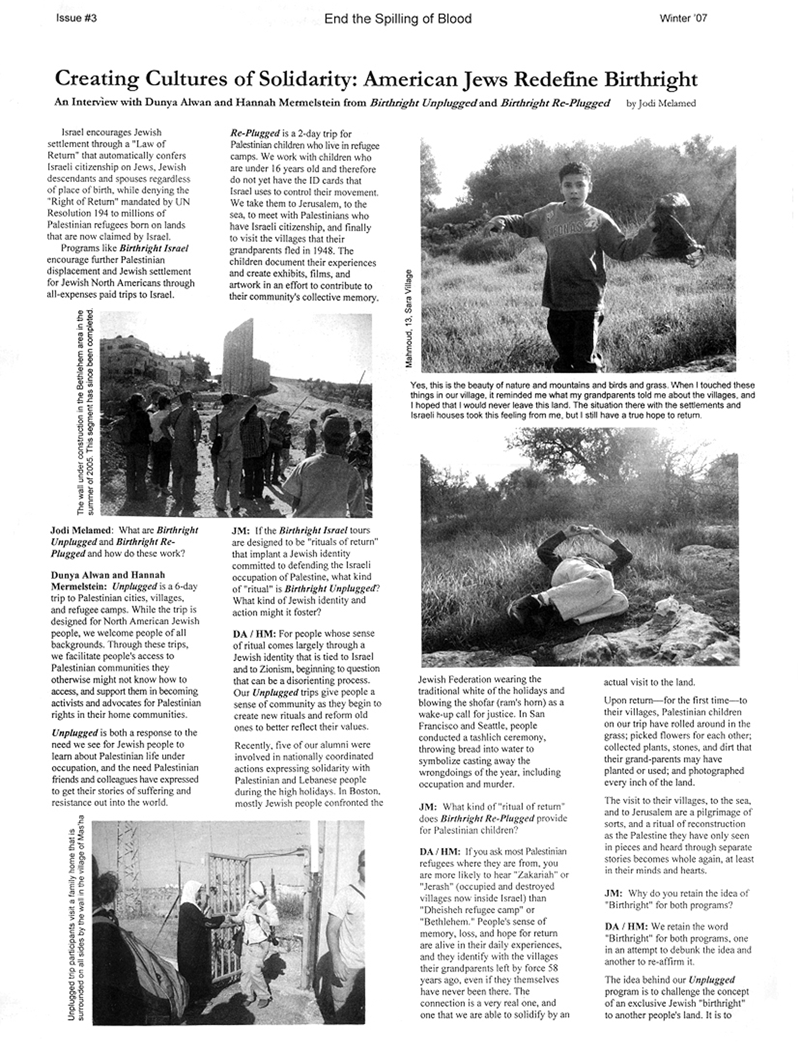
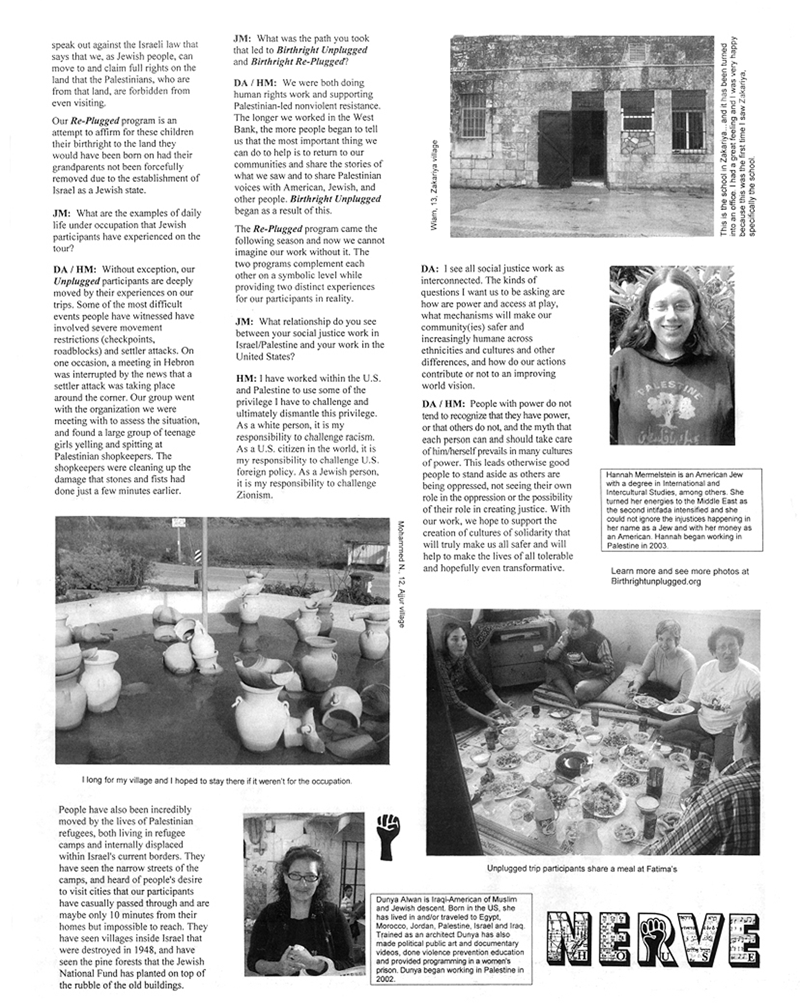
return to top
Creating Cultures of Solidarity: American Jews Redefine Birthright
An Interview with Dunya Alwan and Hannah Mermelstein from Birthright Unplugged
and Birthright Re-Plugged
Jodi Melamed | Nerve House | December 2006
Israel
encourages Jewish settlement through a "Law of Return" that
automatically confers Israeli citizenship on Jews, Jewish descendants
and spouses regardless of place of birth, while denying the "Right
of Return" mandated by UN Resolution 194 to millions of
Palestinian refugees born on lands that are now claimed by
Israel. Programs
like Birthright Israel encourage further Palestinian displacement
and
Jewish settlement for Jewish North Americans through all-expenses
paid
trips to Israel.
Jodi Melamed: What are Birthright Unplugged and Birthright Re-Plugged
and how do these work?
Dunya Alwan and Hannah Mermelstein: Unplugged is a 6-day trip to
Palestinian cities, villages, and refugee camps. While the trip is
designed for North
American Jewish people, we welcome people of all backgrounds. Through
these trips, we facilitate people's access to Palestinian communities
they otherwise
might not know how to access, and support them in becoming activists
and advocates for Palestinian rights in their home communities.
Unplugged is both a response to the need we see for Jewish people
to learn about Palestinian life under occupation, and the need Palestinian
friends
and colleagues have expressed to get their stories of suffering and
resistance out into the world.
Re-Plugged is a 2-day trip for Palestinian children who live in refugee
camps. We work with children who are under 16 years old and therefore
do not yet have the ID cards that Israel uses to control their
movement. We
take them to Jerusalem, to the sea, to meet with Palestinians who
have Israeli citizenship, and finally to visit the villages that
their grandparents
fled in 1948. The children document their experiences and create
exhibits, films, and artwork in an effort to contribute to their
community's collective
memory.
JM: If the Birthright Israel tours are designed
to be "rituals of
return" that implant a Jewish identity committed to defending the
Israeli occupation of Palestine, what kind of "ritual" is
Birthright Unplugged? What kind of Jewish identity and action might
it foster?
DA / HM: For people whose sense of ritual comes largely through a
Jewish identity that is tied to Israel and to Zionism, beginning
to question that
can be a disorienting process. Our Unplugged trips give people a
sense of community as they begin to create new rituals and reform
old ones to
better reflect their values.
Recently, five of our alumni were involved in nationally coordinated
actions expressing solidarity with Palestinian and Lebanese people
during the high
holidays. In Boston, mostly Jewish people confronted the Jewish Federation
wearing the traditional white of the holidays and blowing the shofar
(ram's horn) as a wake-up call for justice. In San Francisco and
Seattle, people
conducted a tashlich ceremony, throwing bread into water to symbolize
casting away the wrongdoings of the year, including occupation and
murder.
JM: What kind of "ritual of return" does
Birthright Re-Plugged provide for Palestinian children?
DA / HM: If you ask most Palestinian refugees where they are
from, you are more likely to hear "Zakariah" or "Jerash" (occupied
and destroyed villages now inside Israel) than "Dheisheh refugee camp" or "Bethlehem." People's
sense of memory, loss, and hope for return are alive in their
daily experiences, and they identify with the villages their
grandparents
left by force
58 years ago, even if they themselves have never been there.
The connection is a very real one, and one that we are able to
solidify
by an actual
visit
to the land.
Upon return—for the first time—to their villages,
Palestinian children on our trip have rolled around in the grass;
picked flowers
for each other; collected plants, stones, and dirt that their
grand-parents may have planted or used; and photographed every
inch of the land.
The visit to their villages, to the sea, and to Jerusalem are a pilgrimage
of sorts, and a ritual of reconstruction as the Palestine they have
only seen in pieces and heard through separate stories becomes whole
again,
at least in their minds and hearts.
JM: Why do you retain the idea of "Birthright" for
both programs?
DA / HM: We retain the word "Birthright" for both
programs, one in an attempt to debunk the idea and another
to re-affirm
it.
The idea behind our Unplugged program is to challenge the concept
of an exclusive Jewish "birthright" to another people's
land. It is to speak out against the Israeli law that says
that we, as Jewish
people,
can move to and claim full rights on the land that the Palestinians,
who are from that land, are forbidden from even visiting.
Our Re-Plugged program is an attempt to affirm for these children
their birthright to the land they would have been born on had their
grandparents
not been forcefully removed due to the establishment of Israel as
a Jewish state.
JM: What are the examples of daily life under occupation that Jewish
participants have experienced on the tour?
DA / HM: Without exception, our Unplugged participants are deeply
moved by their experiences on our trips. Some of the most difficult
events people
have witnessed have involved severe movement restrictions (checkpoints,
roadblocks) and settler attacks. On one occasion, a meeting in Hebron
was interrupted by the news that a settler attack was taking place
around the
corner. Our group went with the organization we were meeting with
to assess the situation, and found a large group of teenage girls
yelling and spitting
at Palestinian shopkeepers. The shopkeepers were cleaning up the
damage that stones and fists had done just a few minutes earlier.
People have also been incredibly moved by the lives of Palestinian
refugees, both living in refugee camps and internally displaced within
Israel's current
borders. They have seen the narrow streets of the camps, and heard
of people's desire to visit cities that our participants have casually
passed through
and are maybe only 10 minutes from their homes but impossible to
reach. They have seen villages inside Israel that were destroyed
in 1948, and
have seen the pine forests that the Jewish Nationacnbcl Fund has planted
on top of the rubble of the old buildings.
JM: What was the path you took that led to Birthright Unplugged and
Birthright Re-Plugged?
DA / HM: We were both doing human rights work and supporting Palestinian-led
nonviolent resistance. The longer we worked in the West Bank, the
more people began to tell us that the most important thing we can
do to help
is to return to our communities and share the stories of what we
saw and to share Palestinian voices with American, Jewish, and other
people. Birthright
Unplugged began as a result of this.
The Re-Plugged program came the following season and now we cannot
imagine our work without it. The two programs complement each
other on a symbolic
level while providing two distinct experiences for our
participants in reality.
JM: What relationship do you see between your social
justice work in Israel/Palestine and your work in the
United States?
HM: I have worked within the U.S. and Palestine to use
some of the privilege I have to challenge and ultimately
dismantle this privilege.
As a white
person, it is my responsibility to challenge racism.
As a U.S. citizen in the world, it is my responsibility
to challenge U.S. foreign policy.
As a Jewish person, it is my responsibility to challenge
Zionism.
DA: I see all social justice work as interconnected.
The kinds of questions I want us to be asking are how
are power and access at
play, what mechanisms
will make our community(ies) safer and increasingly humane
across ethnicities and cultures and other differences,
and how do our actions
contribute or
not to an improving world vision.
DA / HM: People with power do not tend to recognize that
they have power, or that others do not, and the myth
that each person can and
should take
care of him/herself prevails in many cultures of power.
This leads otherwise good people to stand aside as others
are being oppressed,
not seeing their
own role in the oppression or the possibility of their
role in creating justice. With our work, we hope to support
the creation of cultures
of solidarity that will truly make us all safer and will
help to make the
lives of all tolerable and hopefully even transformative.
......
Dunya
Alwan is Iraqi-American of Muslim and Jewish descent.
Born in the US, she
has lived
in and/or traveled to Egypt, Morocco, Jordan, Palestine,
Israel and Iraq. Trained as an architect Dunya has also
made political public
art and documentary
videos, done violence prevention education and provided
programming in a women's prison. Dunya began working
in Palestine in 2002.
Hannah Mermelstein is an American Jew with a degree in
International and Intercultural Studies, among others.
She turned her energies
to the Middle
East as the second intifada intensified and she could
not ignore the injustices happening in her name as a
Jew and with her money
as an American. Hannah
began working in Palestine in 2003.
return to top
Birthright Unplugged's Communiqué
September 29, 2006
Dear Birthright Unplugged Friends,
We are writing with feelings of both accomplishment and sorrow.
We’ve recently finished another successful season of Unplugged and
Re-Plugged trips, with record numbers and more variety of participants
than ever before. At the same time, the context for our work – the
situation in Palestine – gets progressively worse, and this summer
was particularly difficult for everyone in the region.
This season, we took about twenty people on our two six-day Unplugged
trips. This
is the largest group we have taken since we began last summer, while still
small enough to have meaningful conversations with our hosts. You
may remember the story of Sierra, who was uninvited from a Birthright Israel
trip because of her planned participation in a Birthright Unplugged trip. Despite
the efforts of Birthright Israel to prevent Sierra’s trip, we fundraised
for her and she was able to join us after all. Other members of this
summer’s trips included a rabbinical student, a college professor,
a journalist, a photographer, a retired physicist, and three people about
to lead a tour of Israel for more than a hundred teenagers from a Jewish
youth movement.
We arrived in early June to Palestine and an economy in which one third
of the workers had not been paid in four months and another third of
the population was deprived of the income they generally receive from
those
workers. Since the Palestinian elections in January, Israel has withheld
$500 million of Palestinian tax money owed to the Palestinian Authority,
and the United States has led the world in an embargo against the newly
elected government, affecting every sector of society. Since our
arrival in June, the four months have become almost eight. Some
people continue to work without pay while others, like the public school
teachers,
have gone on strike in the hopes of bringing about some positive change
in their lives.
Our first Unplugged trip began a few days after Israeli ships shelled
a beach in Gaza, killing almost an entire family. As always, we started
our program with an orientation and a panel of Israeli activists in Jerusalem. We
then set off into the West Bank and began immediately to hear Palestinians
tell stories of increased deprivation due to the economic situation,
more severe movement restrictions, and numerous stories of friends and
family
members held in Israeli prisons without charges.
Our group was in Khalil (Hebron), meeting with families severely affected
by settler violence, when we heard that an Israeli soldier had been captured
and taken to Gaza. As we traveled over the next few days, concern
over massive bombing in Gaza infused all of our meetings. We met
with Palestinian government officials, a family surrounded by the wall,
young women from a Palestinian girls’ group, and a nonviolent activist
who has been shot and paralyzed by the Israeli army. As all of these
people spoke with us, they also spoke of the broader context in which they
live. Many talked about their feelings of being actively and unjustly
isolated by the West and expressed their gratitude for our presence,
our listening, and our pledges to share their stories and concerns upon
return
to the United States.
While the news is ever present in our work, so is history. On the
last day of our second trip, we visited Miske, a Palestinian village largely
destroyed in 1948. Our Palestinian tour guides, who hold Israeli
citizenship and whose parents are from this village, are forbidden from
living on their families’ ancestral lands. As we walked on
the rubble of dozens of destroyed houses, our guides pointed out the remains
of the village mosque, two in tact school buildings, and newly planted
crops being farmed by Jewish Israelis. They told us of their efforts
to maintain the school grounds and regularly use the buildings for cultural
activities, and of the harassment they faced during these times. Two
weeks after our visit, the Israeli government demolished both school
buildings and planted trees in their place.
Our participants were incredibly moved by their experiences and the many
Palestinian people we met throughout the week. At the end of our
trip, we shared ideas with each other and made commitments for future involvement
with the issues we encountered. Already this summer’s participants
have given public talks, written articles, staffed our Re-Plugged trip,
and volunteered with Palestinian and Israeli organizations working for
justice. Five of our alumni are involved in nationally coordinated
activities with Jewish people in solidarity with the people of Palestine
and Lebanon during the current Jewish High Holiday season.
Having completed the successful first half of our summer’s work,
we moved on to our Re-Plugged trips. We had planned to take a group
of children from Balata refugee camp in Nablus to visit Jerusalem and the
sea, to stay in homes of Palestinians with Israeli citizenship, and to
spend time in the villages their grandparents fled in 1948. The week
before our planned trip, Nablus was invaded by the Israeli army and four
people from the camp were killed. Israel was bombing Lebanon and
Gaza, and Hizbollah was firing rockets into northern Israel. Parents
from the camp were too concerned to let their children travel at this
time, and together we decided to postpone the trip until the winter.
At the same time, we were asked by a Palestinian colleague to work with
the Tel Rumeida Project, another international organization, on a one-day
version of our Re-Plugged trip with the children of the Tel Rumeida neighborhood
of Khalil (Hebron). While not refugees like our other Re-Plugged
participants, these children and their families are struggling not to become
refugees. They live under constant attack by Israeli settlers living
in their neighborhood, are regularly stoned, beaten, spat on and yelled
at on their way to school, and are stopped and checked by Israeli soldiers
on every block of their neighborhood. During the school year families
brave this violence in order to send their children to school, but during
the summer there is very little programming for the children. This
Re-plugged trip was a way not only to provide programming, but to give
these children an opportunity they would not otherwise have to visit
Jerusalem and the sea.
Like last time, we took children under sixteen years old because they
do not yet have the ID cards that Israel uses to track and control their
movement. Unlike
last time, we traveled with over forty children and ten staff on a full-sized
bus. We worried that soldiers might stop us at the checkpoint between
Khalil and Jerusalem, and although we carried the children’s birth
certificates with us, proving they were under sixteen, we knew that we
could be held at the checkpoint for hours or even turned around on the
whim of a single soldier. Our bus driver, a Palestinian from Jerusalem
with an ID that allows him to be in the West Bank, Jerusalem and Israel,
had a yellow license plate. Also to his advantage were the Hebrew
writing on the side of the bus, two Americans sitting in front with him,
and an attitude of confidence as he approached the checkpoint. He
waved at the soldiers, did not slow down or pull over, and drove through,
settler-style, without being stopped. We continued to Jerusalem.
Although leading a group of forty excited children through the dense
bustling old city of Jerusalem is not an easy task, we managed to show
them the
city and their holy sites. For most of them, this was the first time
they had visited this renowned city less than an hour from their homes. After
lunch we continued to the sea, where the children could barely contain
their enthusiasm long enough to change into swimming clothes before diving
into the water. The kids collected shells and sand, jumped in the
waves, and were surprised at the saltiness of the water that they had never
tasted. One particularly talented boy caught a large fish and held
it in a bag of water for half an hour as he paraded it around the beach,
showing his friends and warning them not to touch the bag because the fish’s
scales were sharp and painful.
As we watched the children swim, we also watched airplanes and helicopters
fly overhead every few minutes. Sometimes the kids would look up
and point excitedly, probably not realizing that these were not commercial
flights, and certainly not noticing that the helicopters flying north
towards Lebanon were carrying bombs and those returning south were not.
After several hours of swimming, we gathered the still energetic kids
together and returned them to Khalil. We drove to the edge of their neighborhood
and walked them home past a series of checkpoints as only settlers are
allowed to drive in Tel Rumeida. A few days later we collected
the digital cameras we had given the older kids to document their trip
and
their neighborhood, and made CDs of photos for all the families that
we delivered to them the following week.
Three international groups asked us for advice on how to run similar
trips and we wrote an instruction manual for them and others to use. We
are encouraged by the thought that these groups might plan similar trips
soon, before the Wall, movement restrictions, and other barriers make
it impossible for yet another generation to take such trips. We
recognize the urgency of the situation as we remember our January trip
to Gaza
in which organization after organization told us that no, as much as
they
would like to send their childrn into Israel to visit holy sites in Jerusalem
and see their families’ land,
there was no way to get these children through Erez crossing.
As the Wall enters its final construction stages in the West Bank, Palestinians
constantly emphasize to us the importance both of bringing our Unplugged
groups in and taking our Re-Plugged groups out. There is a prevalent
and seemingly justified fear that the West Bank with its cantons is fast
becoming a series of contained ghettos like Gaza.
We are committed to honoring our friends’ requests to continue our
programming and plan to run Unplugged trips and Re-Plugged trips again
this winter. We are deeply grateful for your attention to and support
of this work, and hope that our efforts will contribute in some way to
justice.
Sincerely and with love,
Dunya and Hannah
return to top
Statement
by accepted trip participant Birthright Israel removed from trip
because she planned to travel to the West
Bank with Birthright Unplugged.
by Sierra | June 5, 2006
My name is Sierra. I signed up with Birthright Israel to learn about
my background and to develop a deeper understanding of my ancestry and heritage.
But I was
removed from Birthright Israel’s trip because of their opposition to
my planned tour with Birthright Unplugged, an educational group touring the
West
Bank.
I’m biracial and grew up in a multicultural environment at home with
my parents. My mom is African-American and my father is European-American Jewish.
I am sensitive to cultural conflict and my particular vantage point has shown
me through my life
and my community that building bridges across such conflict is possible.
I want to travel to Israel to learn about and increase my connection to Jewish
culture and religion. I was very much looking forward to this trip with Birthright
Israel. I was excited to take advantage of the fantastic opportunity provided
by Birthright Israel and committed to participating fully in all their activities
and learning from these experiences during their ten day tour. I also want
to learn about the Israeli/Palestinian conflict. I know that there's a human
rights issue going on in Israel/Palestine, a conflict with people suffering
on both sides. I don't want any organization or the media to tell me what to
think; I want
to see for myself and learn from differen perspectives. Participating in Birthright
Unplugged’s upcoming tour will provide me with this opportunity.
Israel/Palestine has always seemed like an inaccessible place to me, both because
of the historic violence and because of an almost otherworldly nature that
the region has due to its religious and spiritual importance. Over the past
few years I've had a couple close friends go and come back, and they've made
me realize that it's a real place; it has layers and is not only
accessible, but is a phenomenal region of the world. I was excited to partake
in my first trip and still hope that I can go.
Wednesday morning, May 31st, I received a phone call from Tel Aviv with Avi
Green, the director of Israel Outdoors, on the other line. Israel Outdoors
is the trip
organizer contracted by Birthright Israel for the trip that I joined. He called
me bearing “unfortunate news.” According to Mr. Green, it wasn’t
meant to be a value judgment on Birthright Unplugged, but I must be removed
from the pending Birthright Israel trip due to my anticipated participation
with the
Birthright Unplugged tour. When I asked if my removal was caused by an email
sent to Birthright Israel, informing them of my planned trip with Birthright
Unplugged, he said that he was not able to discuss that topic.
I asked him about the trip waiver form that I signed. It didn’t refer
to the West Bank or Birthright Unplugged; in fact it stated that the decision
to extend my plane ticket and participate in another program is mine:
“Furthermore, and without derogating from the above, you understand that
should you decide to extend your ticket and remain in Israel longer, or should
you participate in a program which goes beyond the days in which BRI participates
financially, the decision to do so is yours, and the said extension is in no
way part of the program for which any funding or assistance was provided by
BRI and/or by BRI Funders.”
Mr. Green said that Birthright Israel is a serious organization and mustn’t
be taken trivially. I continue to agree with him and my actions and intentions
are very serious. I
was excited and looking forward to learning about Israeli and Jewish culture
from Birthright Israel,
just as I am excited and looking forward to learning about the Palestinian and
Israeli conflict with Birthright
Unplugged. I simply want to learn about the conflict and learn about Israel.
I
do
not believe this is mutually exclusive or a reason to remove me from Birthright
Israel’s
trip. I hope
that I can continue my plans to participate with Birthright Unplugged’s
tour and fulfill my dream to learn about my Jewish ancestry and learn about
the Israeli/Palestinian conflict.
I was devastated to find out that Birthright Israel removed me from their
tour group. They misunderstood an e-mail that was sent to them, which included
my plans to travel with Birthright Israel and Birthright Unplugged. They made
their
decision without clarifying the information by asking me about it. I was committed
and excited to learn about Israel by participating in Birthright Israel's trip.
return to top
Birthright
Israel removes participant because she also planned to take an educational
trip to the West Bank with Birthright Unplugged
Birthright Unplugged Press Release | June 1, 2006
Birthright Israel removes participant because she also
planned to take an educational trip to the West Bank. On May 31, 2006,
one week before Sierra’s planned departure for Tel Aviv, she received
a call from Birthright Israel trip organizers telling her she was no
longer welcome on their free 10-day tour of Israel. The reason:
she planned to join the 6-day Birthright Unplugged trip through the West
Bank after the first trip was finished.
Sierra’s stated goal was to go to the region to learn from both Israelis
and Palestinians about the situation there.
Birthright Unplugged offers opportunities for mostly young Jewish North Americans
to meet Palestinians and learn about daily life under occupation. The
trip takes participants through Palestinian cities, villages, and refugee camps,
and organizes formal and informal meetings with a variety of Palestinians and
Israelis.
According to Birthright Unplugged co-founder Hannah Mermelstein, “We
started this program to put trip participants in conversation with Palestinian
civil society, to learn firsthand about the situation in Israel/Palestine,
and to use their knowledge to make positive change in the world. By denying
Sierra the opportunity to have this educational experience, Birthright Israel
is further proving the need for our existence.”
Since 2000, Birthright Israel has sent 100,000 Jewish people, ages 18-26, on
free trips to Israel. Participants are encouraged to extend their tickets
beyond the dates of their Birthright Israel trip, which is exactly what Sierra
intended to do. Apparently, any desire to meet Palestinians living under
occupation is reason to disqualify one from Birthright Israel’s trip.
Jewish individuals have already stepped forward and offered to contribute towards
the purchase of a plane ticket for Sierra in the hopes that she can still participate
in Birthright Unplugged and in order to send a message to Birthright Israel
that the quest for knowledge is a value held by many Jewish people.
“ Birthright Israel does not have a monopoly on Jewish people’s relationship
to Israel/Palestine,” said Mermelstein. “As hard as they try,
they will never be able to stop people from pursuing knowledge and breaking down
walls and barriers.”
WHAT CAN YOU DO?
1) Call Birthright Israel and tell them what you think about their attempt
to stop people from learning firsthand about the situation in Israel/Palestine.
Birthright Israel phone number: 888-99-ISRAEL (994-7723). Israel Outdoors program
(the specific program Sierra planned to go on): 800-566-4611.
2) Support Sierra to come on Birthright Unplugged. Now that she is not going
on a Birthright Israel trip, she needs to raise the money for a plane ticket
if she wants to join our Unplugged trip. We want to send a message to Birthright
Israel that they can't stop people from learning. Please contact us ASAP at
info@birthrightunplugged.org if you are interested in sending a donation to
help buy Sierra a plane ticket, and let us know how much you are able to give.
3) Donate to Birthright Unplugged to support our important work at a time like
this! As walls and barriers continue to go up, we are more committed than ever
to continue our work and cross those barriers. To send a tax-deductible donation
to Birthright Unplugged, please make checks out to the Gandhian Foundation,
with a notation in the memo line for "Birthright Unplugged", and send to Birthright
Unplugged, 18 Northview Drive, Glenside, PA 19038. (If you don't need a tax
deduction you are welcome to make checks out directly to Birthright Unplugged.)
Birthright Unplugged, info@birthrightunplugged.org.
return to top
Birthright Israel: Joining West Bank trip is grounds
for expulsion
Daphna Berman | Haaretz | June 6, 2006
U.S. college student bumped from program after signing up
for competing tour of Palestinian territories.
Taglit-birthright israel recently rescinded a participant's enrollment in the
program after learning that she planned to extend her trip to tour the Palestinian
areas in the West Bank.
Officials at birthright, which offers a free ten-day tour to young Jews from
abroad, told the participant that she was no longer welcome because she had also
signed up for Birthright Unplugged. The latter program is also aimed at young
American Jews, but instead of visiting Jewish Israeli sites it offers a six-day
tour of Palestinian cities, villages and refugee camps.
Representatives of birthright israel confirmed that the ban was part of a broader
policy to prevent participants from "exploiting" the free plane ticket
to further "non-Israeli or non-Jewish causes." Taglit-birthright israel
is funded mainly by Jewish philanthropists.
The participant, Sierra, has not released her last name but in a statement this
week the California college student said, "I simply want to learn about
the conflict and learn about Israel. I do not believe this is mutually exclusive
or a reason to remove me from birthright israel's trip."
Just this week, birthright israel's 100,000th participant arrived at Ben Gurion
airport. The organization expects to send 12,000 young Jews between the ages
of 18 and 26 to Israel this summer alone. Sierra, whose mother is African-American
and whose father is Jewish, was informed of the decision just a few days before
her scheduled departure date this week.
"It is not in our agenda to help people find programs that aim to strengthen
the claims of other ethnic groups," Gidi Mark, international director of
marketing of Taglit-birthright israel said. "We have tens of thousands of
people on our waiting lists."
"Our goals are to strengthen the participants' Jewish identity, strengthen
the participants' connection to Israel, and strengthen their connection to their
Jewish communities," Mark added. "Birthright Unplugged is not connected
to any of these goals. We refuse to participate with people who want to exploit
us to get access to the territories."
While Mark was not familiar with Sierra's case he confirmed that expulsion in
such circumstances was part of the organization's policy.
He said Taglit-birthright israel is considering legal action against Birthright
Unplugged for its use of his organization's name.
According to its website, Birthright Unplugged "rejects the notion of a
'birthright,' as embodied in Jewish-only fully-funded trips to
Israel."
Sierra is now trying to raise money to participate in Birthright Unplugged. "I
know that there's a human rights issue going on in Israel/Palestine, a conflict
with people suffering on both sides," she also said in her statement. "I
don't want any organization or the media to tell me what to think; I want to
see for myself and learn from different perspectives."
According to Mark, only a dozen or so of prospective birthright israel participants,
out of a total of 100,000, have been expelled after program officials learned
that they intended to tour or volunteer in the West Bank after the Taglit trip.
Mark says he knows of just five birthright alumni who went on the program with
firm plans to spend time in the Palestinian territories immediately afterwards.
According to officials at Birthright Unplugged, however, seven people - one-third
of those who have attended the program - joined soon after completing birthright
israel.
Birthright Unplugged discourages participants from advertise their intentions. "We
know that certain Israel programs try to filter out people who might be visiting
the Palestinian Territories or spending time with Palestinians even after their
trip is over," group organizers warn on the website. "Again, the decision
of how much to tell your program leaders is a personal one, and we are more than
willing to have in depth discussions with you about your own case."
Birthright Unplugged co-founder Hannah Mermelstein slammed birthright's decision
to eject Sierra. "Birthright Israel does not have a monopoly on the Jewish
people's relationship to Israel/Palestine," she said. "As hard as they
try, they will never be able to stop people from pursuing knowledge and breaking
down walls and barriers."
return to top
Crossing the Green Line: Birthright nixes woman with West Bank plans
Chanan Tigay | JTA | New York | June 6, 2006
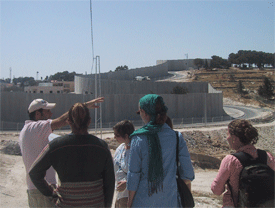
A Birthright Unplugged tour views Israel’s
security barrier.
This week, the birthright
israel program is celebrating the 100,000th participant on its free,
10-day trips to Israel. But one person who’d hoped to be among the thousands
of young Jewish adults joining this summer’s festivities won’t
be.
That’s because the woman, a 26-year-old resident of California,
was dropped from the program last week when birthright officials
learned that after participating
in their program, she planned to join another group in a trip through the
Palestinian territories.
Birthright is standing unapologetically behind its decision on the woman,
Sierra, who has denied interview requests and asked that her last name not
be used.
Its program is meant to build Jewish identity, officials say, and if
participants are using the trip for other purposes, birthright reserves
the right to turn
them away.
But a co-founder of Birthright Unplugged — the name of the program in the
Palestinian territories, a clear dig at the birthright israel brand — says
that by denying Sierra a ticket to Israel, birthright simply confirms the
need for alternative programs.
But while Birthright Unplugged launched a campaign to call attention to the
incident, here’s the kicker: birthright learned about the woman’s plans from
her mother, who — apparently out of concern for her daughter’s safety
in the Mideast — forwarded them an e-mail in which her daughter details
her itinerary and explains that if birthright israel learned of her plans,
she would be dropped from its upcoming trip.
The spat highlights some complex questions with which birthright must contend:
how to keep out those it does not see as its target audience while remaining
open enough to meet its goals; and whether or not keeping out people like
Sierra, who was seeking to explore the political issues in Israel as well
as her Jewish
identity, is the most effective way of furthering the program’s goals.
Since birthright’s goal is to bring as many young Jewish adults to
Israel as money will allow, as few applicants as possible are turned away,
officials
say.
This means that some who aren’t birthright’s target audience can
slip through the cracks, including non-Jews and those who have previously taken
part in a peer trip to Israel. Had birthright not been contacted by this young
woman’s mother, its officials say, they’d never have known of
her plans.
“This is the best possible policy that we decided to endorse, bearing in
mind the need to be loyal to our partners and the goals that they set for us,” said
Gideon Mark, national director of marketing for the birthright israel program.
These goals, he said, include strengthening participants’ Jewish identities,
their relationship with the State of Israel and Jewish solidarity worldwide.
Of Birthright Unplugged, he said: “Theirs is a tiny organization which
tries to build on a very successful brand, taking part of its name, trying
to teach potential participants in Taglit-birthright israel how to go to
meet with
Palestinians with a generous gift funded by the Jewish people. And when Taglit-birthright
israel does not cooperate, then they go to the public and complain.”
But Birthright Unplugged — which says it has hosted just more than 20 young
Jews on its programs since its first trip last summer, and expects to bring an
additional 15 or 16 this summer — denies the charge.
“We started this program to put trip participants in conversation with
Palestinian civil society, to learn firsthand about the situation in
Israel/Palestine,
and to use their knowledge to make positive change in the world,” said
Hannah Mermelstein, co-founder of Unplugged.
“By denying Sierra the opportunity to have this educational experience,
birthright israel is further proving the need for our existence.”
Birthright Unplugged takes young Jewish adults through the West Bank to “try
to get people to understand what it means to live under occupation,” Mermelstein
said. Some of those who’ve taken part in Unplugged have previously
been on birthright israel trips, she added; others have taken part while
on their
year abroad in college, or while visiting Israel with their families.
The program also takes young Palestinians living in refugee camps to their
ancestral homes in Israel.
The group’s name, Mermelstein acknowledged, is a reference to birthright
israel, but also refers to something larger.
“We are against this concept of a Jewish birthright to this place,” said
the Boston-based Mermelstein.
“We’re not afraid of people going on birthright israel, seeing what
they have to say and then coming and seeing what we’re showing them on
our trip,” she said. “It seems like birthright israel is afraid of
having people see things that would put into question the perspective they’re
trying to give their participants, or provide information that isn’t
controlled by birthright israel.”
The group is funded largely by private donations from American Jews, Mermelstein
said, and recently received a grant from the Sparkplug Foundation, which
funds startup projects and innovations in music, education and community
organizing.
Birthright israel officials say that its programs are not political, and
that it employs no ideological litmus test for participants. When politics
are discussed,
they say, its bent has to do with individual tour guides rather than with
any official birthright policy.
Other programs in Israel explore political issues with their participants.
The Bronfman Youth Fellowships in Israel, for example, runs an entire “political
week” as part of its five-week programs, during which participants
meet with political leaders from the right and the left; Palestinians and
Israelis;
Arab and Jewish members of the Knesset.
“We try to have not too far right and not too far left, because it gets
a little crazy and nonrepresentative,” said Rabbi Shimon Felix, the program’s
executive director.
Still, Felix said, if his program were just 10 days, like birthright, rather
than five weeks, “I probably would not do the politics.”
“It would be doing a disservice to the issues to squeeze that into a half
day of a 10-day trip,” he said.
At least several birthright participants have gone on from the program to
work with the pro-Palestinian International Solidarity Movement in the territories.
Birthright did not know in advance of their plans. Although birthright participants
are interviewed before they’re granted a spot, there is no uniform
roster of questions, and information about post-trip plans is not always
solicited,
officials said.Bronfman fellows have landed in the Palestinian territories
following the program, Felix said. But as for how the program would respond
if it knew
in advance
that a potential participant was planning to head to the territories, he
said, “We
would have to think long and hard about it. We don’t have a policy.
I don’t
think it’s ever come up.”
For her part, Sierra, the child of an African-American mother and a Jewish
father, said she had planned to take part fully in both programs in hopes
of learning
about “a conflict with people suffering on both sides.”
“I simply want to learn about the conflict and learn about Israel,” she
said in a statement passed on to JTA by Mermelstein. “I do not believe
this is mutually exclusive or a reason to remove me from birthright israel’s
trip. I hope that I can continue my plans to participate with Birthright Unplugged’s
tour and fulfill my dream to learn about my Jewish ancestry and learn about
the Israeli-Palestinian conflict.”
Birthright Unplugged has launched a campaign among its supporters to fund
a new ticket so that Sierra can still fly to the Middle East this summer.
return to top
Come, See Palestine! Upstart tours of
Palestine are challenging fully paid "See Israel" holidays
in a battle for the hearts and minds of young American Jews
Rachel Shabi | salon.com | June 5, 2006

A Palestinian child puts a flag in the controversial security wall in the
West Bank town of Qalqiliya.
The fight is on for the hearts of young Jewish Americans.
The battlefield is Israel and Palestine. It's a hopelessly unequal battle --
one side has considerably
more clout and cash and, currently, appeal. But this struggle hits the core
of what it means to be an American Jew in a modern political context.
This summer, record numbers of young Jewish Americans will travel to Israel
-- despite concern over security. Most of them will arrive courtesy of pro-Israel organizations that seek to
reconnect Diaspora Jews to Judaism and Israel. They will be on a free
tour of the Jewish state, presented to them as a gift, their "birthright."
But others will travel with Palestine solidarity campaigners who hold
that being both American and Jewish (as are nearly 6 million U.S. citizens)
brings with it a responsibility to at the very least understand the Palestinian
position. They'll visit the West Bank and witness firsthand the effects
of the occupation in Palestine. These latter tours are still in infancy
but word about them is rapidly spreading through American campuses and
Jewish networks. So, two camps with diametrically opposed intentions
are targeting exactly the same audience of young American Jewry. And
the cutting-edge cool tool on both sides of the terrain is a holiday.
Well, of sorts.
The context is about six years old. Having identified Diaspora Jews as
being hopelessly lapsed and in danger of intermarrying into extinction,
two New Yorkers, Michael Steinhardt and Charles Bronfman, founded Taglit-birthright
israel. Billionaire Bronfman inherited the Canadian Seagram's liquor
empire while Steinhardt made a small fortune as a Wall Street wizard.
The latter, a self-proclaimed atheist, is nonetheless worried that Judaism
is in danger of becoming obsolete. Both feature high up on a list of
Israel's most generous philanthropists.
"
The vision is to ensure the continued existence of the Jewish people
because of the very high rate of assimilation," says Gidi Mark,
Taglit's director of marketing. He admits that what might appear to be
a severe stance against multiculturalism is a "bold and ambitious
plan." But he believes it has "changed dramatically the attitude
of Jewish young adults to Israel." Taglit offers Diaspora Jews between
the ages of 18 and 26 a free, 10-day tour of Israel, their "birthright" or "homeland" country,
courtesy of the Israeli government, United Jewish Communities and private
philanthropists. Since 2000, Taglit has taken 100,000 young Jews, 75
percent of whom are North American, to Israel. That's an impressive figure,
although one Israeli academic has noted that young American Jews might
equally be interested in a free trip to the Bahamas.
But the Taglit organization is indeed a success story. Prior to it, around
1,500 Jews of the same cohort would come to the country each year. Now
around 22,000 visit Israel annually on Taglit trips; places fill up rapidly
and waiting lists are at bursting point. And these trips achieve what
they set out to do. They are, says Mark, "the most effective Jewish
educational project in the world." That's measured by polls that
question former birthrighters on their feelings of connection to the
Israeli state; those strong feelings don't diminish even six years after
Taglit trips.
Birthright trips to Israel are many-flavored -- there are trek-focused,
religious, secular or graduate and professional varieties. It's a packed
schedule, socializing is a key component and sleep-deprivation is a given.
Traveling in groups of 40 in security-escorted buses, birthrighters might
take in the Dead Sea, Tel Aviv nightlife, a trip to Masada or a kibbutz
visit. But the essentials are the same. All trips in some way cover modern
Israel, Zionism and the Holocaust; all have Israeli escorts. And absolutely
non-negotiable is a visit to the Wailing Wall in Jerusalem -- the remains
of the second Jewish temple and therefore the holy of holies for Judaism.
Posters to the Taglit Web site enthuse about the birthright trip as a
life-changing experience that showed them the "gift of being Jewish" and
led them to conclude, as one trip alumini writes, "Wherever I stand,
I stand with Israel." They speak of the emotional charge and the
effects on young Americans just beginning to define their own identity;
for many, it is their first trip abroad.
But some former birthrighters say that there's no such thing as a free
holiday. They question whether Taglit may be pushing them a little too
hard to have a profound experience, particularly at the Wailing Wall. "Our
tour leader got everyone to close their eyes and put their hands on the
shoulders of the person in front of them," says one tripper. "He
walked us all in a line to a spot where we could get a high-up view of
the wall. Then he said something like, 'Your ancestors were praying towards
this wall for generations.' And you open your eyes and there it is ...
and there are tears streaming down everyone's faces."
One 25-year-old graduate student from Chicago describes the last day
of the trip, on a Tel Aviv beach. "It's a really hot day and one
guy from our trip runs into the water, and the sea's beautiful, at a
perfect temperature for swimming and he says, 'OK, OK, I'm a Zionist!'
It's facetiously said, but also ironic because that's exactly what [tour
leaders] want." This graduate is still with the young Jewish woman
he met while on the trip last summer. The matchmaking element is a key
component of birthright trips, say past participants. After all, the
idea is to stem the assimilation tendencies of Diaspora Jews.
What worries critics, however, is not the "I love being Jewish" outcome
of a trip to Israel but the underpinning political goals of Taglit. Susan,
a 27-year-old Seattle student, took the Taglit tour last year. She was
struck, she says, by "the levels of Zionism" and the prevalence
of anti-Palestinian comments during her trip, organized through the University
of Washington (campuses often coordinate birthright trips). She didn't
like the tour leader expressing his view as universal truth while leaving
out facts that supported the Palestinian side.
The Taglit tour might encourage tears at the Wailing Wall, but the 8-meter-high,
concrete separation wall snaking through the West Bank is rarely mentioned.
When it is, says Susan, the context is dismissive. "At one point
I saw what looked like the [separation] wall in the distance and asked
our guide about it," she says. "The guide gave a very terse
response about how, yes, that was the wall and, see everyone, the Palestinians
are trying to drive 'us' from 'our land' and so we must keep 'them' out." Taglit
trips do not go beyond the Green Line marking the internationally recognized
border between Israel and Palestine. According to one former birthrighter,
the Green Line was not even marked on the map he was given on the tour.
The Taglit trip, one former participant says, does a good job of "tugging
at one's Jewish heartstrings," and then seeks to equate being Jewish
with the need for Israel to "protect us and all the Jews." According
to Susan, her attempts to redress the pro-Israel slant were not welcome.
Group discussions were zealously facilitated and stuck to a narrow script
that excluded any conversations about how participants felt about Israeli
policy.
Aaron took the trip in December 2004 when he was 22; he's now back in
Canada where he lives and works in community radio. He believes Taglit
aims to encourage pro-Israel activism overseas. His trip leaders, he
says, "kept emphasizing how much we could do to help on campus at
universities." He adds: "This point was driven a lot: that
Israel is suffering from constant insecurity and a state of war against
them, and the way we can prevent that is to try and promote Israel's
good image back home."
Taglit bats off any accusations of having a political agenda. "I
don't think it's political for Jews to support Israel," says Mark. "It
should be an integral part of every Jew's identity." Mark draws
a distinction between supporting Israel and supporting Israel's policies.
He adds that Taglit trips incorporate organizers and speakers from a
variety of backgrounds and viewpoints. As to why Taglit trips don't go
to the West Bank, he first cites the security issue and then says, "We
feel that people first of all should feel strong about their own identity
and then know about other ethnic groups."
For those who want a different experience of the region, there's now
an altogether different sort of trip on offer. Last year, around 30 young
Jewish Americans took the first Birthright Unplugged trips to the West
Bank. "It changed my world," says Jessy Tolkan, 26, a political
consultant from Washington, D.C., who was on one of the Unplugged trips
last year. "Everything I had learned as a Jewish person prior to
the trip was turned totally upside down."
If Taglit trips gloss over the Palestinian experience, Unplugged trips
live it. Traveling on Palestinian transport and staying in Palestinian
homes, participants experience for themselves the difficulties of life
under occupation. "We are offering an opportunity for Jewish people
to be exposed to a narrative and life experience that they would rarely
encounter," says Hanna
Mermelstein, an American Jew who co-founded the project with Dunya Alwan,
an American-Iraqi of Muslim and Jewish descent. Both are members of the
International Women's Peace Service, which supports the nonviolent Palestinian
struggle against the Israeli occupation. An architect by training, Alwan
became involved in social justice work prior to the first Gulf War, and
by 2002 was engaged in human rights and education work in Palestine.
Mermelstein has a degree in international and intercultural studies,
women's studies, and peace studies; she turned her energies to the Israel-Palestine
conflict during the second intifada.
The two women met in Palestine in 2003. They both led various international
delegations in the West Bank. As a result of those experiences, they
identified a need to set up opportunities for Jews who cannot otherwise
visit the area or are simply too afraid to. The conflict in Israel and
Palestine has many distortions, one of which is the perception that Jews
are not welcome in the territories. "We planned the itinerary with
Palestinians and asked them, 'Look, do you want American Jews to come
here?' They said, 'Yes, these are exactly the people we want to come
to our communities.'"
Starting with an orientation meeting in Jerusalem, Unplugged goes to
Bethlehem and nearby Deheishe refugee camp, Hebron, Ramallah, the northern
region of Salfit, and finally a destroyed Palestinian village on the
Israel side of the Green Line. (The trips cost $350 excluding travel
to Israel.) "Mostly, it just takes you to places and you see things
with your own eyes, things that are self-evident and require no explanation
whatsoever," says one former Unplugged participant. It's enough,
he adds, just to see the effect of the separation wall and countless
checkpoints on daily Palestinian life. Many Unplugged participants take
the trip directly after a Taglit tour of Israel and recommend doing so.
Of course, at this point, with less than 100 participants, the Unplugged
Tour's impact on young Jews is only a footstep compared to the stampede
of the established Taglit tour.
To Taglit leaders, the birthright trips have had some unwanted consequences.
Some participants have used the trips to either "birthleft" or "desert," as
they put it. Trippers ranging from a handful to hundreds, depending on
whom you ask, have crossed the Green Line into the Occupied Territories
after the Israel trip, to work with the International Solidarity Movement.
This organization defines itself as "a Palestinian organization
committed to resisting the Israeli occupation of Palestinian land using
non-violent, direct-action methods and principles." ISM delivers
food and medicine to houses under curfew, supporting demonstrations --
currently against the separation wall -- and documenting violations of
human rights. In March 2003, an American activist with ISM was killed
by an Israeli bulldozer while trying to protect a home from demolition
in the Gaza strip. The Israeli government accuses it of supporting terrorism
and often refuses entry to its volunteers.
Jacob Rosenblum, a 22-year-old from Portland, Ore., traveled with Taglit
in 2004. "I wasn't there for the birthright trip," he says. "It
was just my vehicle to get to Israel and Palestine. After the trip, he
participated in ISM training and volunteered in Nablus, Tulkarem and
Qalqilya. Similarly, says Aaron, the Canadian radio worker, "My
plan all along was to spend two months in the West Bank with the ISM." While
in the West Bank, he tried "to do as much independent radio journalism
as possible," while also involved with "general ISM things
like accompanying farmers who face settler harassment and delivering
bread and medicine to people under curfew." Lora Gordon, 24, from
Chicago, didn't plan on taking such a course of action after her Taglit
trip in 2002. But she ended up spending 10 months working with ISM in
the then heavily invaded Gaza strip, engaging in media work, staying
with families whose homes were threatened with demolition, and teaching
English to high school students.
Taglit is not too thrilled with these developments, mainly because it
funds the ISM volunteers' travel to Israel. "It is taking advantage
of the Jewish money that sends people to Israel, exploiting this money
to promote an agenda which is not the agenda of the people who funded
Taglit," says Mark. Potential candidates who are discovered to have
a "hidden agenda" are not allowed onto the trips.
But "birthlefters" have no qualms over misused money. They
say the idea of a blanket Jewish birthright to Israel is fundamentally
flawed, given that countless Diaspora Palestinians are accorded no such
right. "Billions of dollars are used to give free trips to American
kids and if the Israel government funds it then that comes through the
U.S., people's tax dollars," says Gordon. She sees anti-occupation
work as a good use of that money. Others point out that in the P.R. battle
between pro-Israelis and pro-Palestinians, the former has huge resources
while the latter "has to do bake sales to fund our next event." Moreover,
says Gordon, "If Birthright is going to weed people out according
to politics, then it's not really about Judaism anymore." And yet
this emerging dynamic, between Birthright and those who seek to counter
it or provide alternatives, is precisely about Judaism. It
comes up time and again when speaking to birthlefters who say that, prior
to visiting the region, they felt unable to find a voice in the Israel-Palestine
conflict. Raised on Jewish Sunday school and years of Jewish summer camp,
Jessy Tolkan says, "I purposefully stayed away from the Israel-Palestine
argument, unable to reconcile myself with being a pro-Israeli Jew and
also a left-wing person." After seeing the situation on the ground
in Palestine, she says she felt "sad and angry that I had been lied
to by the Jewish community that I was and continue to be proud of." Until
that point, she says, she had been "using a different framework
to view the Israel-Palestine conflict that I use to view everything else
in the world."
Many of those who traveled in both regions say they left with a deeper
connection to Judaism, challenging one very sacred cow: that a loyal
relationship to Israel is fundamentally a part of Jewish identity. Gordon
speaks of discovering the "joyful way of being Jewish, that Shabbat
can mean dancing on the roof and singing songs and having a wonderful
communal meal and then having a day working on your inner self." Jacob
Rosenblum says he returned from Israel and the territories more committed
to Judaism and engaged with more moderate Jewish political groups. "I
got really into claiming Judaism as my own and finding the religious
parts and practice that really speak to me as a political activist," he
says.
return to top
An Expedition into the Occupied Palestinian Territories
Thorsten Schmitz | Suddeutsche Zeitung (A German Daily Newspaper) | April 24, 2006
Download the PDF

return to top
Flap over young Jews' visits to Holy Land
After free trips to Israel, some activists stay on in the Middle East - to work for the Palestinian cause.
Matt Bradley | Correspondent of The Christian Science Monitor | March 9, 2006

HOLY
LAND VISITOR:
Jessica, an American Jew, at a protest of Israeli policies
toward Palestinians in 2004.
About 10,000 young Jews from 29 countries
will enjoy a generous gift this winter: a vacation to Israel - with the
Israeli government and Jewish philanthropies picking up the tab for transportation,
food, and lodging.
Those who fund the trips say the opportunity to experience Israel is the birthright
of every Jew. But to donors' chagrin, handfuls of young activists have used the
trips in recent years to volunteer for pro-Palestinian organizations in the West
Bank - some of which directly oppose the Israeli government and Zionist ideology.
The small movement has some in the Jewish community wondering whether the Taglit-birthright
Israel program is being hijacked. But as the Holocaust shifts from memory to
history, it also points to efforts of young diasporal Jews to define their own
ideologies, symbols, and institutions within a religious tradition that has long
been at the forefront of social change. "They have the right to explore" all
sides of the Palestinian-Israeli
conflict, but not using the money given "to explore certain values," says
Allyson Taylor, with the American Jewish Congress's Western Region.
"You
have the right to buy a movie ticket, but do you sneak into another theater to
see a different movie?" While some
American Jews say the issue is much ado about nothing, others see a premeditated
attempt to defraud the Israeli government and Zionist advocacy groups.
Some young Jewish leftists, meanwhile, say volunteering in the occupied
territories is in keeping with the goals of Taglit-birthright Israel:
It is an essential part of their Israel experience.
"For me, being a Jewish person means supporting social justice. For me,
being Jewish doesn't mean supporting Israel," says Jessica, who traveled
to Israel with Shorashim, a Birthright travel organizer, during the summer of
2004. "The lessons of the Holocaust and the lessons of Jewish history mean
we need to stand up for people's rights. Otherwise, who's going to stand up for
us?" Jessica asked that her last name not be used so as not to jeopardize
her work on behalf of Palestinians.
Since Taglit-birthright Israel's inception in 1999, it has provided 10-day trips
for some 88,000 young people - any Jew aged 18 to 26 who has never been to Israel
with a guided group. The goal, say organizers, is to strengthen the commitment
of a new generation of Jews to the world's only Jewish state. As for the number
who volunteer for pro-Palestinian activist organizations while abroad, some say
only half a dozen while others cite growing ranks of activists trained to exploit
the program's generosity.
Taglit-birthright Israel declined to comment for this article.
Among pro-Palestinian organizations aided by non-Israeli Jewish activists - including
an unknown number of former Taglit-birthright volunteers - is the International
Solidarity Movement (ISM). The organization, according to its website, is "committed
to resisting the Israeli occupation of Palestinian land using nonviolent, direct-action
methods and principles." The Israeli government, though, accuses it of supporting
terrorism. Since the group's founding in 2001, several activists have been killed
or injured while participating in ISM protests and nonviolent resistance efforts.
"If you go to an organization like ISM, which clearly advocates suicide
bombers and things like that, I would say it's not a very honest way of using
this program," says Meir Shlomo, Israel's consul general to New England.
ISM advocates an end to Israel's occupation of Palestinian territories, says
cofounder Huwaida Arraf. But members deny that ISM endorses violence or supports
political terror. Beyond that, says Ms. Arraf, ISM does not specifically encourage
its Jewish volunteers, which she estimates make up about 25 percent of the group's
staff, to travel for free via Taglit-birthright.
"Birthright Israel does nothing to expose these students to the occupation
that the Palestinians are living through," says Arraf. "To ... take
the initiative to see more than what the Birthright organizers want them to see
- we guarantee their lives will be changed."
Last summer, this reaction to the Taglit-birthright program became more institutionalized.
Birthright Unplugged, a group that gives guided tours of the West Bank, offers "an
educational project that primarily seeks to expose young Jewish people to the
realities of Palestinian life under occupation," its website states. By
design, the six-day Unplugged tours coincide with Taglit-birthright Israel's
programs. Geographically, chronologically, and ideologically, Birthright Unplugged
picks up where Taglit-birthright leaves off.
Last year Taglit-birthright Israel filed a "cease and desist" complaint
for trademark infringement against Birthright Unplugged and charged it with "unfair
competition." A lawsuit is pending.
For the many Taglit-birthright participants who don't volunteer in the West Bank,
their peers' actions can elicit feelings of betrayal. Catherine Heffernan, a
Birthright participant who attended Shorashim with Jessica in 2004, felt outraged. "Whatever
respect I ever had for you and your beliefs is gone," she fired off in an
e-mail last summer after learning how Jessica had spent her remaining time in
Israel.
But even Ms. Heffernan, who considers herself a "peaceful Zionist," says
Judaism is what has informed Jessica's misguided struggle for social justice. "Jessica
... [has] a desire to see justice done in the region, and that is something [she
has] learned through [her] Judaism," says Heffernan. "It seems that
it is very politically savvy to be anti-Israel, and Israel has a lot of problems.
I don't think that should mean joining an organization that hurts Israel."
return to top
Birthright Unplugged's March 2006 Communiqué
Dear Birthright Unplugged friends and supporters,
We are writing to you because we have successfully completed our second season
of Birthright Unplugged trips!
This winter we again took two groups of mostly young, Jewish North American
people on 6-day trips into the West Bank, in order for them to have a firsthand
experience
of Palestinian daily life under occupation. This is our Unplugged trip. We
are also proud to let you know about our Re-plugged trip, a new program that
we began this winter, in which we take children from Palestinian refugee
camps on two-day trips to Jerusalem and their holy sites, to the sea, to
stay with
Palestinian citizens of Israel, and to visit the villages that their grandparents
fled in 1948. The children documented
their trips with digital cameras and audio recorders, and the experience
culminated in a celebration and exhibit in Dheisheh refugee camp.
Without exception, the Jewish North American participants on our Unplugged
trips continue to be deeply moved by their experiences. Most have told
us that it has been a life-changing journey and even a turning point for them.
One
of the most wrenching sights we witnessed was a rural Palestinian family completely
surrounded by Israeli walls and fences. Our participants were also
profoundly affected by seeing settler attacks perpetrated by teenage girls
against Palestinian shop-owners, neighborhood residents, and human rights
workers.
The program for each Unplugged group was similar, but as always, the functioning
of the occupation and the composition of the groups provided for distinct
experiences. This
was reflected in the groups’ daily discussions as well as in our closing
dinner, during which the participants evaluated the program and thought about
how to engage in the future with the issues
they
encountered over the week. Participants’ commitments for the
coming months include: inviting a speaker from our trip to give a talk at
a university in Israel; hosting house parties, film screenings, photography
exhibits,
concerts,
and Shabbat dinners related to Palestine; developing a fund for Jewish people
to support Palestinian organizations; integrating new knowledge into Sunday
school curricula at synagogues; doing outreach and media interviews for Birthright
Unplugged;
being present where tough questions about
Israel/Palestine need to be asked and asking them; getting involved in
community groups at home; and continuing to learn about the issues brought
up during the trip.
Our Re-plugged trips with children living in a West Bank refugee camp complement
our Unplugged trips described above. As Jewish people, the participants
on our Unplugged trips have an open invitation by the Israeli government
to move to a nation that has been superimposed on the lands of displaced
people. These displaced people, Palestinian refugees, are
denied their internationally recognized right to return to their land. Strict
movement restrictions require Palestinians to obtain permits for themselves
and their cars if they want to move from place to place. Most Palestinian
people do not have these permits and are unable to enter Israel, which for
refugees means they cannot even visit the villages they were expelled from
in 1948. Israel controls Palestinian movement through the ID card system,
which begins at age 16 for Palestinian people. Until that age, children
are able to move with fewer constraints, but rarely do because their parents,
grandparents, and older siblings are unable to do so. This is where
we come in. As internationals with foreign passports, we can move with
relative freedom, and we can escort the children our of their refugee camp
in the
West Bank, through checkpoints, and to the places they always talk about
but are rarely able to visit.
We ran two Re-plugged trips, one for 8 girls and one for 8 boys. Some
of the most moving experiences we had with the children included their first
sight of the sea, discovering their ancestral villages and connecting with
the land, and seeing their community come together to share and celebrate
during the exhibit.
You can see the children's photo exhibition at:
www.birthrightunplugged.org/replugged/exhibits/life-within-two-days, and our photos of their journey
at:
www.birthrightunplugged.org/replugged/photos.
The girls’ trip was first, and we had not emphasized the importance
of bringing towels and changes of clothing. When we arrived at the
sea, the girls ran straight into the water, despite the mid-January weather. They
played, danced, and ran around for an hour or two, and came out of the
water soaking wet. At this point, they realized they would have to
share towels, and many of the girls had to wear pajamas for the rest of
the day, not having any dry clothes.
The host families they met later, through the Yaffa-based Palestinian organization
Al-Rabita, took good care of them and their wet clothes. Many of
the children do not know Palestinian people who live inside Israel, and
vice versa, since Israeli travel restrictions prevent West Bank Palestinians
from entering Israel and Israeli citizens from entering Areas “A” (or
urban centers) of the West Bank and Gaza Strip. The experience was
moving for both parties, and the kids invited their host families to the
exhibit in Dheisheh two weeks later.
Most profound for all the children was experiencing the villages they have
heard their grandparents talk about since they were born. The boys
ran around picking flowers and plants for each other, rolling around on
the land, and kissing the earth they have never touched before. The
girls dressed in traditional embroidered dresses in preparation for the
visit. In one village, they climbed the minaret of the mosque that
still stands amidst a newly built Jewish Israeli community, its prayer
space now filled with trash. In another village, they ran up a hillside
to find the remains of their grandparents’ houses, old water wells,
and olive and fig trees probably planted by their ancestors. Their
exuberance at discovering these things turned into a kind of hysteria as
they laughed and screamed,
and then decided they wanted to stay and sleep on the land, refusing to
leave.
We finally boarded the van to return to the camp, the girls still angry
and upset about what they had seen and having to be pulled away from it. Our
driver, Rimon, tried to appease the girls with, “Next time we’ll
stay longer.” Twelve-year-old Lana responded: “There
is no next time. You know that, and we know that. We’re
going back to Dheisheh now and we will die in Dheisheh.”
We had anticipated painful moments like this, and in preparation for the
program, had spoken with people who had gone to their villages as children.
We were assured that the kids would carry this once-in-a-lifetime experience
with them always, making it well worth it. The organizations we worked
with in Dheisheh camp, Shiraa’ and Ibdaa’, also had follow-up
meetings with the children, helping to support them upon their return.
After the trip, we helped the children curate an exhibit of their photographs
and objects they had collected. The planning and carrying
out of the exhibit gave the children the opportunity to reflect on their
experiences, as well as a way to make a tangible contribution to the collective
memory in the camp, where the photographs still hang.
The opening day of the exhibit was a huge success. Close to two hundred
people attended the children’s presentation, including relatives
and friends of the children, some of the host families from Yaffa, our
colleagues from the International Women’s Peace Service, and friends
from a neighboring refugee camp. That morning, we had met with the
children to figure out who
would be describing different aspects of the trip to the community that
evening. One of the quietest boys took out a book and said, “There’s
a poem I like that I want to read.” As he began to read, we
were shocked by his booming melodic voice that is typical of Arabic poetry
reading. The
other children began suggesting further components of the presentation,
and at theend had designed a program including trip description, poetry,
dancing, singing, and even a juggling performance on a unicycle.
The exhibit included its poignant moments as well. A few of the kids
had photographed the wall of the only remaining house in the village of
Jerash, which turned out to belong to the grandparents of three of the
children. When this couple arrived at the exhibit, they saw the photograph
and the man began to kiss the picture of his old house, explaining to his
grandchildren what life was like when he lived there before 1948. Fourteen-year-old
Hitham was in tears as he listened to his grandfather speak.
All of the people involved in the trip and exhibit have expressed their
support for our doing the trips again. We are hoping to run our summer
Re-plugged trips out of Jenin refugee camp, so we can get to know this
community and explore some of the destroyed and depopulated Palestinian
villages of northern Israel. In addition, the children of Dheisheh
have photographed life in their camp so that we can bring a version of
their exhibit to the United States, including photographs of where their
families
are from in addition to where they now live. Our Unplugged trip dates
are set for the summer, and we are beginning to recruit people for these
trips.
Please visit our updated website (www.birthrightunplugged.org) for more
details about both of our programs, and for information on how to donate
to help us continue them.
Thank you for your support, past, present, and future!
Much love,
Dunya and Hannah
www.birthrightunplugged.org
return to top
An Interview with Birthright Unplugged Founders Hannah
and Dunya
Joseph | www.jewschool.com | July 12, 2005
Q. What exactly is Birthright Unplugged?
A. Birthright Unplugged is an educational project that primarily seeks
to expose young Jewish people to the realities of Palestinian life and
to
humanize the situation through encounters with a variety of Palestinian
people. In six days, we visit Palestinian cities, villages, and refugee
camps and help participants develop an understanding of daily life under
occupation.
Q. Why do you think it's important for young Jews to meet
Palestinians and see what's happening in the Occupied Territories?
A. It’s important for human beings to be compassionate about other
human beings everywhere, and to expose themselves to as many realities
and experiences
as possible. We have chosen to work mostly with young Jewish North Americans
because this is a group that is constantly targeted for trips that fulfill
Israeli state objectives and have an allegiance to an unquestioned Zionism.
People who go through these programs, and many Jewish people who never
go to the area at all but who have grown up in the US, are missing much
of the picture. We want to help people develop a fuller sense of what
is happening in Israel/Palestine, and in order to do this, it is essential
to understand the experiences of people who have been living there for
centuries
Q. Clearly this is a trip for Jews, but do you also see
it is a
Jewish trip?
A. While Birthright Unplugged is designed for young Jewish North Americans,
we welcome participants of all ages and backgrounds. So we are not necessarily
exclusively a trip for Jews. Is the trip a Jewish trip? Well, the cofounders
and facilitators of the trip are Jewish, and while the two of us have
very different relationships to Judaism and Jewishness, we both would
not be
doing this project if we were not Jewish. Our inspiration comes partly
from the commitment to social justice found throughout Jewish history,
tradition, and community. Our history has taught us that we must work
for justice for people everywhere and at all times. To that extent, yes,
it
is a Jewish trip.
We recognize also that events and interactions depend on the people experiencing
them. We both lead other delegations that are not mostly Jewish people,
and we follow very similar itineraries.
Q. The trips have different characters
because the participants are different.How did you two come to do this
work?
A. We met while doing human rights work with the International Women’s
Peace Service (there are many factors and experiences that brought us
each to that work, but we won’t go back that far right now). With
IWPS, we led short delegations (mostly day trips) for many different
people
who passed through the area, and we each started to work on other longer
delegations
as well. We found that it was virtually impossible for people to come
to the West Bank and not have an incredibly moving experience, so we
started
to expand our work to include more of this educational/encounter piece.
In the summer of 2004, Dunya’s aunt went on a free trip to Israel
for Jewish educators. Dunya tried relentlessly to get her to bring her
group for just a few hours into the West Bank, just to see a little bit
of how Palestinians move (and are restricted from moving), what settlements
are doing to Palestinian communities, and how the Wall is affecting Palestinians’ daily
life. Her aunt refused. Dunya told Hannah about this, dismayed that people
who call themselves educators would consciously stop themselves from knowing
an essential piece of the story. Hannah told Dunya about the many people
she knows who have been on similar trips, especially young people who don’t
know any better but are enticed by “free trips to Israel.” We
decided we were uniquely positioned to engage this reality, and Birthright
Unplugged was born.Having spent time in the West Bank, I know from experience
that it's safe. But all people see on the news is the violence so they
can't help but have reservations.
Q. What do you say to someone who has
safety concerns about going on the trip?
A. We have traveled with over a dozen delegations throughout the West
Bank. We are conscious of the risks and have designed Birthright Unplugged
trips to be educational journeys, making every effort to avoid violence.
The greatest risk of injury in the West Bank is for Palestinians and
comes from aggression on the part of the Israeli army and settlers. Participants
should not expect to be targeted in any way - quite the opposite. Visitors
to the Palestinian territories are quite distinguishable from the local
population, which soldiers and settlers tend to be responsive to, and
foreign
passports offer a high level of mobility. In addition, Palestinians tend
to be very protective of visitors and to treat them as honored guests.
They are extremely attuned to negotiating risk levels for themselves
and communicative within their communities about managing risk.
Throughout the trip, participants can expect us to be proactive and vigilant
in keeping those we are traveling with out of harm’s way. We have
a wide network of contacts in and around the towns and villages we will
be visiting and will be checking the situation in these areas regularly,
avoiding situations where the possibility of violence may be increased.
Q. When
are the next trips?
A. The next trips are January 1-6 and January 10-15. We still have a
few spaces left on each trip, so we are accepting applications, but apply
soon! Trips
run every winter and summer.
Q. How can people get in touch with you?
A. Everything you could possibly want to know is on our website at birthrightunplugged.org.
If there’s anything more that people are wondering about, they
can e-mail us at info [at] birthrightunplugged.org.
return to top
Group
showing Jews Arab West Bank
Anthony Tricot | Yediot Ahronot in English | August 28, 2005

The "Wall:" One
Birthright Unplugged destination.
Ata Urisat
Dunya and Hannah started taking groups to West Bank
to give people Palestinian narrative of Arab-Israeli conflict.
Despite charges they teach Jews to hate Israel, they say they are promoting
human rights and instilling Jewish values.
This July Dunya and Hannah took groups of young Jews to the West
Bank on a tour
they call "Birthright Unplugged ."
They aim to tell the Palestinian narrative to Jews who do not normally venture
across the "Green Line " on trips with mainstream organizations, such
as Birthright Israel , the organization from which Birthright Israel took its
name.
Dunya, an Iraqi-American
whose parents are of Jewish and Muslim ethnicity, says her organization's
trip is about taking people to see the Palestinian
Territories, meet the people and hear of their experiences living under occupation.
Birthright Unplugged is principally intended for Jews, though not exclusively,
as it is meant to provide an alternative to the regular Jewish tours of Israel.
"You get a pretty slanted view from only doing an Israel tour. The classic
Israeli narrative is already told in many more ways than the Palestinian."
Refugee camps:
Birthright Unplugged takes people on a six-day tour of the West Bank, seeing
Bethlehem, Hebron, Jerusalem and Ramallah.
They also see such sites as refugee camps, security checkpoints, the security
fence ("Wall") and former Palestinian towns.
This year they took one group of four people another five, all from North America.
Dunya says eight is their capacity on any tour so that they can all fit in
the transport and conversations can be intimate.
The tour costs USD 350 and is subsidized by Jewish philanthropists and Jewish
educational organizations.
Itineraries are provisional and subject to revision - particularly according
to Israeli security restrictions.
Dunya and Hannah are both part of IWPS (International Women's Peace Service),
which opposes Israeli occupation of Palestinian territories and the "apartheid
wall."
Not political:
Yet Dunya says Birthright Unplugged is non-political.
"There is no political agenda whatsoever in this trip. Hannah and I are
both from a background of human rights," she says.
Critics allege that Birthright Unplugged gives participants a one-sided view
of Palestinian society, with Israel as the sole aggressor and violator of human
rights.
Dunya accepts that issues such as the rights of women or gays afforded by Palestinian
society were barely discussed this year, with the main topic being living under
Israeli occupation.
"Participants are encouraged to ask whatever they want but most largely
wanted to listen to whatever the speakers had to say, asking questions like "what
do you think is not being told?" or "tell us about your life," she
says.
Birthright Unplugged also does not visit Jewish settlers.
"We have gone with other trips to meet settlers but we decided against
for this one as there isn't enough time," Dunya says.
She says this year the tour groups were spat upon and stoned by settlers while
visiting a Palestinian family living opposite the Jewish settlement of Tel
Rumeida .
Birthright Unplugged, though, denies that the trip is unsafe.
Controversial name:
Dunya says all the danger is from "aggression on the part of the Israeli
army and settlers," and her group's Palestinian contacts are "good
at negotiating risk as they live with it every day. They are more protective
of us than we ourselves would be."
Birthright Unplugged has proved highly contentious, and not just on account
of its content.
Even the trip's name is controversial. Taglit (Birthright Israel) says that
Birthright Unplugged makes inappropriate and illegal use of their name.
Taglit International Marketing Director Gidi Mark says Birthright Israel is "the
most successful brand in the Jewish world, and one that we have built over
the last five years. 'Birthright Unplugged' comes with a different message
to us but uses our name."
Taglit Birthright started five years ago and has since brought 88,000 Jews,
aged 18-26 to Israel on 10-day trips.These tours are free for participants
and are paid for by a partnership of private philanthropists, the Israeli government,
the Jewish Agency and other Jewish organizations.
Jewish links:
Birthright Israel, like most Israel trips, has a set-piece itinerary that includes
Jerusalem's Old City, Holocaust memorial and museum Yad Vashem, mystical Tzefat
(Safed), hiking in the Gallilee and the Negev, floating in the Dead Sea, as
well as spending time in Eilat and Tel Aviv.
Taglit Birthright aims to be politically neutral, studiously avoiding going
beyond the Green Line into the West Bank and Gaza.
Partly this is for security reasons and to reassure anxious parents, but it
is also because the trips' aim is for people to develop links with their Jewish
homeland.
This is often successful - many return to campus filled with pride for Israel
and wearing Zionist T-shirts ("Don't worry America: Israel is behind you.").
Many more stay on or return to get a more genuine experience of the country,
through ulpans and internships.
Naomi from Sydney, Australia, who went on Birthright in 2004, says Taglit has
political aspects but is very pluralist: "Many of the exercises were about
understanding different groups' point of view, such as the Palestinians and
the settlers, without saying one is right and the other is wrong."
return to top
Taglit Birthright versus 'Birthright Unplugged'
Sheera Claire Frenkel | Jerusalem Post | July 12, 2005
Taglit Birthright Israel was looking into the legality of the chosen name "Birthright
Unplugged" of a newly established tour program that showcases the Palestinian
narrative in the Israeli-Palestinian conflict to young Jews.
The new program opened this month with six-day tours of the Palestinian territories
to instill "an understanding of daily life under occupation," according
to the program's founders.
Taglit, a program that has brought more than 88,000 Jewish youth on tours of
Israel over the past five years, said that it was looking into the legal use
of the name "birthright."
"This organization is taking advantage and using the good brand name that
Taglit Birthright has built for itself," said Gidi Marc, international director
of marketing. "We don't want people confusing this program with birthright
or thinking they are associated in any way."
Marc also criticized Birthright Unplugged's purported agenda. "I don't
think it is the place for Jews to fund a program which explores the Palestinian
narrative," he said.
While Taglit Birthright touches on the issues around the Palestinian Israeli
conflict, Marc said, the program's prime objective was to inspire in its participants
a connection to Judaism and the State of Israel.
Hannah, an American Jew and one of the founders of Birthright Unplugged, insisted
that the trips provide an important experience of the Palestinian side, which
is often overlooked in typical tours of Israel.
"We felt that there are so many programs targeting the young Jewish community
in Israel that showed only the Israeli side," said Hannah, who refused to
give her last name. "We assume that the participants on our program have
heard the Israeli narrative and we provide them with an opportunity to see what
is going on in Palestinian communities."
Hannah plans and leads the tour with Dunya, an Iraqi American of Muslim and
Jewish descent. The two have worked together on the International Women's Peace
Service since June 2003.
The tour has a tentative itinerary that includes Bethlehem, Hebron, Beit
Sahur, Beit Jala and Dehaishe. Participants use public transportation
throughout the
trip, and often stay overnight with local families. The trip's $350 pricetag
completely covers expenses.
"A few years ago it became apparent to me that
a lot of the information that had been given to me was not a complete picture
of the region," said
Michelle, a participant on the organization's first tour last week, who also
refused to give her last name, saying that in the past friends of hers who
identified themselves with Palestinian activism had trouble reentering
Israel. "I've
been seeking to complete that picture, which is what this tour was about."
Michelle added that the tour's focus was strictly on the Palestinian narrative,
and therefore should be attended by people who had already been exposed
to the Israeli point of view.
"I think that if a person went on this trip without previous knowledge
of this situation, they would be lacking the Israeli narrative," she
said. "But
given that the trip is organized for individuals that have a background in
the Israeli narrative, it provides a complementary set of information to
preexisting values."
While some have criticized the trip for promoting anti-Jewish values, Michelle
disagreed, saying that it has enhanced her respect for Judaism and reminded
her of her core values of "social justice."
For Mark Lehr, a participant on last month's birthright trip, a little
more time on the Palestinian narrative would have been well spent.
return to top